BIOC3021 #3 - Nucleic Acid Structure

0.0(0)
Studied by 0 people
call kaiCall Kai
learnLearn
examPractice Test
spaced repetitionSpaced Repetition
heart puzzleMatch
flashcardsFlashcards
GameKnowt Play
Card Sorting

1/17

encourage image

There's no tags or description

Looks like no tags are added yet.

Last updated 7:07 PM on 9/25/26
Name
Mastery
Learn
Test
Matching
Spaced
Call with Kai
Chat

No analytics yet

Send a link to your students to track their progress

18 Terms

1
New cards

Nucleic Acid Hierarchy

  1. Primary Structure: sequence of nucleotides along RNA/DNA

  2. Secondary Structure: formation of double helix by specific base pairing

  3. Tertiary Structure:

    • Prokaryotic Cells: supercoiling of circular DNA molecules

    • Eukaryotic Cells: organization of DNA into chromosomes by interactions with histone and non-histone proteins


<ol><li><p>Primary Structure: sequence of nucleotides along RNA/DNA</p></li><li><p>Secondary Structure: formation of double helix by specific base pairing</p></li><li><p>Tertiary Structure: </p><ul><li><p>Prokaryotic Cells: supercoiling of circular DNA molecules</p></li><li><p>Eukaryotic Cells: organization of DNA into chromosomes by interactions with histone and non-histone proteins</p></li></ul></li></ol><p></p>
2
New cards

What determines if a Nucleic Acid is Primary?

Dideoxynucleotides (ddNTPs) lack a 3’ (-OH) group, and cannot form a 3’-5’ phosphodiester bond ➡ Terminates DNA chain growth

<p>Dideoxynucleotides (ddNTPs) lack a 3’ (-OH) group, and cannot form a 3’-5’ phosphodiester bond <span data-name="arrow_right" data-type="emoji">➡</span> Terminates DNA chain growth</p>
3
New cards

What is Supercoiling in Tertiary Nucleic Acids?

If two DNA strands are under/overwound, this imposes strain on the DNA double helix, causing DNA to contort ➡ Forms supercoils

<p>If two DNA strands are under/overwound, this imposes strain on the DNA double helix, causing DNA to contort <span data-name="arrow_right" data-type="emoji">➡</span> Forms supercoils</p>
4
New cards

Types of Supercoils

  1. Toroidal Supercoiling

  2. Interwound Supercoiling


<ol><li><p>Toroidal Supercoiling</p></li><li><p>Interwound Supercoiling</p></li></ol><p></p>
5
New cards

Topoisomerase

  • Enzyme that regulates the under/overwinding of DNA

    • Type 1: cuts a single strand of DNA

    • Type 2: cuts both strands of DNA


<ul><li><p>Enzyme that regulates the under/overwinding of DNA</p><ul><li><p>Type 1: cuts a single strand of DNA</p></li><li><p>Type 2: cuts both strands of DNA</p></li></ul></li></ul><p></p>
6
New cards

B-DNA Definition

Standard, stable DNA structure under ordinary cellular conditions

<p>Standard, stable DNA structure under ordinary cellular conditions</p>
7
New cards

Properties of B-DNA

  • Width = 20 A

  • Pitch (complete turn of helix) = 34 A

  • 10 base pairs/pitch

  • Right-handed helix


<ul><li><p>Width = 20 A</p></li><li><p>Pitch (complete turn of helix) = 34 A</p></li><li><p>10 base pairs/pitch</p></li><li><p>Right-handed helix</p></li></ul><p></p>
8
New cards

Properties of A-DNA

  • Formed by the dehydration of B-DNA

    • 11 base pairs/pitch

    • Right-handed helix


<ul><li><p>Formed by the dehydration of B-DNA</p><ul><li><p>11 base pairs/pitch</p></li><li><p>Right-handed helix</p></li></ul></li></ul><p></p>
9
New cards

Properties of Z-DNA

  • Formed by synthetic oligonucleotides with an alternating purine-pyrimidine sequence

    • 12 base pairs/pitch

    • Left-handed helix


<ul><li><p>Formed by synthetic oligonucleotides with an alternating purine-pyrimidine sequence </p><ul><li><p>12 base pairs/pitch</p></li><li><p>Left-handed helix </p></li></ul></li></ul><p></p>
10
New cards

DNA Melting Curve is related to…

A:T and G:C content

<p>A:T and G:C content</p>
11
New cards

Why does the melting point of DNA increase?

  • Higher G:C content

    • 3 hydrogen bonds

    • stronger stacking interactions


<ul><li><p>Higher G:C content</p><ul><li><p>3 hydrogen bonds</p></li><li><p>stronger stacking interactions</p></li></ul></li></ul><p></p>
12
New cards

DNA Renaturation (annealing)

Separated base-pair (hydrogen) bonds reform after melting
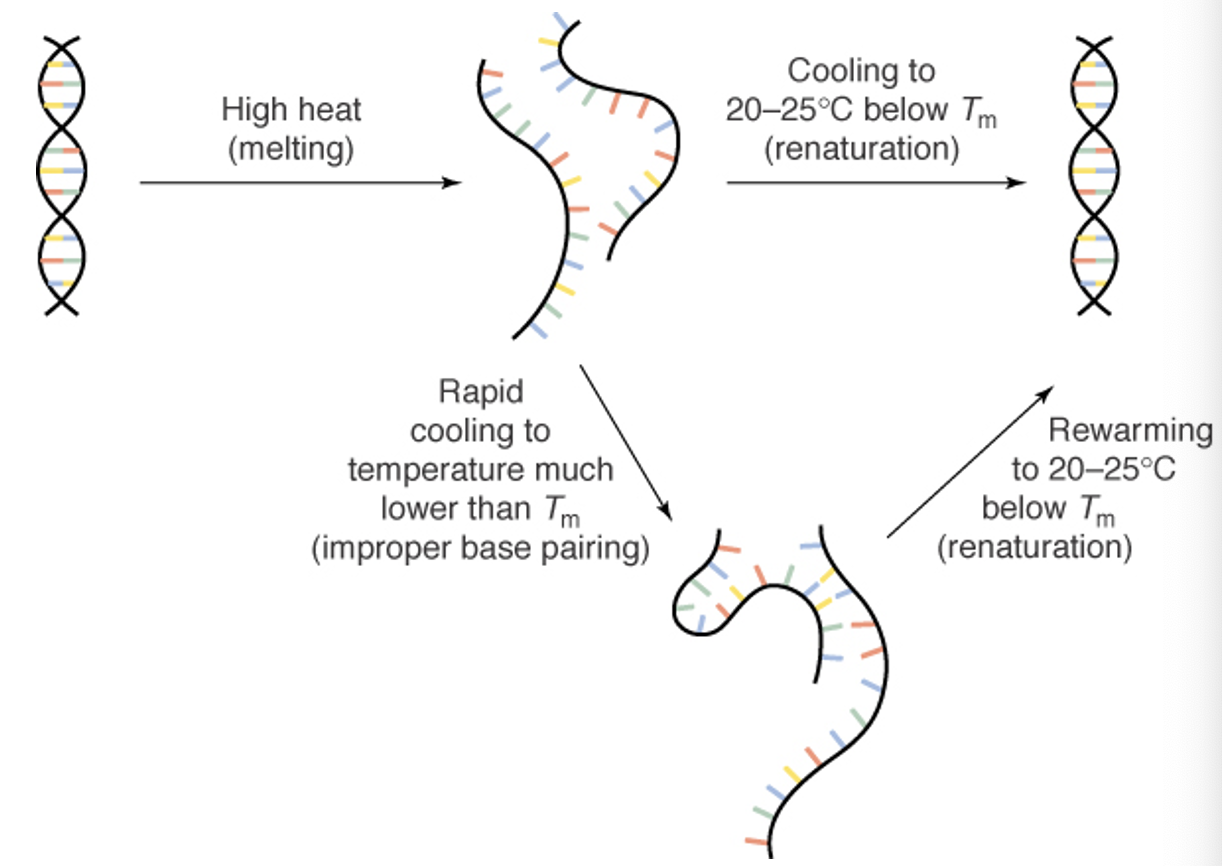
<p>Separated base-pair (hydrogen) bonds reform after melting</p>
13
New cards

Eukaryotic Chromosome Structure

  1. DNA

  2. Histones

  3. Nucleosomes

  4. Chromatin Fiber

  5. Chromatin

  6. Chromosome


<ol><li><p>DNA</p></li><li><p>Histones</p></li><li><p>Nucleosomes</p></li><li><p>Chromatin Fiber</p></li><li><p>Chromatin</p></li><li><p>Chromosome</p></li></ol><p></p>
14
New cards

Tertiary Structure of RNA Function

Transfer RNA (tRNA) and Ribosomal RNA (rRNA) molecules are folded into 3-D structures to carry out their functions in the process of protein synthesis

15
New cards

tRNA Tertiary Structure

tRNA’s 2-D, cloverleaf secondary structure fold into a 3-D, L-shaped tertiary structure

<p>tRNA’s 2-D, cloverleaf secondary structure fold into a 3-D, L-shaped tertiary structure</p>
16
New cards

tRNA Acceptor Stem

Binds the amino acid

<p>Binds the amino acid</p>
17
New cards

tRNA Anticodon

Binds to the mRNA

<p>Binds to the mRNA</p>
18
New cards

rRNA Tertiary Structure

rRNA molecules interact with numerous ribosomal proteins to form the small and large ribosomal subunits

<p>rRNA molecules interact with numerous ribosomal proteins to form the small and large ribosomal subunits</p>



