Microbiology Chapter 6
 Call Kai
 Learn
Learn Practice Test
 Spaced Repetition
 Match
Match Flashcards
 Knowt Play
1/75

There's no tags or description
Looks like no tags are added yet.
Name | Mastery | Learn | Test | Matching | Spaced | Call with Kai | Chat |
|---|
No analytics yet
Send a link to your students to track their progress
76 Terms
Microbial growth
an increase in a population of microbes rather than an increase in size of an individual
Colony
-an aggregation of cells arising from a single cell
-super concentrated mound of bacteria
Biofilm
collection of microbes living on a surface in a complex community
Growth requirements
use a variety of nutrients for their energy needs and to build organic molecules and cellular structures (CHON)
Photoautotrophs (for sure know this)
-their energy source is light
-their carbon source is carbon dioxide
Chemoautotrophs
-energy source is chemical compounds
-carbon source is carbon dioxide
Photoheterotrophs
-energy source is light
-carbon source is organic compounds
Chemoheterotrophs
-energy source is chemical compunds
-carbon source is organic compounds
auto-
carbon source= carbon dioxide
Photo-
energy source= light
chemo-
energy source= chemical compounds
hetero-
carbon source= organic compound
breaking down from other living things
oxygen for obligate aerobes
essential
oxygen for obligate anaerobes
deadly/toxic
Why is oxygen toxic to obligate anaerobes?
-neither gaseous O2 nor oxygen covalently bound in compounds is poisonous
-forms of oxygen that are toxic are highly reactive & oxidizing agents
-oxidations cause irreparable damage to proteins and lipids
How do you combat toxic O2?
consume antioxidants to prevent unnecessary redox reactions from occurring
Aerobes
undergo aerobic respiration
anaerobes
do not use aerobic metabolism
facultative anaerobes
can maintain life via fermentation or anaerobic respiration or by aerobic respiration (prefers aerobic conditions, facilitates in anaerobic)
aerotolerant anaerobes
do not use aerobic metabolism but have some enzymes that detoxify oxygen’s poisonous forms (prefer anaerobic)
Microaerophiles
-aerobes that require oxygen levels from 2 to 10% and have a limited ability to detoxify hydrogen peroxide & superoxide radicals
-tolerate small amounts of oxygen
What element do animo acids need?
nitrogen
What are nitrogen atoms needed for?
proteins and nucleotides
Why can’t we use nitrogen straight from air?
nitrogen gas has triple bond that is very hard to break
Nitrogen fixation
reduction of nitrogen gas to ammonia
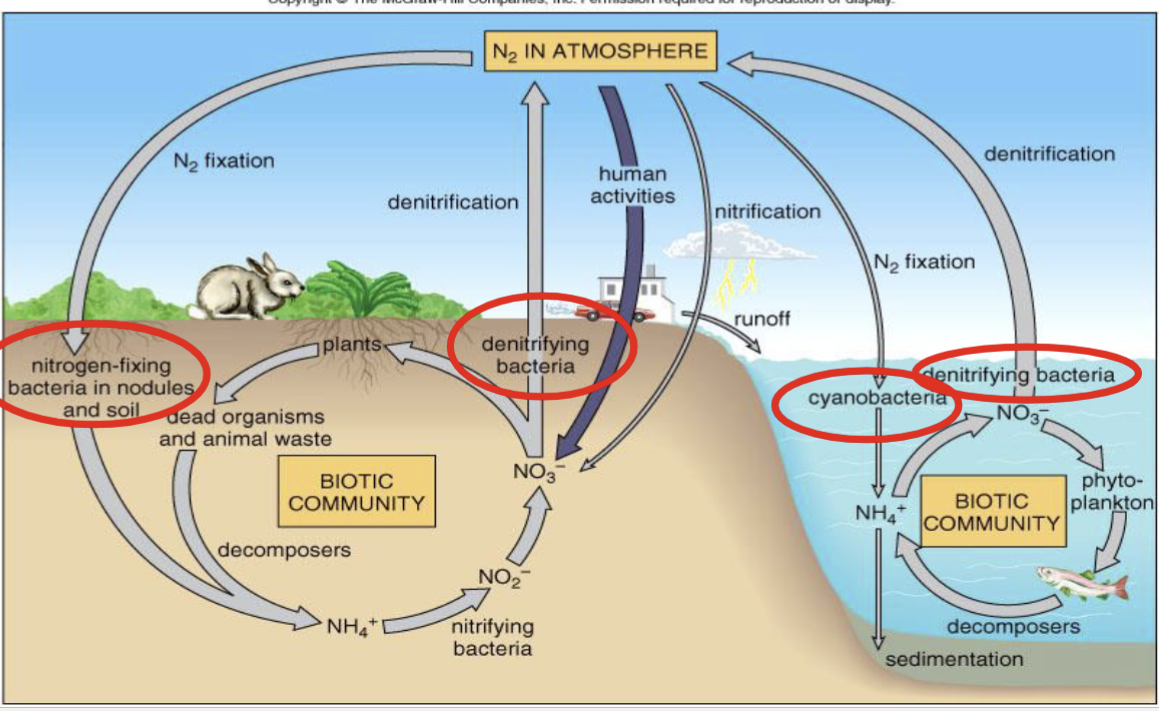
Where do humans get nitrogen from?
plants consumed or animals that eat plants consumed
Phosphorus
a component of phospholipid membranes, DNA, RNA, ATP, and some proteins
Sulfur
-a component of sulfur-containing amino acids
-disulfide bonds critical to tertiary structure of proteins, & in vitamins
Trace elements
-only required in small amounts
-usually found in sufficient quantities in tap water
Growth factors
-things we need, but can’t make on our own
-vitamins, certain amino acids, purines, pyrimidines, cholesterol, NADH, and heme
Physical growth requirements
-temperature, pH, and water
Temperature effects
-effects on proteins (denatures if too hot)
-Effect on membranes and organelles
If temperature too low
membrane becomes ridged and fragile
if temperature too high
-membrane too fluid and cannot contain organelles
-denatures proteins
-vibrate really fast, phospholipids start opening up and things can get in
what are the 4 types of bacteria?
Psychrophiles, mesophiles, thermophiles, and hyperthermophiles
which bacteria thrive in the human body?
mesophiles
pH growth requirements
H+ & OH- can interfere with H bonding in proteins and nucleic acids
Neutrophiles
grow best in a narrow range around (6.5-7.5)
Acidophiles
grow best in acidic habitats pH 3 or less
alkalinophiles
up to pH 11.5
Water requirements
-dissolve enzymes and nutrients required in metabolism
-react in many metabolic reactions
-most cells die in absence of water
—some have cell walls that retain water
—endospores and cysts cease most metabolic activity in environment for years
osmotic pressure
The pressure exerted on a semipermeable membrane by a solution containing solutes that cannot freely cross membrane
hypotonic
water moves in to cell. Cell may swell and burst in absence of cell walls
hypertonic
water moves out of cell. cell shrinks in absence of cell wall
obligate halophiles
grow in 30% salt, tolerates high concentration of salt on the outside
facultative halophiles
can tolerate high salt concentrations, prefers isotonic
Hydrostatic pressure
-deeper into water, pressure on body increases
-10m depth, water pressure increases 1 atm
Barophiles
organisms that live under extreme pressure
-their membranes and enzymes depend on this pressure to maintain their 3D functional shape
Biofilms
-develop an extracellular matrix that adheres cells to one another
-allows attachment to substrate
-sequesters nutrients
-may protect individuals within
Relationships within biofilms
antagonistic, synergistic, and symbiotic
Antagonistic relationship
one against the other
Synergistic
work together towards one common goal
symbiotic
both benefit from one another
quorum sensing
How bacteria communicate with each other in biofilms
Inoculum
-transfer from one spot to another
-introduced into medium (solid or broth)
culture
refers to act of cultivating microorganisms or the microorganisms that are cultivated
aseptic technique
to prevent contamination of sterile substances or objects
What are the two most common isolation techniques?
pour plates and streak plates
Defined media (know this)
exact
complex media (know this)
partial digests; don’t know full concentration of everything
Selective media (know this)
inhibitory; inhibits growth of other things
differential media (know this)
tests; color change to define difference from bacteria with the use of acidity
Anaerobic media (know this)
reducing; reduces amount of oxygen available to allow anaerobic bacteria
Transport media
to transport, keep organism alive, but not for growing
Special culture techniques
-animal and cell culture
-low-oxygen culture
-enrichment culture
-chemostats
Preserving cultures
refrigeration, deep-freezing, and lyophilization
Refrigeration
stores for shot periods of time; reactions slow down
Deep-freezing
stores for years; liquid nitrogen or ice; cells really slow down
Lyophilization
stores for decades; sucks out all H2O, so all reactions stop
Chemostat
huge containers to keep bacteria growing by feeding them culture media and using what they produce

Generation Time
time required for a bacterial cell to grow and divide
Microbial growth chart
-lag phase: susing out situation to see if its fit for survival
-log phase: exponential growth
-stationary phase: plateau due to limiting resources, born=death
-death phase: completely out of essential resources to survive

CFU
colonies X dilution factor
Viable plate count (know this)
serial dilution in broth, spread 0.1ml of each broth to plates, plates with about 30 colonies needed for statistical significance
Most probable number (know this)
-for faster results
-undiluted, 1:10, 1:100
-1.0ml into 5 tubes of phenol red at each dilution
-results give most probable number of bacteria per 100ml

Indirect methods of measuring microbial populations
spectrometer: more absorbance means more colonies