aldol
 Call Kai
 Learn
Learn Practice Test
 Spaced Repetition
 Match
Match Flashcards
 Knowt Play
1/27

There's no tags or description
Looks like no tags are added yet.
Name | Mastery | Learn | Test | Matching | Spaced | Call with Kai | Chat |
|---|
No analytics yet
Send a link to your students to track their progress
28 Terms
what do carbonyl carbons have?
alpha protons
what are alpha protons?
hydrogen attached to carbon bonded to carbonyl bond
pKa of alpha proton?
18-20
is alpha hydrogen a strong acid?
no, but it also does not need extreme conditions to do acid-base reaction with
why is alpha hydrogen more acidic than alkane hydrogens?
bc of resonance stability offered by the C=O bond
the resonance structure form (structure and name)
enolate
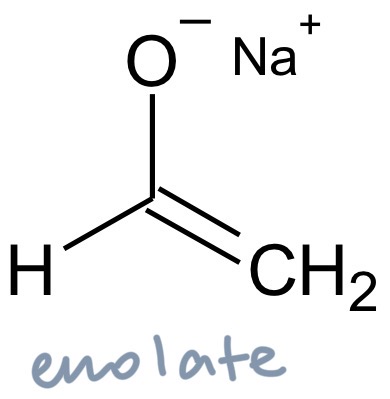
give acid-base reaction with alpha proton

special qualities about enolate
it has a nucleophilic carbon, you can use nucleophilic carbon to attack electrophilic carbon
give mechanism

in the end, we form?
beta-hydroxy aldehyde
this reaction allows us to make?
a new carbon-carbon bond
mixed aldol reaction
trying to form C-C bond from two different carbonyl compounds
mixed aldol reaction problems
1. multiple enolates (both carbonyls can form one enolate)
2. multiple electrophiles (both carbonyls can be electrophiles)
what to do if we only want one enolate to form?
must set up reaction in a way where only one will form
one way to solve multiple enolate problem (not the best)
make enolate first, then add electrophilic carbon, but enolate will react with original carbonyl before adding electrophilic carbon
why does it react with itself?
Keq of reaction = 10^-4, there are a lot of reactants
this is ok when reacting with itself bc?
enolate reacts with original carbonyl, enolate/products removed, more enolate will be made
is problem when reacting with another carbonyl bc?
need to shift equilibrium where there will be more enolate, thus use more powerful base (LDA), get Keq = 10^17
- this way there is so much enolate, do not need to worry about remaining original carbonyl
- then, add to other carbonyl group
our experiment reaction
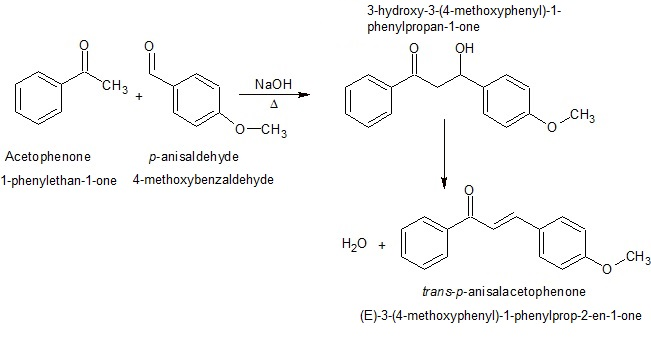
why are we mixing carbonyls together and using NaOH for our experiment
1. there is only one possible enolate because acetophenone is the only one with an alpha proton
2. aldehydes are better electrophilic carbons than ketones bc there is less steric hindrance when attacking it, thus aldehyde reaction happens faster (solves multiple electrophiles)
when acetophenone reacts with p-anisaldehyde, rapidly undergoes dehydration, why?
have extended conjugation, which is very energetically stable
- there is energy sink forming, so when trans-p-amisalacetophenone is formed, it is so stable that reaction btwn acetophenone and itself does not have enough time to create large amounts of product
good % yield
75%
most % yield
50-60%
- doing things microscale, so spilling a little can lose a lot
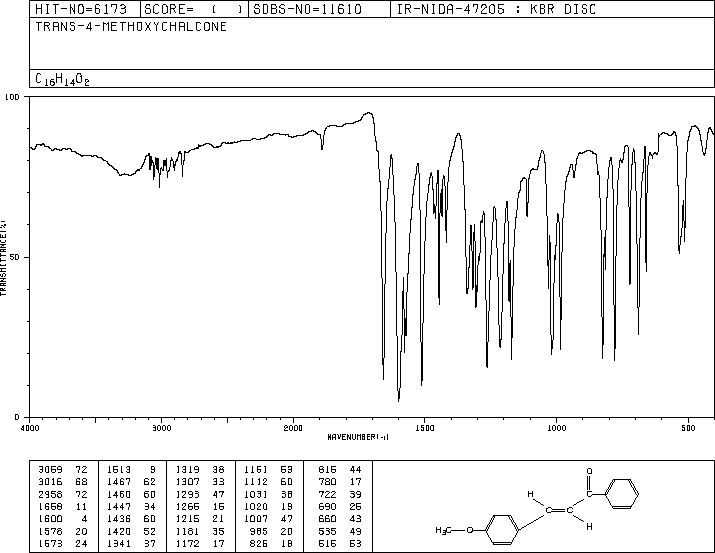
IR
- looking for ketone carbonyl peak (1725-1705)
- looking for C-H stretches that are small bc aromatics (3150-3050)
IR image of trans-p-anisalacetophenone
MP
73-76
beta-hydroxy carbonyl undergoes dehydration under elevated temperature to create?
alpha,beta-unsaturated carbonyl
“Why is an aldehyde or ketone attack nucleophilic addition not substitution”
bc aldehydes and ketones do not have good leaving groups