AP Pysch Sleep & Dream
 Call Kai
 Learn
 Practice Test
 Spaced Repetition
 Match
 Flashcards
 Knowt Play
1/18

There's no tags or description
Looks like no tags are added yet.
19 Terms
what is consciousness + history

Circadian Rhythms
“about a day” biological clock; regular body rhythm, 24 hour cycle
Examples of circadian disruptions:jet lag; night shift (what is it called)
internal desynchronization
how does light mantain circadian rythms
Light triggers the suprachiasmatic nucleus to decrease (morning) melatonin from the pineal gland and increase (evening) it at night fall.
24 hour cycles
3. 24-hour cycles: Humans experience 24-hour cycles of varying alertness (sleep), body temperature, and growth hormone secretion.
(but is it really 24 hours?)...
NO its 25!!!!!!
90-minute cycles
We go through various stages of sleep in 90-minute cycles.
endogenous
= runs on its own
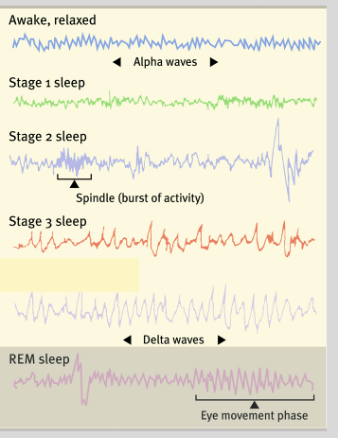
stages 1-3 of sleep (plus stuff to know about each)

sleep stage 4

what happens with each 90 minute sleep cycle
With each 90-minute cycle, stage 2 & 3 sleep decreases and the duration of REM sleep increases.
what are beta waves
During strong mental engagement, the brain exhibits low amplitude and fast, irregular beta waves (15-30 cps). An awake person involved in a conversation shows beta activity.
alpha waves
When an individual closes his eyes but remains awake, his brain activity slows down to a large amplitude and slow, regular alpha waves (9-14 cps). A meditating person exhibits an alpha brain activity.
theta waves
During early, light sleep (stages 1-2) the brain enters a high-amplitude, slow, regular wave form called theta waves (5-8 cps). A person who is daydreaming shows theta activity.
delta waves
During deepest sleep (stages 3), brain activity slows down. There are large-amplitude, slow delta waves (1.5-4 cps).
REM sleep

what does a normal night of sleep look like

what are the diff sleep theories
Sleep Protects: Sleeping in the darkness when predators loomed about kept our ancestors out of harm’s way. Evolutionary Perspective
Sleep Recuperates: Sleep helps restore and repair brain tissue, hormone levels, chemicals etc. Neuroscience Perspective
Sleep Helps Remembering: Sleep restores and rebuilds our fading memories. Cognitive Perspective
Sleep and Growth: During sleep, the pituitary gland releases growth hormone. Older people release less of this hormone and sleep less.
Developmental Perspective
sleep stage waves summary