NURS2602 Exam 1 Study
 Call Kai
 Learn
 Practice Test
 Spaced Repetition
 Match
 Flashcards
 Knowt Play
1/40

Earn XP
Description and Tags
still editing this srry! (sm)=self made, this is not directly on her study guide but I thought it was important/related context in the book. (slides)=on the slides.
Name | Mastery | Learn | Test | Matching | Spaced | Call with Kai | Chat |
|---|
No analytics yet
Send a link to your students to track their progress
41 Terms

Why is licensure important for nursing?
Licensure is needed to actually PRACTICE nursing and work directly with patients….
It is necessary to regulate nursing licensure laws bc they ensure that nurse individuals achieved the necessary education, experience, and competencies needed to practice nursing. (nursing activities are complex, req specialized knowledge, skills, and decision making!)

Acts that are a crime, unethical, or unsafe can result in ______, such as fines, reprimands, revocation/removal of a license, or restrictions. (sm)
disciplinary action
Is an RN allowed to administer O2 without a physician’s order? Explain. (sm this is what dr sam gave as an example when i emailed her)
yes but only in an emergency
Is there any scenario when a nurse can prescribe? (sm this is what dr sam gave as an example when i emailed her)
yes. an APRN (specifically an FNP) has prescribing privileges, due to the fact they have advanced education and preparation in pharmacology.

injunctive relief vs revocation (sm)
Injunctive relief: a court order “injunction” that req an individual or org to stop a particular activity
Revocation: removal of a license
Both are examples of disciplinary actions that can be taken if a nursing crime seriously affected public safety

what are some common reasons disciplinary action is taken? (sm)
Fraud or deceit in obtaining a license
Criminal conviction
Unethical conduct
Drug diversion
Unsafe or unprofessional practice (including practicing while chemically impaired)
Practicing outside the scope of practice
Social media misuse
Contrast licensure vs certification. (sm, i feel like she rlly emphasized knowing the difference in class)
Licensure: needed to PRACTICE a profession (meaning needed to have direct contact with patients)
Certification: when a professional organization recognizes an individual’s competence (they have met qualifications and standards in a specific area)
Define credentials and accreditation. (sm)
Credentials: state whether qualifications and standards have been met (either in an individual or an organization)
Accreditation: a professional/governmental body gives approval, telling the public that the judged healthcare organization is actually following standards and practices quality improvement.
___ is a way that students, families, government officials, and the press know that an institution or program provides a quality education.
(T/F) The public and employers often ONLY accept academic degrees and certificates if the educational institution is accredited.
(sm)
Accreditation; T

(slide) How is education related to licensure? (Go over the history of education and licensure requirements back then for nursing practice.)
Early laws of the Nurse Practice Act said that as long as an individual graduates from a nursing school, they could practice nursing even without a license.
Later, there was a MANDATORY LICENSE so that individuals must graduate from nursing school, pass a standardized exam, and get a license to practice.

What is the Nurse Practice Act? (sm) Who regulates this?
the set of laws that regulate the practice of nursing
The ANA helped promote the idea of nurse licensure laws, then
The state legislature is who passed the Nurse Practice Act., then
The state Board of Nursing is who enforces the Nurse Practice Act
(slide) Go over the timeline of the history of licensure in Nursing. …also box 3.1 in book
main events would be like
first nursing licensure was in new zealand then US then england
ANA drafts first nurse practice act
All US states enact licensure laws
first MANDATORY licensure act was in NY
A national exam was used for the first time “state board test”
States begin to recognize expanded practice
States start requiring continuing education for relicensure (renewal)
national exam changes to the NCLEX
Computer testing is available
Mutual recognition nurse licensure compact is created (interstate)
There becomes a consensus on the education and practice needed to be a Advanced Practice RN


(slide) Which professional organization decides a nurse’s scope of practice?
They also establish standards for licensure, renew licenses, regulates specialty practice, approving nursing education, establishes standards for nursing programs, ENFORCES the Nurse Practice Act
State Board of Nursing (BRN)

(slide) Which professional organization makes NCLEX questions?
National Council of State Boards of Nursing, Inc. (NCSBN)

(slide) What is the relationship between scope of practice, education level, and credentials?
As education level and credentials increase, scope of practice also increases.

Is the NCLEX-RN an exam for licensure or certification? (sm)
licensure

(slide) What was the influence of religion on early nursing?
The first hospitals were built near monasteries, and religious groups focused on caring for sick ppl.
Nurses were expected to devote their lives to caring and showing selfless commitment based on their religious faith
How did Florence Nightingale contribute to nursing?
Florence Nightingale: highly educated woman, determined to be a nurse.
Early career: she studied at a care facility under the Protestant church. She later worked with a nursing committee, thus growing her knowledge of hospitals and nursing reform. This showed providers and reformers that there is a need for trained nurses.
Role in wars: During Crimean War, she brought many nurses to Crimea, greatly reduced mortality rates. She continued reforming soldier healthcare through hospital construction, improved hygiene and public health measures (cleanliness, better food, fresh air) for the army.
Other life efforts:
Wrote about hospitals, sanitation, health, health stats, nursing education
Created a nursing school with criteria like: nurses are trained in teaching hospitals, nurses live in nurse houses, curriculum is theory and practice, teachers r paid, a report card is kept on students
Believed nurses should do more CARING FOR PTS, not cleaning
Nurses must continue learning THROUGHOUT LIFETIME
Nurses must use intelligence to improve pt’s conditions
Nursing leaders should have social standing

(slide) Describe military influence on nursing.
Nursing innovations happened bc of needs of soldiers/veterans
American revolution - vaccinations against smallpox
Civil war - inventions of ambulances
Spanish-Amer war - Red Cross is founded, Army Nurse Corps established, then Navy Nurse Corps
When 30k nurses served in WW1, they won the right to vote. WW2 helped increase status for nurses. Flight nursing was born.
The GI bill at the end of WW2 allowed many nurses to enter BSN and MSN programs after serving with the military.
Korean and Vietnam wars brougt many developments in triage and surgery, when MASH (mobile army surgical hospital) units were established.

(slide) Describe the early image of nursing.
Early images of nursing include…
Folk image of nursing: caring for family members who are sick. Ex) responsibilities are nurturing children, caring for older adults, caring for aging fam members, nurses use common sense and trial and error to help the sick.
Religious image: churches have nurses who devote lives to caring and showing selfless commitment based on their religious faith. They cared for the sick, poor, orphans, widows, older adults, slaves, prisoners.
Servant image: at this time, women were only supposed to be childbearers and housekeepers. Hospital care was for “uncommen women” (low status ppl in society such as prisoners, prostitutes), so many capable ppl didn’t wanna do nursing at this time (due to bad rep)
(slide) What is the difference between profession vs professional? Provide examples.
In class, Dr Sam emphasized that a PROFESSION HAS EVIDENCE-BASED RESEARCH/KNOWLEDGE to back it up.
The book lists these criteria for a profession: possession of specialized knowledge, use of scientific method to expand knowledge (aka evidence based education/practice), education should be institutions like colleges (not hospitals), nurses should help control nursing policies, code of ethics, view nursing as a lifetime commitment, and service to the public.
Professional: ppl view professionals as ppl who do their job earnestly, excellently, and with ethics. Has to do with attittude, dress, conduct, deportment.

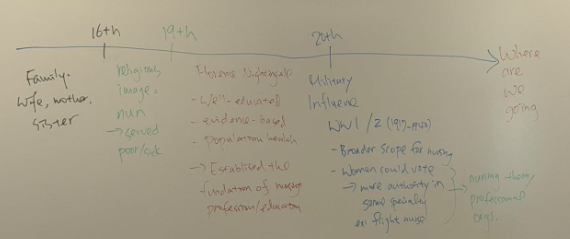
Go over the timeline of nursing history events. (sm review the timeline she made us in class on the first week.. she said we don’t need to memorize dates but i have a feeling we should know the order since she drew it in a timeline)
(practice drawing it out or verbalizing it) see answer key:
Other contexts..
1. Folk, religious, and servant images of nursing (more details on other flashcard)
More church groups form nursing groups
During industrial revolution (1900s), Florence Nightingale develops nursing. She is well educated, high socioeconomic standing. She wanted to be a nurse despite the servant image of nursing. Florence contributes to public health, hospitals, nursing reform, sanitation, health stats, created a school of nursing, nurses did apprenticeship training in hospitals.
(slide) Nursing tradition vs professional images. Describe traditions like the nursing pin, cap, uniform, and ceremonies. What professional images are needed to attract more qualified candidates to the nursing profession?
Nursing pin: has religious origin. Original pin is shaped like a Maltese cross as a symbol of respect for groups who cared for the sick during Holy Land battles.
Nursing cap: diff explanations of origin. Back then, it was proper for women to cover their heads, so the cap was proper. But cap eventually become bothersome due to changing roles of nurses and high technology.
Nursing uniform: Religious and military history of nursing began with a white outfit to show confidence and professionalism. This uniform was long, had collars, cuffs, arpons for morning/afternoon. The uniform kept evolving. At one point, there was a tight corset on the uniform, making it more attractive and helping develop nursing’s professional, high status image. But by 1900s, uniform became more functional. Started becoming pantsuits. White was no longer suitable. Scrubs are now common.
Ceremonies: Pinning is for program completion, and graduates may say the Nightingale Pledge. A rep of the graduating class will hand a lamp to the rep of the next graduating class (representing Florence’s idea of continual caring)

(slide) A. What is competency and why is it important? B. Who determines nursing competencies?
A. integrated knowledge, skills, abilities, and professional behaviors required for a nurse to practice safely and effectively
B. AACN

SMART goals (stands for…)
Specific, measurable, attainable, relevant, time-based
How do you obtain a nursing license? Hint: There are 2 main procedures… (sm)
AI answer: licensure by examination is for first-time graduates getting their initial license after passing the NCLEX, while licensure by endorsement allows a nurse already licensed in one U.S. state to transfer or get verified to practice in another state without retaking the exam



History of the nursing assistant (sm. When did nursing assistants/aides come about? Where do they commonly practice? What is the Omnibus Budget Reconcilliation Act?)
Nursing aides started to be used during WW1.
Nursing aides have always provided most care in nursing homes.
They are a part of UAP (unlicensed assistive personnel)
Omnibus Budget Reconciliation Act: an act that said ppl working as nursing assistants in nursing homes (only) would have to complete minimum 75 hrs of theory and practice AND pass a theory and practice exam to be CERTIFIED
BRN regulates the list of nursing assistants.
Nursing Assistants back then could be trained by the hospital itself and practice as an assistant (without having certification). However this is no longer preferred…
NOTE: A NURSING ASSISTANT IS NOT NECESSARILY CERTIFIED! U can only make this distinction based on the specialty (ex we know that a CNA is certified)

Education preparation (and scope of practice) for: CNA
Certified Nursing Assistant: works under the direction of the RN or LPN. Each state determines which basic nursing skills their CNAs can do (ex bathing, helping eating, exercises.)
There are no national regulations for the educational preparation / scope of practice for CNAs; instead it is up to each individual state. Here are common rules tho…
Education preparation:
some states req a certain # of hours per year of continuing education
Now, accredited hospitals are required to ensure that all employees are competent. So they hire CNAs (since they are alr CERTIFIED nursing assistants)
Scope:
CNAs can only assist, monitor, and report (they cannot assess, initiate, evaluate, or use clinical judgment)
CNAs can help create a safe environment, be aware of pt’s rights, and should be knowledgeable of the use of side rails and restraints.
Education preparation (and scope of practice) for: home health aide
Home health aide: assists individuals with basic care in their own home
program of instruction includes content related to shopping for groceries, cooking, and doing laundry.
Depending on the hospital and state, some home health aides need/don’t need formal certification, some states do not have a statewide standardized certification req. (so main takeaway: HHA is super case by case)

History of the practical nurse (sm. Which state first req licensure for practical nurse?
Practical/vocational nurse is historically someone who is self-taught, learned by experience, and did basic procedures like bathing, cooking, housekeeping.
The first formal practical nursing program was in Ballard School, NY—established by YWCA (young womens christian assoc) bc here lived many young women in search of better careers
More practical nursing programs begin in other states
NY becomes first state to req licensure for practical nurse. Then later all US states had licensure laws for practical nurses.

Education preparation for: licensed practical (vocational) nurse (LPN/LVN)
LPN/LVN: Today, their roles include stuff like caring for patients whose conditions are considered stable, giving direct patient care; observing, recording, and reporting; administering treatments and medications; and assisting in rehabilitation procedures. They follow directions from RNs or licensed primary providers.
This also varies from state to state, but the general curriculum is like this…
about a 1 yr program. (some schools measure education in clock hours while others, credit hours)
You get licensure and become a LPN/LVN after graduating the school’s practical nursing program then PASSING THE NCLEX-PN LICENSURE EXAM.
In some states that allow it, community college offers ADN and practical nursing programs that are stackable. Ex) first year is just core nursing classes, then from there you can either seek licensure as a practical nurse by taking the NCLEX-PN, or continue and do 1 more yr of schooling so that you can get yourn ADN and take the NCLEX-RN.
Programs today stress CLINICAL EXPERIENCE, esp in structured settings like hospitals and long-term care facilities.
Students learn therapeutic knowledge, introductory sciences content (in bio and behavioral sciences)
1/3 of program is in classroom/theory ; 2/3 is in clinical practice

Education preparation for: RN (what are the 3 routes?)
Registered Nurse:
3 routes: hospital-based diploma programs, associate degree programs, baccalaureate programs
Some RN programs only admit CNAs
To be an RN, you must pass the NCLEX-RN licensure exam

Early nursing education: hospital based diploma programs
FIRST, there were hospital-based diploma programs. Gradually, these programs joined with nearby colleges and universities. This added gen ed reqs (like a&p, psych, sociology).
At this time, the National League of Nursing actively guided nursing programs’ curriculum and accreditation. Ultimately, this made nursing programs more similar to other types of postsecondary education (strengthening the educational foundation of nursing)

Modern nursing education: hospital based diploma programs
Today, these diploma schools are accredited. They employ qualified faculty.
A key diff is that now, these instructors help teach clinical experiences that meet the student’s learning needs (this is priority over the hospital’s service needs)
Also there are much less diploma programs now than back then (current ones are mostly in the East). A lot of previous diploma schools discontinued their programs or merged with local cc/universities that took the ADN or BSN route instead.
This happened bc hospitals could not afford to pay for these programs when students alr started preferring college programs instead.
These programs emphasize pt experiences, nursing management.

How did ADN education begin? (sm. There are 4 main events that started ADN…)
2-yr CC in the US started to grow and popularize
WW2 cadet nurse program showed that qualified students could be educated well even tho they don’t do the traditional 3 yr diploma program
Studies on nursing education in the US encouraged ADN
Nursing shortage of the 1950s, when WW2 nurses returned home to raise families. The ADN program would help this nursing shortage.

Early vs modern nursing education: ADN (mention how the origin of ADN is so unique.)
EARLY: ADN programs are the first and only type of nursing education that is based on planned research and experimentation.
There was a 5 yr research project in the US that let 7 CCs graduate from an ADN program and take the RN licensing exam.
MODERN: There are 1000+ ADN programs now. In a typical program, 40% are gen-eds/pre-reqs, and 60% are nursing courses.

Benefits vs Challenges to ADN education (sm)
benefits
ADN education increased diversity in students. From single young white women back then, to now also older students, married men/women, underrepresented groups, and students with diff intellectual abilities.
ADN takes shorter time than a bachelor degree, so ppl who alr have bachelors+ may be attracted to ADN program
CCs are more accessible than many 4-yr colleges
challenges
SELECTIVE ADMISSION PROCESS.
MISUNDERSTANDINGS ABOUT ASSOC. DEGREE EDUCATION. There is controversy about whether ADN is enough to practice professional nursing.

Early Nursing Education: BSN
BSN: 4 yr college or university education
EARLY
BSN program was first called a branch of a school of medicine (not its own thing yet)
The first BSN programs were 5-yr programs. This meant 3 yrs of nursing school curriculum (like hospital-based diploma programs did) but + 2 yrs of liberal arts.
The Yale School of Nursing was the first to make its own Nursing dpt in a university, with a woman, Annie W Goodrich, as the dean.
EARLY BSN NURSING came with many challenges/opposition…
At the time, nursing was considered a undesirable job and only for women. Nursing characteristics like liberal education, scholarship, and knowledge “interfered” with the female personality and nursing students were not allowed to marry.
The nursing curriculum was about skill performance rather than the typical theoretical/philosophical approaches used in the humanities. Therefore universities did not like nursing
Primary providers opposed BSN education bc they argued nurses would be overtrained. They believed nurses just deserve to pay for school that teaches technical skills (rather than paying extra for knowledge)
Finally, in 1965, ANA recommended BSN as the MINIMUM educational prep to enter professional nursing practice.

Modern nursing education: BSN
BSN is a basic/generic program bc it is a prelicensure program, letting students be eligible to take the NCLEX-RN.
The program layout is like… 2 years of liberal arts and sciences and then 2 years of upper-division nursing major classes.
Curriculum includes… basic nursing skills, health promotion, disease prevention (individual and population level), supervisory and leadership theory, intro to research. Clinicals include exp in community health settings and leadership responsibilities, nursing judgment..
Recently, the need for more licensed RNs has resulted in the development of ACCELERATED PROGRAMS and EXTERNAL DEGREE PROGRAMS.
External degree program: more flexible and learner-oriented education. There are 2 main parts of curriculum. 1) cognitive learning, measured thru standardized exams and 2) clinical skills at regional assessment centers. But some states do not accept these Excelsior degrees for reasons like unsupervised clinical practice

What type of nursing roles call for a DNP? (sm)
Nurse with a doctorate will usually take a leadership role in education (as a faculty member, dean, or director of a nursing program). Or they may be involved in research and development of a body of nursing knowledge.