East Asian Art Final Exam Study Guide
 Call Kai
 Learn
 Practice Test
 Spaced Repetition
 Match
 Flashcards
 Knowt Play
1/47

There's no tags or description
Looks like no tags are added yet.
48 Terms
Intro to Early Japan and Korea
Centralized states in the Japanese archipelago and the
Korean peninsula succeeded chiefdoms
• Yayoi and Kofun periods in Japan left behind metal
artifacts and monumental mounded tombs
• Regional kingdoms in Korea created diverse images and artworks
• On the East Asian mainland, the Han dynasty collapsed
• Gentlemanly arts of calligraphy and painting developed
• Buddhism brought new art forms to East Asia
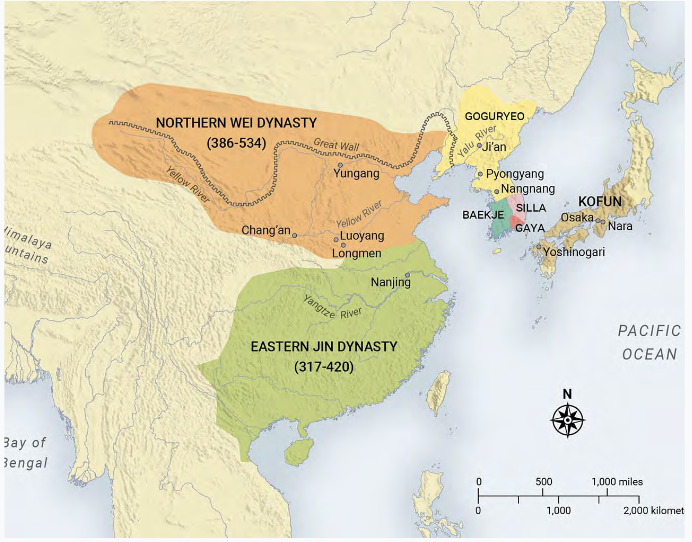
Map: East Asia, Fifth Century CE
Art of the Yayoi and Kofun Periods in Japan, c. 400 BCE–538 CE
Named after site in Tokyo where pottery was first found; functional, reddish pottery.
Contact with both China and Korea. Rice, iron, and bronze introduced from the mainland via Korea (see Korea section). Rice culture transformed early subsistence economy based on hunting and gathering; gave rise to agricultural settlers. Iron for tools, bronze for ritual objects; bronze bells (dōtaku 銅鐸); non-Chinese-style bronze mirrors. Tribal groups gained power in the Kinki 近畿 area (central Japan - Nara-Kyoto-Osaka region). Surface dwellings; raised storehouses, which later became models for palaces and shrines.


Jar, Japan, Yayoi period. c.100–300. Earthenware with incised decoration
Yayoi pottery typically has smooth surfaces and balanced shapes
• Stacking coils used for the body
• A potter’s wheel (introduced via the Korean peninsula) was used for the foot and the mouth for greater symmetry
• Purposes vary from everyday use to ceremonial to burial
“Burnishing” “Slipping”

Dōtaku (bronze bell)
Kagawa Prefecture, Japan, Yayoi period, second to first century BCE, bronze.
• Some dōtaku have clappers, others do not, but they all served ritual purposes
• Top row: salamander and dragonfly
• Middle row: human leaping and human shooting a deer
• Bottom row: two figures pounding rice (?) and structure with elaborate roofline
“Low relief”

Pensive Bodhisattva
Probably Maitreya (Korean Mireuk), Three Kingdoms Period, early seventh century, gilt bronze
• Gilt bronze sculpture, likely from the Silla kingdom (and likely commissioned by royalty)
• Left foot rests on a lotus flower (metaphor for the Buddha)
• Triple-lobed lotus crown points to origin in the Korean peninsula
• Likely depicts Maitreya, who will become the Buddha of the future
Key Terms: bodhisattva, icon, Buddha
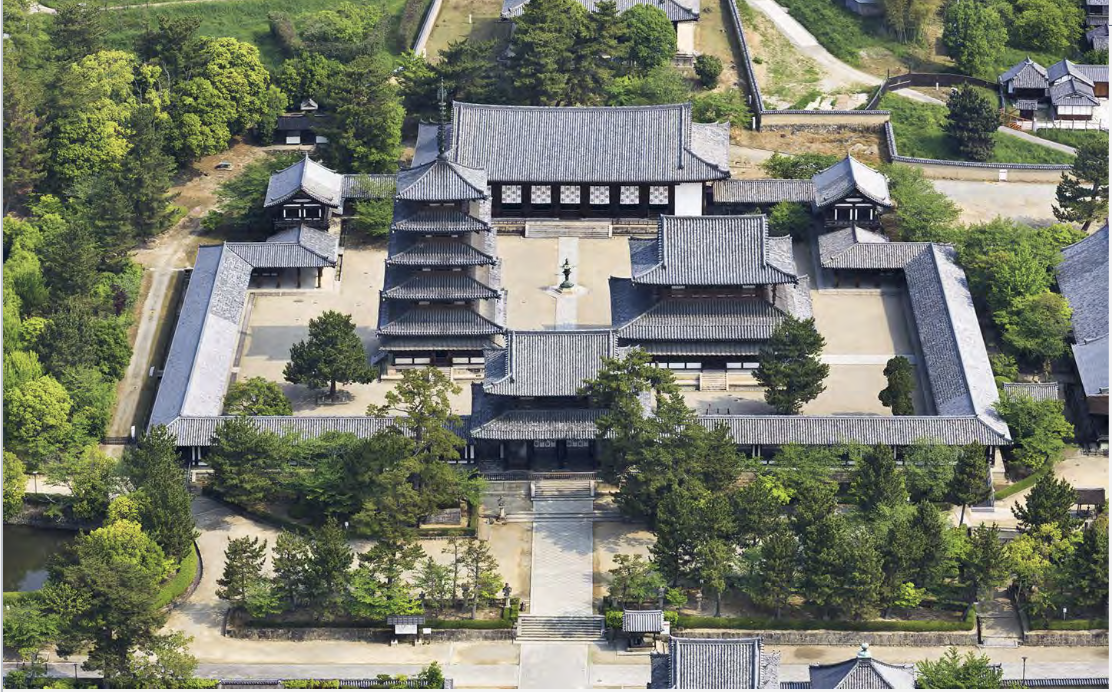
Horyuji
Nara Prefecture, Japan, Asuka Period, seventh century.
Asuka, a district of Yamato; under Empress Suiko, Buddhism spread through the effort of the court. Center in the Kinki area - Nara and south. Buddhism said to have been introduced in 552 from SW Korea; ardently propagated by Prince Shōtoku (Shōtoku Taishi 聖徳太子).
Compromise between Buddhism and Shinto. Art and architecture styles imported from SW Korea chiefly, but of basically Chinese form.
A temple includes a gate, pagoda (to 塔) kondō 金堂 (Golden Hall or Main Hall), and kodō 講堂(Lecture Hall), along with belfry, sutra repository, sometimes a separate refectory, and dormitories.
The pagoda, Main Hall and Lecture Hall are all enclosed within a cloister (garan 伽藍), in block plan, often with simple axial arrangement of buildings.
Cloister creates a sacred precinct separate from the secular world—similar in Greco-Roman and Abrahamic religious constructions
Five-story pagoda uses post-and-lintel construction, functions like a stupa, and features four sculpted tableau of Buddhist narratives.
Key terms: Cloister, pagoda, kondo, post-and-lintel, cantilever, brackets, stupa, finial, relics, pradakshina, tableau, parinirvana


Tori Busshi, Shaka Triad
Horuji, Nara Prefecture, Japan, Asuka Period, dated to 623 CE, gilt bronze
• Central sculpture in the kondō at Hōryūji
• Medium of gilt bronze points to metallurgic skill and royal patronage
• Dedicated to Prince Shōtoku and the Princess of Kashiwade
• As visitors viewed it and thought on Buddhist teachings, the makers and those to whom it is dedicated to accrue karma
Key terms: Mudra, Halo, Mandorla

Tamamushi Shrine
Horuji, Nara Prefecture, Japan, Asuka Period, dated to 650 CE, Cypress and camphor wood, with lacquer
• Semi-portable votive shrine that resembles the kondō at Hōryūji
• Features an icon inside sanctuary hall elevated on a pedestal with lacquer paintings of bodhisattvas, the Four Heavenly Kings, and jatakas
• One painting is the Mahasattva jataka
key terms: votive, filigree, lacquer, jatakas

Mahasattva Jataka
detail of the RTamamushi Shrine, Horyuji, Nara Prefecture, Jaoan, Asuka period, 650 CE, lacquer painting on wood
• This jataka depicts three distinct moments simultaneously
• Prince Mahasattva jumps to the ground where the mother tiger and her cubs devour his body
• Image is not distressing but an elegant self sacrifice
Ise Shrines (Ise Jingu)
Ise Shrines (Ise Jingu 伊勢神宮), Mie prefecture; rebuilt every twenty years, first known structure rebuilt c. 690, 62st rebuilding in 2013; dedicated to chief deities of Shinto 神道 (the way of the gods. Religion shamanistic; polytheistic, veneration of spirits (kami 神) in nature, sacrifices to deities and purifications.

Tang Dynasty
618 -906 CE
Sui Dynasty (589 – 618)
Capitals at Chang’an and Luoyang; country unified under Chinese authority. Building of Grand Canal; Emperor Wendi important patron of Buddhism. Buddhist sculpture acquired a more integrated style from synthesis of foreign and Chinese elements.
Tang Dynasty (618 – 906)
Capital at Chang’an, Shaanxi. Great imperial period. Foreign contacts and trade stimulated prosperity. An Lushan rebellion of 755 marked decline of latter half of the dynasty. Religious tolerance: Zoroastrianism, Manichaeanism, Nestorian Christianity, and Islam all had establishments in capital. Buddhism reached its zenith in China. Buddhism declined after persecution of 845


Chang’an (present-day Xi’an): capital Grid plan; rectangular, surrounded by a wall. Palace and administrative area in the north, residences around, markets on east and west. Temples throughout the city, served as clinics, baths, parks, etc. Pagodas broke the simple skyline. Organization of city designed to control the populace. City plan became models for early Japanese capitals of Nara and Kyoto.
Former Sui capital, renamed during the Tang dynasty (“everlasting peace”)
• One of the three largest cities of the time
• Size and wealth of the city were due in large part to trade (note markets)

Camel Carrying Musicians
Excavted in 1957 from the tomb of Xianyu Tingui, Xi’an, Shaanxi province, dated to 727, earthenware with three-color glaze
• Exemplifies Tang interest in the exotic (musicians appear to be Han Chinese and Central Asian)
• Camels were the primary transport on the Silk Road
• Style typical of Tang dynasty ceramics (sancai, or three-color ware)
Note naturalism

Colossal Vairochana and Attendants, Fengzian si (“Temple of Honoring Ancestors”)
Longmen caves, cave 19, Henan province, China, Tang Dynasty, 660-76, limestone
• Carved into the cliffs of Longmen, or Dragon Gate, at the Temple of Honoring Ancestors
• Sculptures were originally painted
• Third Tang emperor Gaozong and his wife, Empress Wu, were the patrons
Key terms: Rock-cut, ushnisha, chakravartin

Amitabha Buddha Presiding over the Western Pure Land
Cave 217, Mogoa Cave Temples, Dunhuang, Gansu province, China, Tang dynasty, 713-66 CE, Cave mural
• Wall mural in Cave 217 of the Mogao (“Peerless”) Cave Temples
• In Mahayana Buddhism, Amitabha proposes rebirth in a Pure Land as an intermediary step towards release from samsara (endless cycle of death and rebirth)
• Amitabha sits in the center on a lotus throne with a retinue of bodhisattvas
Key terms: Mural, balustrade, illusionism

The Diamond Sutra
Tang Dynasty, 868, Woodblock print, ink on paper
• The world’s earliest completed and dated (868)
printed book
• “Diamond” (Sanskrit: vajra) refers to the sutra’s power to cut like a diamond blade through illusions
• Scene preceding the text depicts the Buddha beneath a jeweled canopy
Key terms: Auspicious, woodblock painting
Tang Dynasty three-colored-glaze


Shōsōin (the imperial storehouse of treasures), donated by Empress Kōmyō after Emperor Shōmu died in 756. Shōsōin is located on the grounds of Tōdaiji. Reflects metropolitan culture of Tang China; exotic, luxury goods of gold and silver, textiles, glass, ceramics, musical instruments, and foreign motifs; Nara now considered the eastern terminus of the Silk Road.

Five-stringed lute (biwa)
Chinese, Tang dynasty, 8th century, Shosoin, Todai-ji, Nara
Red sandalwood and chesnut inlaid wih mother-of-pearl, a,ber, and tortoiseshell

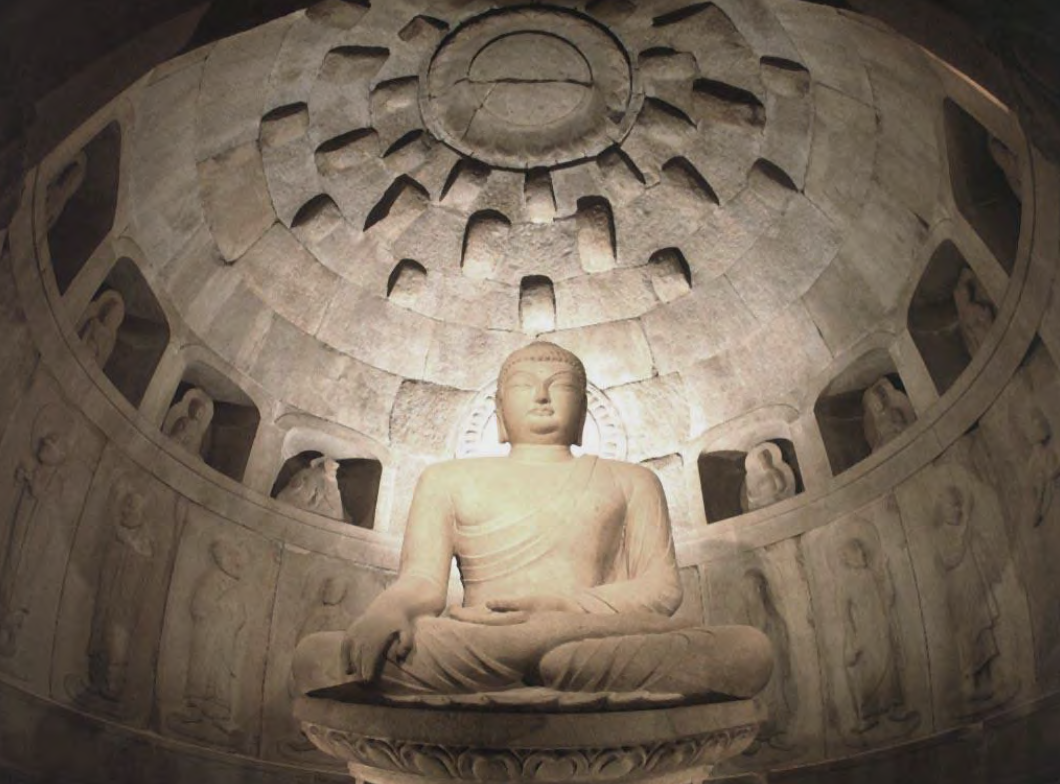
Seated Buddha at Seokguram Grotto
North Gyeongsang province, South Korea, Unified Silla period, 751-74, granite
• Looking for influence in earlier works often reflects implicit bias that the secondary work is somehow lesser
• Appropriation and adaptation recognize that artists and cultures make choices rather than just adhering to established conventions
• Appropriation here means borrowing preexisting images without the negative connotation

Great Buddha Hall (Daibutsu-den)
Todaiji, Nara Prefecture, Japan, original structure completed in 752, destroyed 1180, reconstruction completed in 1707, further restored 1906
• The building that houses the Vairochana icon (Daibutsu means “great Buddha”)
• Shares the language of the Tang palace architecture
• Double-eave hip roof, complex array of brackets
• Shows the connection between politics and religion
Key terms: Facade, bay, hip roof

Vairochana Buddha
Baibutsu-den, Todaiji, Nara prefecture, Nara period, Bronze
• Commissioned by Emperor Shōmu to promote religious piety that would bring the Buddha’s protection to the nation
• Styles from several periods exist within the statue
• Engraved lotus pedals on the pedestal (Fig. 6.12a) show Nara period image of the historical Buddha
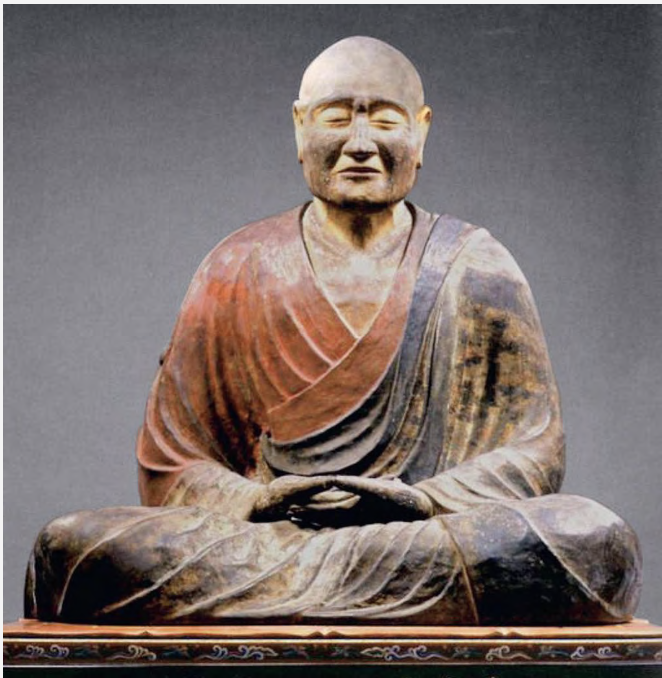
Ganjin (Jianzhen)
Toshodaiji, Nara period, mid-eight century, dry lacquer painted.
• Buddhist monk Ganjin (688– 763, Chinese: Jianzhen) presided over the ordination of Emperor Shōmu and Empress Kōmyō
• Founded Tōshōdaiji
• Portrait is naturalistic and painted

Layout of Heian-kyō (Kyoto)
Capital of Heiankyō 平安京 founded in 794; present-day Kyoto. Contact with continent practically ceased except for monks travelling. Buddhism continued to flourish, some synthesis with Shinto. Fujiwara 藤原 family as regents during the latter period, thus also called Fujiwara period. Luxurious court life. Romances in literature and art. Amidism (worship of Amida the Lord of Western Pure (Land) most important to the Fujiwara. An indigenous art style developed, largely free of continental influence.

Womb World Mandala
Toji, Kyoto, Japan, Heian period, late ninth century, hanging scroll, color on silk.
• Cosmic Buddha in the center with the universe expanding outward
• Uses contrasting colors, hierarchical scale, iconography, and symmetry to illustrate abstract Buddhist concepts
• Refers to the womb of great compassion

Pheonix Hall, Byodoin, Uji, Kyoto prefecture, Japan, 1053 CE
The Byōdōin 平等院 (Temple of Equality); South of Kyoto on the Uji River. Fujiwara family members as patrons. Originally part of Old Villa. Hōōdō 鳳凰堂 (Phoenix Hall), dedicated 1053. Claimed to represent a phoenix alighting, wings spread. Use of pond of aesthetic effects and religious symbolism; interrelationship of the arts to produce an ideal, architectural representation of the Western Pure Land.
3D representation of Amitabha’s Pure Land
• Facilitated visualization practices central to Pure Land Buddhism; act of envisioning the Pure Land and deliverance to that paradise would bring about raigō and rebirth


Mural of Western Pure Pand from Dunhuang Cave 320
8th century
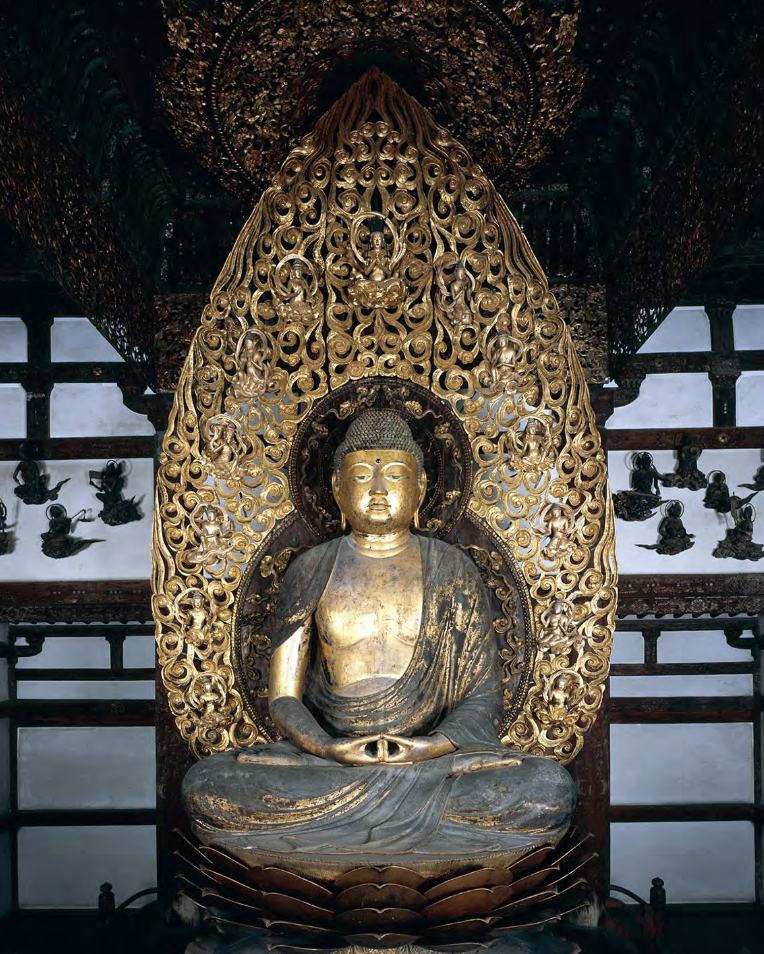
Jocho, Amitabha Buddha
Pheonix Hall, Byodoin, Uji, Jyoto Prefecture, Japan, Gold leaf and lacquer on wood
Amitabha Buddha (Amida) as main icon. Sculptor: Jōchō 定朝 (d. 1057). Multiple-block technique; cypress wood with lacquered cloth and gilt. Concepts of salvation for all; Amida's descent (raigo来迎) to receive the dying; invoking the name of the Buddha.
• Jōchō perfected new sculptural technique–carved and joined together multiple pieces of wood (yosegi zukuri)
• Amida’s snail-shell curls and ushnisha can be traced back to Nara period precedents in Japan and the Gupta period in north India
• Bears the urna, has elongated earlobes, and hands in the mudra of concentration
Late Heian court art
Aesthetic terms for Heian court art:
yamato-e (Japanese-type painting); kara-e 唐絵 (Chinese-type painting)
mono no aware 物の哀れ (melacholy, pathos, heightened awareness)
onna-e 女絵 (women's pictures); otoko-e 男絵 (men's pictures)
Narrative handscroll painting (emaki mono 絵巻物)
The Tale of Genji (Genji Monogatari 源氏物語), pp. 335, 349 Diary of a court lady written by Lady Murasaki Shikibu 紫式部 (c. 978-1016) Illustrated handscrolls executed c. 1120-40, attributed to Takayoshi example of onna-e; courtly, aristocratic; layers of paint; bright, intense colors; oblique perspective.
Frolicking Birds and Animals (Choju Jimbutsu Giga 鳥獸人物戯画), p. 353 Attributed to Toba Sojo 鳥羽僧正 (1053-1140), Kozan-ji 高山寺, Kyoto example of otoko-e; caricature, satire; ink drawing
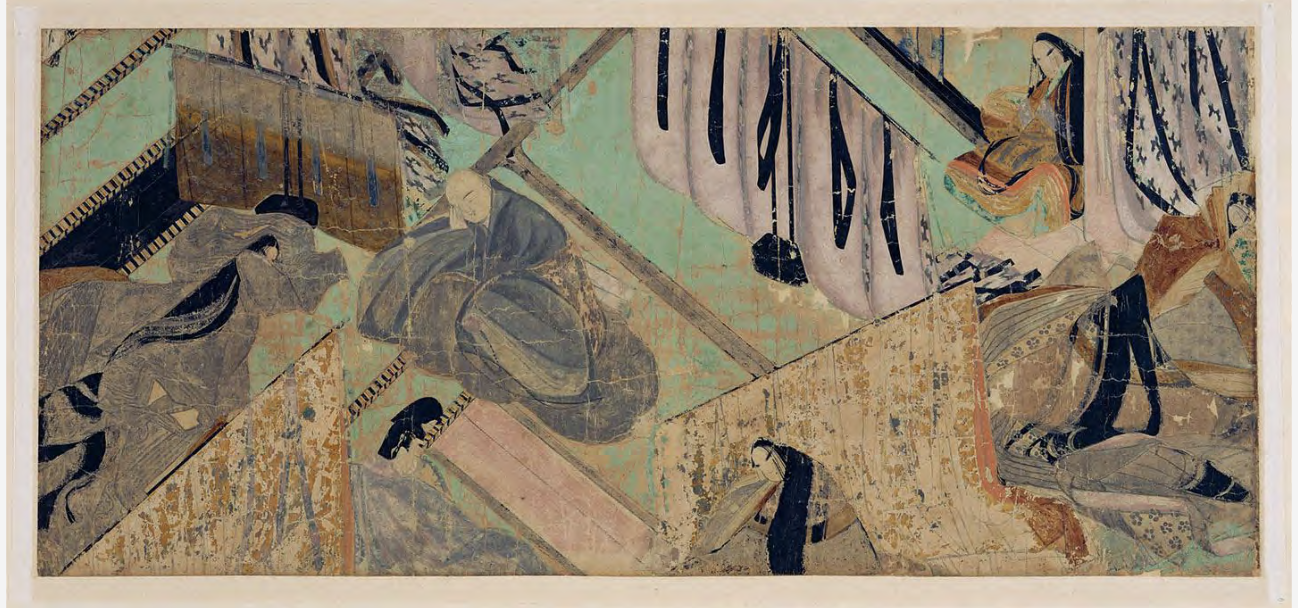
Scene 1 from the “Oak Tree (Kashiwagi)” chapter of The Tale of Genji
Late Geian period, 1120-50, Handscroll, ink and color on paper. Japan
• Onset of mappō fueled aesthetic sensibility of mono no aware (awareness of the transience of things), which pervades The Tale of Genji
• Set of handscrolls from the twelfth century combines skill of papermaking, calligraphy, and painting

Laye heian period, 1120-50, Handscoll, ink and color on paper. Japan
• Genji cradles the newborn baby (the child of Kashiwagi)
• Emotional awkwardness represented indirectly by tipped up ground plane, placement of Genji at upper edge, sharp diagonal lines, and agitated draperies
• Mono no aware refers to the pathos of things, the poignancy of life experiences
key words: Handscroll, calligraphy, ground plane, motif, onna-e

Scrolls of Frolicking Animals (Choju Jinbutsu giga) attributed to Toba Sojo
mid twelfth century. Handscroll, ink on paper. Japan
• Four-scroll set that depicts humans and anthropomorphic animals performing leisure activities and sacred rituals
• This detail depicts a monkey abbot kneeling before a Buddhist altar, frog icon with mudra signaling not to fear, and various animals observing a religious ritual
key terms: Isometric, monochrome, otoko-e
Song Dynasty
Indigenous dynasty with a largely Confucian government and culture
• Robust economy; technological, philosophical, and scientific innovations
Yuan Dynasty
Established after the Mongols conquered China
• Culture was nomadic, based on pasturing animals
• Relative peace and stability increased intercultural contact
Five Dyn. 五代 (906-960) & Song 宋 Dyn. (960-1279)


Attributed to Dong Yuan, Wintry Groves and Layered Banks
Southern Tang Dynasty, 950, hanging scroll, ink and color on silk
• One of the most important paintings associated with Southern Tang kingdom
• Represents early stage of Chinese landscape painting
• Moist brush, layers of ink wash, and limited color create marshy landscape with mountains
Formats of East Asian paintings
Handscroll, hanging scroll. album leaf, circular fan, folding fan

Art during Northern Song Dynasty
960 - 1127
Song Painting
Roughly divided into northern and southern Song; the former generally emphasizes court and traditional subjects, the latter is more influenced by the new spirituality of Chan Buddhism. Southern Song tends to be more subjective and philosophical. By subject mater and style this period may be organized into a series of "schools.”
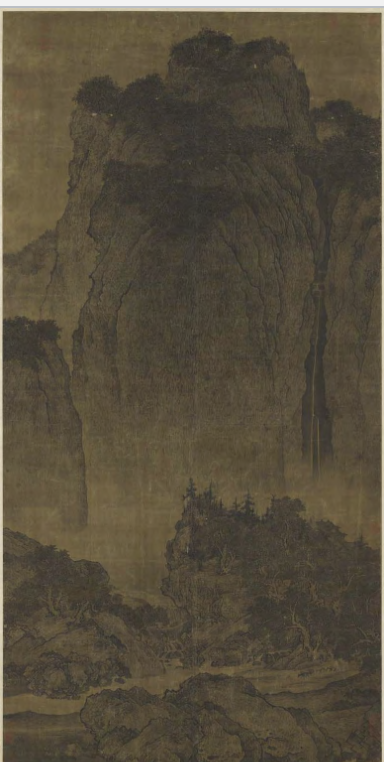
Fan Kuan, Travelers among Streams and Mountains
Northern Song dynasty, 1000, hanging scroll, ink and colors on silk. China
• Quintessential example of monumental landscape
• Foreground and middle ground occupy a small area and small figures at the mountain’s base provide scale
• Fan Kuan’s signature (lower right) suggests pride rising status of court painters
• Both this landscape and Fan’s native Shaanxi province share rugged terrain
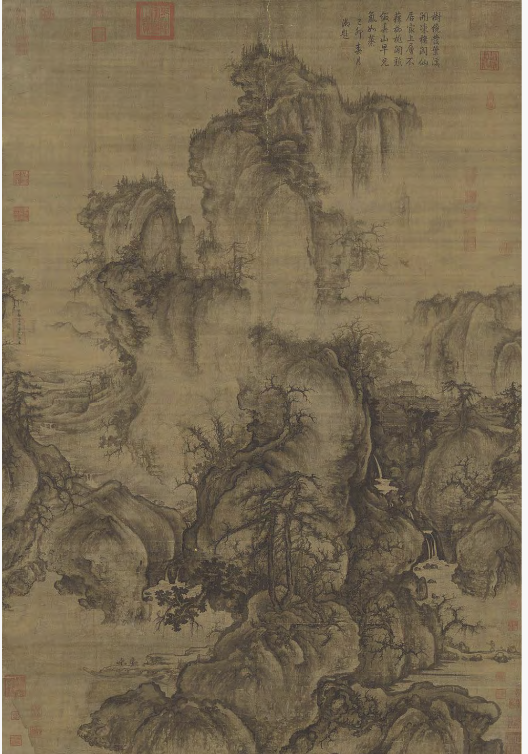
Guo Xi, Early Spring
Northern Song dynasty, hanging scroll, ink and color on silk. China
• Developed out of the work of Dong Yuan and Fan Kuan
• Use of water, mist, clouds, “deep distance,” monumental scale
• Seamlessly integrates multiple points of view
• Firm but dynamic composition and naturalistic style
Key Terms: naturalistic, illusionism, format, screen painting
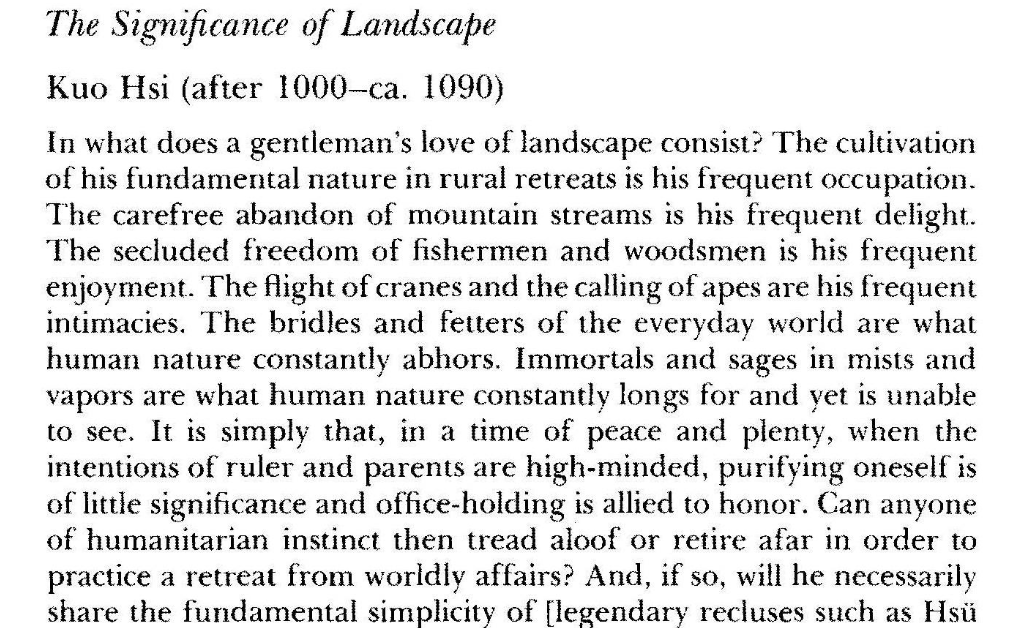
Passage from Guo Xi’s (Kuo His) treatise on landscape painting
• Guo Xi wrote a treatise on landscape painting entitled The Lofty Appeal of Forests and Streams
• Characterized landscape painting as an expression of longing to escape government duty and pursue self-cultivation
• Saw the landscape as a way to express social norms

Zhang Zeduan, Peace Reigns Along the River
Northern Song Dynasty, late eleventh to early twelfth century. Handscroll, ink and color on silk. China
• Designed to be viewed by one person or a small group
• Handscroll allows a sequential viewing process, so the painting is structured as a trip along the river
• Documents idealized version of daily sights and commercial activities
• Skilled ruled-line painting (he likely worked
freehand) Key Terms: handscroll, ruled-line painting, isometric perspective, facade

Su Shi, Poems Written on the Cold Food Festival
Northern Song Dynasty, 1082, Handscroll, ink on paper. China
Scholar-official of the Song court who was banished three times; he wrote this during his first banishment
• Literati painters deliberately pursued awkwardness and abstraction
• Su said painting should be expressive, not refined; emphasis on spontaneity and “naturalness,” de-emphasis of professional painterly skills and thus professional artists;
• merging of painting with poetry and calligraphy;
• Subjects of literati painting associated with the virtues of gentlemen: bamboo, pine, orchid, plum blossoms, old rocks

Attributed to Emperor Huizong, Five-Colored Parakeet on Blossoming Apricot Tree
Northern Song Dynasty, 1110, Orginially oversize album leaves, now mounted as a handscroll, ink on color on silk. China
• Oversized album leaf combines poetry, calligraphy, and painting (“the three perfections”) and attests to the emperor’s mastery of the three art forms
• Fine brushes used to render the parakeet in heightened realism
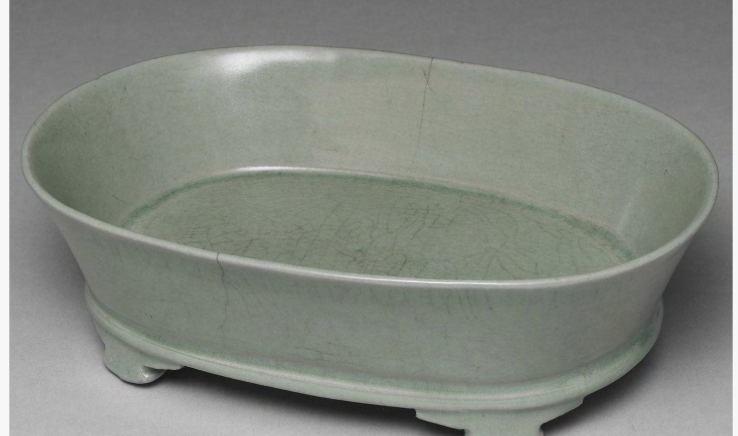
Narcissus Bowl
Northern Song Dynasty, 1101-25, Ru ware. China
• The ru ware glaze is reminiscent of jade and was produced almost exclusively during Emperor Huizong’s reign
• Any flaws in the application of glaze or firing would have been apparent – a testament of skill

Ma Yuan, Apricot Blossoms
Southern Song Dynasty, early thirteenth century, Album leaf, ink and colors on silk
• Stylistic similarities to Emperor Huizong’s Five- Colored Parakeet
• Inscription was made by empress Yang Meizi (they
collaborated frequently)
• Blossoms are personified to invite the emperor to visit her bedchamber

Li Song, Kinck-Knack Peddler
Southern Song Dynasty, 1210, fan mounted as an album leaf, ink and color on silk. China
• Observation of the physical world
• Inscription “three hundred items” is the artist’s claim of the number of objects depicted on the peddler’s racks
• Vision is one of the themes
• Idealized world of peace and plenty legitimizes imperial power