quantitative chemistry
 Call Kai
 Learn
Learn Practice Test
 Spaced Repetition
 Match
Match Flashcards
 Knowt Play
1/20

There's no tags or description
Looks like no tags are added yet.
Name | Mastery | Learn | Test | Matching | Spaced | Call with Kai | Chat |
|---|
No analytics yet
Send a link to your students to track their progress
21 Terms
equation for relative atomic mass

what is the definition of relative atomic mass?
the average weighted mass of all of an element relative to an atom of Carbon-12
how many atoms/molecules is one mole?
6.02×10²³
what is number of molecules equal to?

what is the mass of one mole of a substance equal to?
its relative formula mass (eg. one mole of water = 18 g (Mr of water is 18)
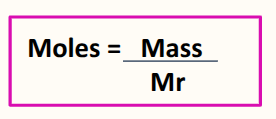
what is moles equal to?
what is a mole ratio?
A mole ratio is the ratio between the amounts in moles of any two compounds involved in a balanced chemical equation
how do you calculate the mass of a product?
Step 1: READ the equation:
Step 2: WORK OUT the relative formula masses (Mr):
Step 3: WORK OUT the MOLES of your substance of “known mass”
Step 4: APPLY the balanced equation
Step 5: WORK OUT the MASS of your unknown substance
what is the limiting reactant?
One of the reactants in any reaction will determine how much product can be made – once it is used up the reaction ends.
what is moles of a gas equal to?

what is percentage composition?

what is percentage yield?
Percentage YIELD is the amount of product you actually make as a % of the amount you should theoretically make
how do you calculate percentage yield?

what is atom economy?
a measure of the amount of starting materials that end up as useful products
how is atom economy calculated?

what is solution concentration?
how much solute is dissolved in a certain volume of solution
what can concentration be measured in?

what is the equation that links concentration, moles and volume?
moles = concentration x volume
what is the equation that links volume, concentration and solute?

what is the aim of a titration?
To determine the reacting volumes of solutions of an acid and alkali by titration.
To determine the concentration of one of the solutions in mol/dm3 and g/dm3
how is a titration carried out?
Use the pipette and pipette filler to add 25 cm3 of alkali to a clean conical flask.
Add a few drops of indicator and put the conical flask on a white tile.
Fill the burette with acid and note the starting volume.
Slowly add the acid from the burette to the alkali in the conical flask, swirling to mix.
Stop adding the acid when the end-point is reached (when the indicator first permanently changes colour). Note the final volume reading.
Repeat steps 1 to 5 until you get concordant titres (within 0.1cm³ of each other). More accurate results are obtained if acid is added drop by drop near to the end-point.