Lecture 6 - Water + Ionic Balance, Kidney Function
 Call Kai
 Learn
 Practice Test
 Spaced Repetition
 Match
 Flashcards
 Knowt Play
1/56

There's no tags or description
Looks like no tags are added yet.
57 Terms
Osmotic pressure
Measure of the total concentration of solutes; determines direction of water movement
Water moves from regions of __ osmotic pressure to regions of __ osmotic pressure.
Low to high
Isosmotic
Two solutions have the same osmotic pressure.
Hyperosmotic
Solution with higher osmotic pressure
Hyposmotic
Solution with lower osmotic pressure
Ionic composition
Two solutions of the same osmotic pressure can have different ion concentrations.
→ Each type of ion diffuses in response to its concentration differences.
Explain how ionic composition of fluids on
different sides of a membrane affect osmotic pressures.
The greater the difference in ionic composition across a semipermeable membrane, the steeper the concentration gradient, resulting in a higher osmotic pressure that aggressively drives water toward the side with more ions to try and achieve balance.
Hyperosmotic regulator
-Animals that use energy to keep themselves hyperosmotic to the environment
-Ex. freshwater animals
-Excrete dilute urine and actively transport Na+ and Cl- back into bodies
Hyposmotic regulator
-Animals that expend energy to expel excess ions
-Ex. bony fishes
Marine osmoconformer
-Isotonic with the environment
-Ex. nearly all invertebrates in the ocean
-Many cannot survive a wide range of salinities
How do seabirds and marine reptiles get rid of excess salts in their bodies?
Extrarenal organs called salt glands → use energy from ATP
Give an example of a fish that migrates between rivers and oceans
Salmon
If a fish moved from fresh water to salt water, which hormone would help it to compensate
for the saltier environment?
Cortisol → Saltwater hormone; chloride cells in gills pump salts out
How about if a fish moved from salt water to fresh water?
Prolactin → Freshwater hormone; chloride cells pump salts in
In fish, where are chloride cells located, and what do they do in fresh water and salt water?
In the gills
In freshwater, they pump salts in.
In saltwater, they pump salts out.

On this graph, which is an osconformer and which is an osmoregulator?
Blue crab is an osmoregulator. Mussel is an osmoconformer.
What is the primary form of nitrogenous waste that a freshwater fish would be expected
to excrete?
Ammonia (most toxic but highly water soluble)
What is the primary form of nitrogenous waste that a dog would be expected
to excrete?
Urea (more expensive metabolically but less toxic)
What is the primary form of nitrogenous waste that a lizard would be expected
to excrete?
Uric acid (most expensive metabolically, highly insoluble, conserves water)
What animals secrete ammonia?
Most aquatic animals that breathe water
What animals secrete urea?
Most terrestrial animals
What animals secrete uric acid?
Insects, reptiles, birds
The 4 basic processes that take place in the renal tubules
Filtration
Secretion
Reabsorption
Osmoconcentration
Filtration
Water and small solutes pass through a barrier while cells and large molecules remain behind.

Secretion
Transport epithelia move specific solutes into the tubule lumen for excretion.
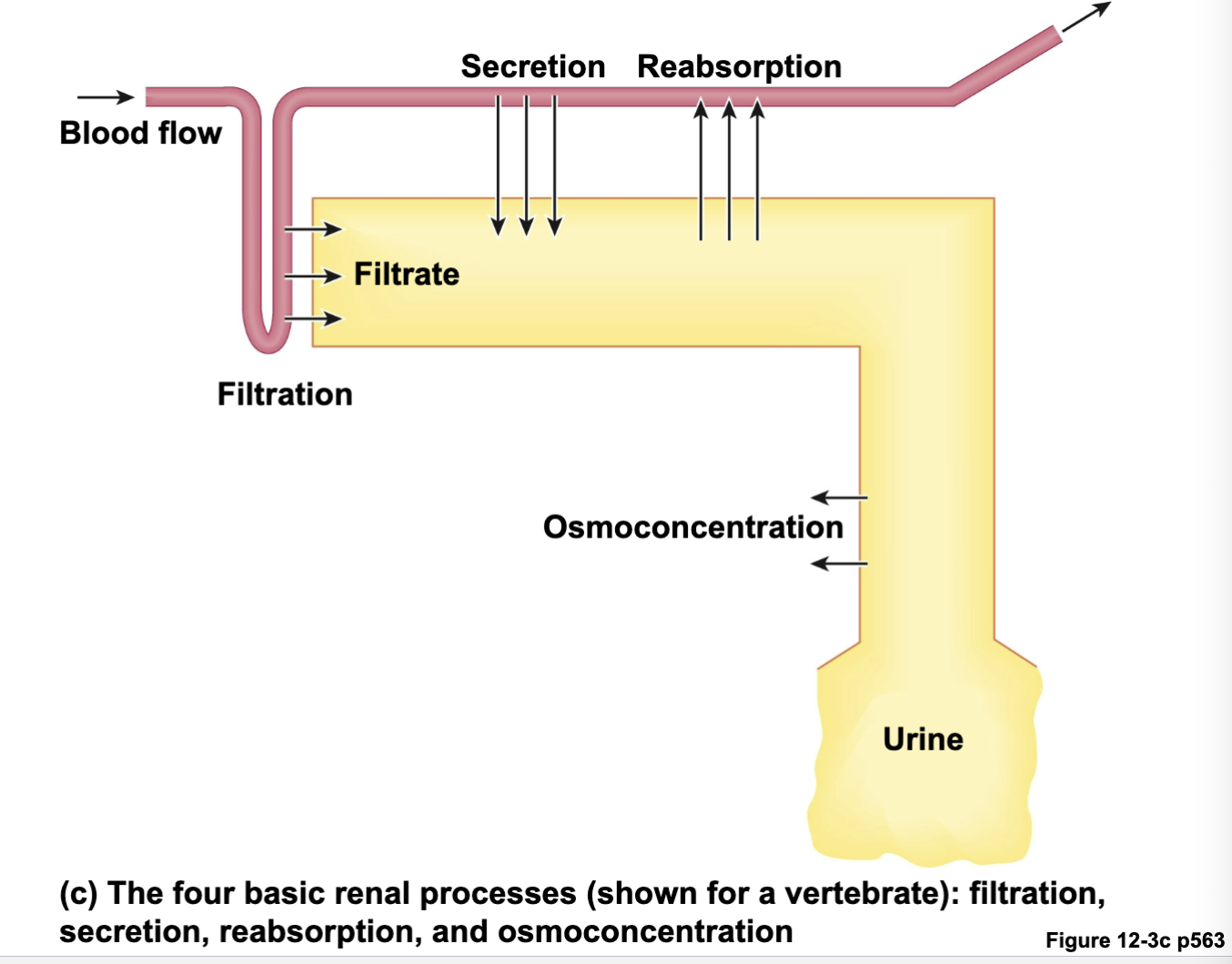
Reabsorption
Transport epithelia move specific solutes and water back into the body from the lumen.

Osmoconcentration
Water is removed from the lumen, leaving solutes behind and producing a more concentrated excretory fluid.
The three types of renal organs
Protonephridia
Mesonephridia and metanephridia
Malpighian tubules
Protonephridia
-Simple invertebrates
-Blind end ducts project into body cavity
-Ultrafiltration driven by cilia moving fluid outward
Mesonephridia and metanephridia
-Ultrafiltration driven by fluid pressure
-Requires a circulatory system
→ Mesonephric = aquatic vertebrates
→ Metanephric = terrestrial animals
Malpighian tubules
-Filtration driven by active secretion of ions
-Arthropods
Kidneys
Urine-forming organ
Where does blood enter and exit the kidneys?
Renal artery; renal vein
Where do ureters empty in reptiles and birds?
The hindgut
Nephron
Smallest functional unit of the kidney; 1 million in human kidney; consists of tubule and vascular component
Vascular component of nephron
Afferent arteriole, glomerulus, efferent arteriole, peritubular capillaries
Tubular component of nephron
Bowman’s capsule, proximal tubule, Loop of Henle, distal tubule, collecting duct
Combined vascular/tubular component of nephron
Juxtaglomerular apparatus
Afferent arteriole
Carries blood to the glomerulus
Glomerulus
A tuft of capillaries that filters a protein-free plasma into the tubular component
Efferent arteriole
Carries blood from the glomerulus
Peritubular capillaries
Supply the renal tissue; involved in exchanges with the fluid in the tubular lumen
Bowman’s capsule
Collects the glomerular filtrate
Proximal tubule
Uncontrolled reabsorption and secretion of selected substances occur here
Loop of Henle
Establishes an osmotic gradient in the renal medulla that is important in the kidney’s ability to produce urine of varying concentration
Distal tubule and collecting duct
Variable, controlled reabsorption of Na+ and H2O and secretion of K+ and H+ occur here; fluid leaving the collecting duct is urine, which enters the renal pelvis
Juxtaglomerular apparatus
Produces substances involved in the control of kidney function
Tubular reabsorption is ___.
highly selective
The descending limb of the loop of Henle allows reabsorption of _______ but not ________.
water but not Na+
The ascending limb of the loop of Henle allows reabsorption of _______ but not ________.
Na+ (active process) but not water
What is meant by the “countercurrent multiplier” of the kidney?
A mechanism within the loop of Henle that creates a high salt concentration deep inside the medulla of the kidney that allows highly concentrated urine (up to 1200 mosm)
What causes aquaporin 2 channels to be added to the kidney, where are they added, and
what do they accomplish?
Why? Due to vasopressin (antidiuretic hormone)
Where? The distal tubule and collecting duct
What do they do? Increase water reabsorption
Water reabsorption is under ___.
hormonal control
What do the vasa recta accomplish in the kidney and, very briefly, how do they do this?
Help conserve vertical osmotic gradient in the renal medulla through countercurrent exchange from a hairpin loop; supplies blood to the renal medulla
What is meant by “urea recycling” in the kidney, and how does this affect water
reabsorption?
-Contributes to medullary hypertonicity
-The lowest section of the collecting duct is permeable to urea. Urea diffuses out.
-Some urea is recycled into the loop of Henle and medulla to increase osmolarity
What are the stimuli for renin secretion from the juxtaglomerular apparatus, and how does
this ultimately result in aldosterone secretion?
Stimuli = low blood volume, low blood pressure
Renin catalyzes angiotensinogen → angiotensin I. Angiotensin I → Angiotensin II via angiotensin-converting enzyme. Angiotensin II is the primary stimulus for aldosterone secretion.
What are the primary functions of aldosterone?
-Increases Na+ absorption
-Stimulates secretion of vasopressin (ADH), which promotes water retention by kidneys
-Potent constrictor of systemic arterioles, directly increasing blood pressure