biology cells
 Call Kai
 Learn
Learn Practice Test
 Spaced Repetition
 Match
Match Flashcards
 Knowt Play
1/81

There's no tags or description
Looks like no tags are added yet.
Name | Mastery | Learn | Test | Matching | Spaced | Call with Kai |
|---|
No analytics yet
Send a link to your students to track their progress
82 Terms
What's the most distinctive thing about a eukaryotic cell?
They have a nucleus.
What is a eukaryotic cell?
Eukaryotic cells contain their genetic material (DNA) enclosed in a nucleus.
What is a prokaryotic cell?
In prokaryotic cells, the genetic material (DNA) is not enclosed in a nucleus.
Which cell is smaller: prokaryotic or eukaryotic cells?
Prokaryotic cells are much smaller.
Are animal and plant cells eukaryotes or prokaryotes?
Eukaryotes.
What is the cytoplasm?
A watery solution where chemical reactions take place (e.g the first stage of respiration).
What is the cell membrane?
The cell membrane controls the molecules that enter and leave the cell.
What are ribosomes?
The sites of protein synthesis.
What is the difference in shape between animal and plant cells.
Plant cells have a regular shape.
What are chloroplasts?
Contain chlorophyll (green pigment) and are the sites of photosynthesis.
What are the mitochondia?
Where aerobic respiration happens.
How does the cell wall help a plant cell?
It contains cellulose, which strengthens the cell
What does the permanent vacuole do in a plant cell?
The vacuole is filled with cell sap. The vacuole gives the plant cell it's shape.
What is the job of a sperm cell?
Join with the ovum (egg cell). We call this process fertilisation.
What happens during fertilisation?
The genetic information of the ovum and the sperm combine.
Where do sperm cells contain their genetic information?
In the nucleus.
The sperm cells only contain half the genetic information of a normal adult cell.
What does the long tail in a sperm cell allow?
Allows them to swim to the ovum. They are also streamlined.
How do sperm cells get their energy for swimming?
Sperm cells are packed full of mitochondria.
How do sperm cells digest their way through the outer layer of the ovum?
They contain a lot of enzymes.
What is the job of a nerve cell?
Send electrical impulses around the body.
How are electrical impulses carried to one part of the body to another in a nerve cell?
Through the axon. Which is covered in myelin → insulated the axon which speeds up the transmission of nerve impulses.
What are synapses?
Located at the end of the axon is the synapses.
Synapses are junctions which allow the impulse to pass from one nerve cell to another.
What do dentrites do to the nerve cells?
Increase the surface area so that other nerve cells can connect more easily.
What is the key feature of muscle cells, how do they do this?
They can contract (get shorter).
Muscles contain protein fibres which can change their length. When a muscle contracts, these fibres shorten.l
What do the root hair cells do?
Increase the surface area, so it can absorb water and dissolved minerals more effectively.
Why do root hair cells not have chloroplasts?
Because they are underground, meaning they cannot carry out photosynthesis.
Where are xylem found?
Xylem are found in the plant stem
What are xylem cells?
They form long tubes which carry water and dissolved minerals from the roots to the leaves.
List features of the xylem cells:
Very thick walls containing lignin, which provide support for the plant.
Lignin causes the xylem cells to die.
End walls between cells have broken down→ water/minerals can flow easily through the long tube.
No nucleus, cytoplasm, vacuole or chloroplasts.→ easier for water/minerals to flow.
What are phloem tubes?
They carry dissolved sugars up and down the plant.
What are the two types of cells in a phloem tube?
Phloem vessel cells - no nucleus and only limited cytoplasm.
Companion cell - the mitochondia inside provide energy for the phloem vessel cells.
What do the end walls of a vessel cells have? (In phloem tube)
End walls of vessel cells have pores called sieve plates. Allowing sugar to flow through.
What is the stage in a microscope?
The centre part where you place the microscope slide. It has clips to hold the slide in place.
What does the lamp in a microscope do?
Light from the lamp passes up through the microscope slide
Why do some microscope have mirrors?
The mirror is used to reflect light up to the microscope slide.
What are the objectives lenses?
They increase the magnification by usually 4x, 10x or 40x.
What is the magnification of the eyepiefe lens?
10x
What is the difference between the course focussing dial and the fine focussing dial?
How do you use a microscope?
Place slide onto stage, use clips to hold it in place.
Select lowest power objective lens (4x)
Position objective lens so it almost touches the slide. By slowly turning the course focussing dial.
Use the fine focussing dial to bring cells into a clear focus.
Why shouldn't you look though the eyepiece when positioning the objective lens?
There's a risk that we damage the slide. Instead look at it from the side.
How do you calculate the total magnification?
Magnification of eyepiece x magnification of objective lens.
What is the difference between a light microscope and an electron microscope.
Light microscopes have a limited magnification and limited resolution (image is blurry).
Electron microscopes have a greater magnification and resolution.
How do you calculate magnification?
Magnification = size of image / size of real object.
Where are chromosomes?
In the nucleus.
What are chromosomes made out of?
The molecule DNA.
How many pairs of chromosomes does a human have?
23
What are gametes?
Chromosomes that aren't paired.
What do chromosomes carry a large numbers of?
Genes (determine many of our features).
Describe the three stages of cell division by mitosis.
1st stage - DNA replicates to form two copies of each chromosome. Cell grows and copies internal structures (mitochondria and ribosomes).
2nd stage - Mitosis takes place. One set of chromosomes is pulled to each end of the cell. Nucleus also divides.
3rd stage - cytoplasm and cell membrane divide to form two identical cells.
What are the functions of mitosis
Growth and development of multicellular organisms (plants/animals).
Repairing organisms (broken bones being healed).
Happens during asexual reproduction.
How does an embryo form?
When the fertilised ovum undergoes mitosis and forms a ball of cells (embryo).
What happens when an embryo begins to change? What is this process known as for scientists?
They become specialised cells such as nerve cells and muscle cells.
This is known as differentiation.
What is a stem cell?
A stem cell is an undifferentiated cell which can give rise to more cells of the same type and can differentiate to form other types of cells.
What do the stem cells in bone marrow differentiate to form?
They form cells found in our blood (red/white blood cells and platelets).
What cancer involves the bone marrow? How is it treated?
Leukaemia:
Patients existing bone marrow destroyed using radiation.
Patient receives a transplant of bone marrow from a donor.
Stem cells in bone marrow divide and form new bone marrow. They also differentiate and form blood cells.
What are the two main problems with bone marrow transplants?
The donor has to be a compatible with the patient. Otherwise the white blood cells produced by the donated bone marrow could attack the patients body.
Risk that viruses can be passed from the donor to the patient.
What is therapeutic cloning?
An embryo is produced with the same genes as the patient.
Stem cells from the embryo can be transplanted into the patient without being rejected from the patients immune system.
Once inside patient, stem cells can differentiate and replace cells that don't work correctly.
What could therapeutic cloning be useful for?
Medical conditions such as diabetes or paralysis.
What do roots and buds contain?
Meristem tissue
What can meristem tissue allow us to do?
Clone a rare plant to stop it from going extinct.
Produce cloned crop plants for farmers.
What's a way molecules can move in and out of cells?
Through diffusion.
What is the definition of diffusion?
Diffusion is net movement of particles from an area of high concentration to an area of low concentration down the concentration gradient.
What are three molecules that move in and out of cells by diffusion.
Oxygen, carbon dioxide and urea.
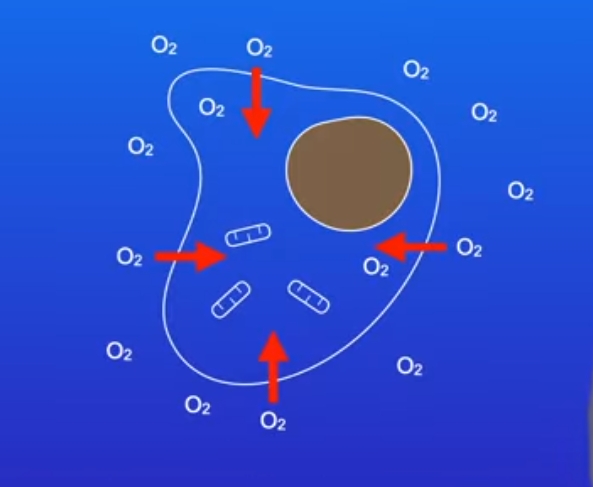
What is happening in this image?
The oxygen is moving from an area of high concentration to an area of low concentration.
What molecules move out of the cell from diffusion?
Urea and carbon dioxide.
How does carbon dioxide exit cells.
Through diffusion
What is urea?
A waste product produced inside cells.
How does urea diffuse out of cells?
It diffuses out of the cells into the blood plasma. It is excreted by the kidneys.
List the factors that affect the rate of diffusion.
Difference in concentrations: the greater the concentration gradient, the faster diffusion takes place.
Temperature: the higher the temperature, the greater the rate of diffusion → particles have more kinetic energy (faster).
Surface area of the membrane: the larger the surface area of the cell membrane, the greater the rate of diffusion.
What happens to the surface area:volume ratio as objects get larger
It falls sharply.
What is the definition of osmosis.
Osmosis is the diffusion of water from a dilute solution to a concentrated solution through a partially permeable membrane.
What can water moving into an animal cell do to it?
Causes it to expand and could even burst.
What happens when an animal cell is placed into a concentrated solution?
Water moves out of the cell by osmosis. The cell will shrink.
What happens when a plant cell is placed in water? Why doesn't the cell break? What is this whole process known as?
Water moves into the cell by osmosis. The cell will expand. But the cell wall prevents it from bursting. Instead it becomes swollen. This is known as turgid.
What happens when a plant cell is in a concentrated solution? What does the cell become?
Water moves out of the plant cell by osmosis. Causing the cell to shrink. This means the cell is flaccid.
How do you find the effects of osmosis on plant tissue (describe the whole practical).
Peel potato skin (the skin affects osmosis).
Use a cork borer to produce three cylinders of potato.
Use a scalpel to trim cylinders to same length (3cm)
Measure length and mass of each cylinder using ruler and balance.
Place each cylinder into test tube
Add 10cm³ of a 0.5 molar sugar solution to the first test tube.
Add 10cm³ of a 0.25 molar sugar in second test tube.
Add 10cm³ of distilled water in third test tube (has no dissolved substances).
Leave potato cylinders overnight and then roll them on paper towel to remove surface water.
Measure length and mass of them again.
Calculate % change in length mass.
How do you calculate percentage change?
Change in value / original value x 100
What is active transport?
Active transport moves substances from a more dilute solution to a more concentrated solution, against the concentration gradient. This requires energy from respiration
How is active transport different from diffusion?
In diffusion particles move down the concentration gradient. In active transport, particles moved against.
Diffusion doesnt require energy from respiration unlike active transport.
What is an example of active transport in plants and animals?
Plants: root hair cells.
Animals: human small intestine.
How do cells lining the small intestine use active transport? Where do they get all the energy for this process?
Cells lining the small intestine (in the lumen) use active transport to absorb sugars (glucose) when the concentration in the lumen is lower than outside.
These cells contain many mitochondria to provide energy for the process.
How do root hair cells use active transport? Where do they get the energy for this?
Root hair cells use active transport to absorb mineral ions (magnesium) from the soil, even when the concentration of it is lower than inside the plant cells.
The cells are packed with mitochondria to fuel the transport of these ions.