1 - Antihypertensive Agents - Jinn
 Call Kai
 Learn
Learn Practice Test
 Spaced Repetition
 Match
Match Flashcards
 Knowt Play
1/72

There's no tags or description
Looks like no tags are added yet.
Name | Mastery | Learn | Test | Matching | Spaced | Call with Kai | Chat |
|---|
No analytics yet
Send a link to your students to track their progress
73 Terms
Hypertension statistics?
~50 million Americans have BP ≥140/90
It is the most common CVD and a major risk factor for CAD, HF, stroke, and renal failure
About 30% don’t know they have it because it often has no symptoms
What are the causes of hypertension?
Primary (essential) → 90–95%, unknown cause
Secondary → ~10%, cause known → kidney abnormalities, congenital heart defects (e.g., aorta), or narrowed arteries
What causes secondary hypertension?
Kidney abnormalities
Congenital heart defects (e.g., aorta)
Narrowing of arteries
What is the short term treatment goal of hypertension?
Reduce blood pressure
What is the long term treatment goal of hypertension?
Reduce mortality → due to hypertension-induced disease stroke
Congestive heart failure
Coronary artery disease
Nephropathy
Retinopathy
What are the 3 ways of lowering blood pressure?
Reducing cardiac output
Reducing plasma volume
Reduce total peripheral resistance
Lowering blood pressure via reducing cardiac output?
Beta blockers
Ca2+ channel blockers
Lowering blood pressure via reducing plasma volume?
Diuretics
Lowering blood pressure via reducing total peripheral resistance?
Vasodilators
Alpha 1 — Adrenergic receptor antagonists
ACE inhibitors

Where do loop / high-ceiling diuretics act?
At the thick ascending limb of the loop of Henle
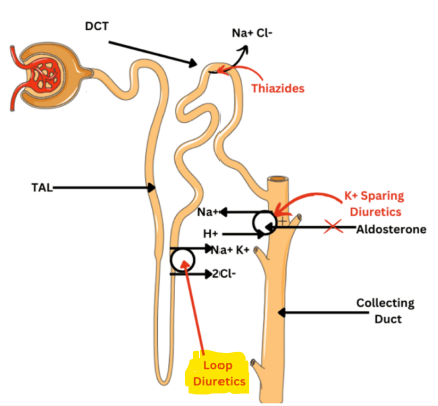
MOA of loop / high ceiling diuretics ?
Inhibit the Na⁺/K⁺/2Cl⁻ symporter in the → thick ascending limb of the loop of Henle
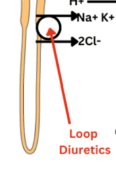
How does loop diuretics inhibiting the Na⁺/K⁺/2Cl⁻ symporter decrease BP?
Inhibiting the Na/K/2Cl symporter → decreases reabsorption of Na⁺, K⁺, and Cl⁻ → increase excretion of these ions and water → decrease blood volume → decrease BP
How are loop diuretics similar to thiazide diuretics?
Both are diuretics used to lower BP
Side effects of loop diuretics?
Hypokalemia → K+
Hyperuricemia → high level of uric acid
Hypersensitivity reactions
Examples of loop diuretics?
Furosemide
Bumetanide
Ethacrynic Acid

Where do thiazide diuretics act?
In the distal convoluted tubule

MOA of thiazide diuretics?
Inhibits Na+/Cl- symporter in the → distal convoluted tubule
How does thiazide diuretics inhibiting he Na/Cl symporter decrease BP?
Inhibiting the Na/Cl symporter → decreases Na⁺ reabsorption → increases water excretion → decrease blood volume AND direct vascular smooth muscle relaxation
Overall → decreasing BP
When are thiazide diuretics used?
For mild — moderate hypertension
For patients with normal kidney function
Well tolerated and cheap
Side effects of thiazide diuretics?
Hypersensitivity reaction
Hypokalemia → K+
What can be added to thiazide therapy to help prevent hypokalemia?
A K⁺— sparing diuretic
Example of a thiazide diuretic?
Chlorothiazide
When are Ca2+ channel blockers used?
For mild — moderate hypertension
All antagonists are equally effective for Stage 1 hypertension
MOA of Ca2+ channel blockers?
Bind to L-type Ca²⁺ channels → decreases intracellular Ca²⁺ → decrease cardiac contractility AND vasodilation → overall decreases BP
Side effects of Ca2+ channel blockers?
Edema
Hypotension
Tachycardia
Dizziness
Headache
What are the 3 classes of Ca2+ Channel blockers?
Dihydropyridines → Amlodipine, Nifedipine, Nicardipine
Phenylalkyl Amines → Verapamil
Benzothiazepine →Diltiazem
What does ACE inhibitor stand for?
Angiotensin-Converting Enzyme inhibitor
How do ACE inhibitors affect the renin-angiotensin system?
Inhibit Angiotensin II formation
Decreases Angiotensin II → less vasoconstriction and less aldosterone → increase Na⁺/water excretion → decrease blood volume → decrease BP
How do ARBs affect the renin-angiotensin system?
Block Angiotensin receptor activation
Block Angiotensin II receptor activation → less vasoconstriction and less aldosterone → increased Na⁺/water excretion → decreased blood volume → decreased BP
What does ARB stand for?
Angiotensin Receptor Blocker
ACE inhibitor vs ARBs?
ACE inhibitor → decrease Angiotensin II formation
ARB → blocks Angiotensin II receptor activation
Have the same overall downstream effects → but they block the pathway at different points
Systemic reduction of ACE inhibitors?
TPR → total peripheral resistance
Systolic and Diastolic pressure
Mean arterial pressure
Aldosterone secretion
Cardiac remodeling → physical heart changes
Systemic increases of ACE inhibitors?
Regional blood flow in vascular beds → more blood reaches tissues
Large artery compliance → arteries become more flexible
Examples of ACE inhibitors?
Captopril
Enalaprilat
Dicarboxylate-containing inhibitors
Lisinopril
Moexipril
Perindopril
Quinapril
Ramipril
Trandolapril
Are ACE inhibitors prodrugs?
Yes!
They must be biotransformed for activity by esterases
What is a common use for ACE inhibitors?
Initial choice for mild–moderate hypertension
What conditions are ACE inhibitors especially useful for?
Drug of choice for hypertension → due to diabetes mellitus
Also for hypertension caused by → CHF, arrhythmia, or kidney disease
What is ACE inhibitors most effective in?
High renin patients → enzyme by kidneys that help controls BP
More effective in Caucasian patients
What increases the efficacy of ACE inhibitors?
Diuretics!
Side effects of ACE inhibitors?
Hypotension
Cough
Hyperkalemia
Angioedema
Acute renal failure
Neutropenia
Proteinuria → protein in urine
Tetratogenic
Examples of ARBs?
Losartan
Valsartan
Irbesartan
Olmesartan medoxomil
Eprosartan
Azilsartan medoxomil
Telmisartan
Candesartan cilexetil
Therapeutic uses of ARBs?
Same uses as ACE inhibitors
First-line alone or with other agents
No bradykinin effects → no cough
Useful for HTN secondary to → CHF
Side effects of ARBs?
Hypotension
Hyperkalemia
Dyspepsia
Diarrhea
Abdominal pain
Headache, dizziness, fatigue
Upper respiratory tract infection
Back pain
Examples of non-selective Beta adrenergic blockers?
Propranolol
Bucindolol
Carteolol
Nadolol
(-)-S-Penbutolol
(S)-Timolol
Pindolol
Labetalol
Examples of Beta 1 selective adrenergic blockers?
Acebutolol
Atenolol
Bexaxolol
Bisoprolol
Esmolol
Metoprolol
(+)-SRRR-Nebivolol
What effects do beta blockers have?
Reduce cardiac output
Reduce renin release
Reduce sympathetic outflow → CNS effect
How effective are β-blockers for lowering BP?
Non-selective and cardioselective β-blockers are equally effective
Monotherapy
Cheap
When are β-blockers especially useful for hypertension?
High-renin hypertension
Hypertension with coronary insufficiency
Side effects of beta blockers?
Decreased exercise tolerance
Bradycardia
Sleep disturbance
Bronchospasm
Coldness of extremities
CNS effects → dizziness, confusion, or depression
Asthma
Peripheral vascular disease and diabetes
What are beta blockers contraindicated in?
Insulin-dependent diabetes
Examples of non-selective alpha adrenergic receptor antagonists?
Phentolamine
Phenoxybenzamine
Dibenamine
Examples of selective alpha-1 adrenergic receptor antagonists?
Prazosin
Doxazosin
Terazosin
MOA of alpha blockers?
Block vascular α₁ receptors → inhibit vasoconstriction → decrease total peripheral resistance → decrease BP
When are non-selective α-blockers used?
Hypertensive crisis caused by pheochromocytoma
How are selective α-blockers used?
As monotherapy or adjunct therapy
Side effects of alpha blockers?
Dizziness
Hypotension
Nasal congestion
Headache
Reflex tachycardia → especially with nonselective
Fluid retention → use with diuretic
Examples of centrally acting sympatholytics?
Methyldopa
Clonidine
Moxonidine
Rilmenidine
Guanabenz
Guanfacine
How do CNS sympatholytics lower BP?
α2 agonists act in the CNS → decrease sympathetic neuron firing → decrease sympathetic activity → decrease BP
What do CNS sympatholytics do to norepinephrine (NE) release?
Prevent it!
Act on prejunctional sympathetic neurons → prevent NE release → decrease sympathetic activity
Where do CNS sympatholytics act?
Nucleus of solitary tract + C1 neurons of the rostral ventrolateral medulla
brain areas that help control sympathetic nerve activity
Therapeutic uses of CNS sympatholytics?
Reduce BP by lowering TPR and cardiac output
Use with diuretic → to prevent fluid retention
Alpha 2 agonists → effective in ALL patients
Adverse effects of CNS sympatholytics?
Hypotension
Sedation: ~ 50% of all patients
Dry mouth
Vivid dreams
Depression
Withdrawal
Tachycardia
Nervousness, excitement
Autoimmune → Lupus, leukopenia
Hyperthermia
Reduced mental acuity
Peripheral sympatholytics?
Rarely used
Ex → Metyrosine (alpha-methyl-tyrosine), Guanethidine, and Reserpine
Metyrosine?
Inhibits tyrosine hydroxylase → rate limiting enzyme for NE synthesis
Peripheral Sympatholytic
Guanethidine?
Gets uptaken into NE vesicle → prevents NE release from the vesicle
Peripheral sympatholytic
Reserpine?
Inhibits accumulation of NE into vesicle
Peripheral Sympatholytic
Examples of direct acting vasodilators?
Hydralazine
Minoxidil
MOA of hydralazine?
Liberates NO from vascular endothelium → vasodilation → decreases total peripheral resistance → decreases BP
When is hydralazine used?
NOT a Monotherapy
Severe or refractory hypertension
Bioavailability → dependent on genetic factors
Adverse effects of hydralazine?
Tachycardia
Hypotension
Fluid retention
Lupus-like syndrome
How does minoxidil lower BP?
Opens K⁺ channels → reduces smooth muscle contractility → vasodilation → decreases BP
When is minoxidil used?
NOT a monotherapy
Severe or refractory hypertension
Long duration of action → 24 hours
Adverse effects of minoxidil?
Tachycardia
Fluid retention
Hypertrichosis → excessive hair growth anywhere on the body