ENT 201 Lecture 2 Notes: Arthropod and Insect History
0.0(0)
Studied by 1 person Call Kai
 Learn
Learn Practice Test
 Spaced Repetition
 Match
Match Flashcards
 Knowt Play
Card Sorting
1/28

Earn XP
Description and Tags
Ancient Critters—Arthropod and Insect History
Last updated 3:43 PM on 2/8/23
Name | Mastery | Learn | Test | Matching | Spaced | Call with Kai | Chat |
|---|
No analytics yet
Send a link to your students to track their progress
29 Terms
1
New cards
How old is the earth?
4\.5 billion years
2
New cards
How old is life on Earth?
3\.7 billion years
3
New cards
How long have insects been around?
385 million years
4
New cards
Why are ladybugs called ladybugs?
The name "ladybug" was coined by European farmers who prayed to the Virgin Mary when pests began eating their crops.
5
New cards
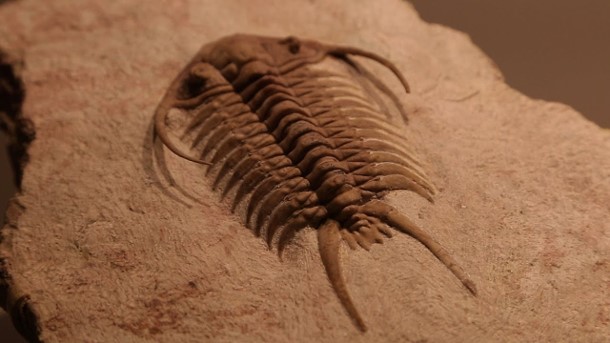
What are these guys? What are some things you notice about them? Where do you suppose they lived? What did they eat?
Trilobites. They have lots of legs and were probably very slow. They might have even been swimmers. They probably were filter feeders, so they ate algae and maybe even smaller trilobites.
6
New cards
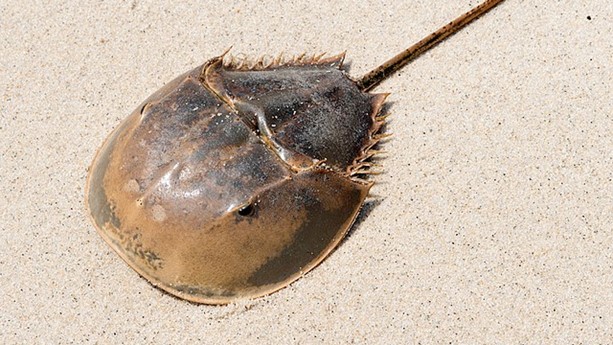
What is this?
Horshoe crab. It has copper in blood. Used in pharmaceuticals to test medication safety (contamination). Called “living fossils”
7
New cards
How do we trace insect history?
We can estimate and trace insect geological history with traditional dirt fossils and amber
8
New cards
Who were the first ancestors of insects?
•Trilobites (\~550-250 mya)
•Horseshoe crabs (\~445 mya)
Characteristics shared: Joined appendages, Bilateral symmetry, exoskeleton
•Horseshoe crabs (\~445 mya)
Characteristics shared: Joined appendages, Bilateral symmetry, exoskeleton
9
New cards
Tracing Insect History from water to land
First insect fossils were tiny, wingless, soft-bodied (420 mya). Later came Mayflies and dragonflies (280-250 M years ago), who breathed through their skin like aquatic animals.
10
New cards
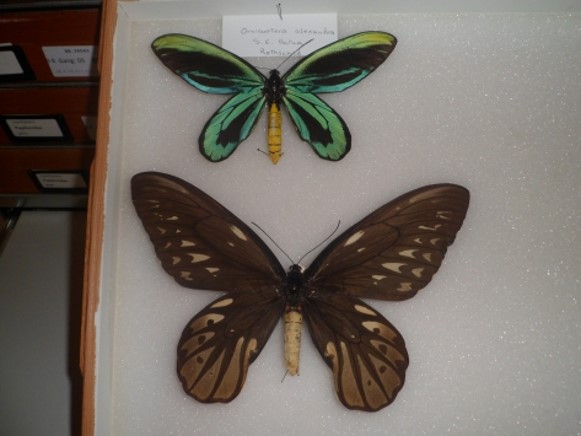
Tracing Insect History from land into the sky. Why were butterflies so big a while ago? Why don’t we have insects this big today?
(Queen Alexandria Bird Wing Butterfly – Papa New Guinea
Giant Weta – New Zealand)
(Queen Alexandria Bird Wing Butterfly – Papa New Guinea
Giant Weta – New Zealand)
Because we don’t have as much oxygen in the air anymore, it was more favorable for insects to grow smaller and maximize their energy.
11
New cards
There are only 4 groups of animals that have been able to fly. What are they?
Insects, birds, bats, pterosaurs
12
New cards
Why were early insects so big?
\-Lack of predators
\-Oxygen
\-Oxygen
13
New cards
Why have insects and relatives lived so long?
They have a successful body plan (they are very adaptable, since they can fly, swim, and walk)
14
New cards
How far back do dragonfly fossils date?
280 mya
15
New cards
How far ago were modern insect relatives dated?
180 mya
16
New cards
Tracing Insect History
•Most modern insect groups were present before dinosaurs (180 mya)
•Many of today’s insect species have lived since the mid Tertiary period (25-30 mya)
Things will not stop evolving! Long after we are gone, they will remain.
•Many of today’s insect species have lived since the mid Tertiary period (25-30 mya)
Things will not stop evolving! Long after we are gone, they will remain.
17
New cards
What was incorrect in the Jurassic Park scene?
Not mosquito in the “amber”
Not female
Not amber! Amber is made from tree resins, tree sap is not made of resin (sugars, water, minerals)
Not female
Not amber! Amber is made from tree resins, tree sap is not made of resin (sugars, water, minerals)
18
New cards
True or false: Modern insects can look very similar to their ancestors.
True
19
New cards
What was the process by which insects came to be?
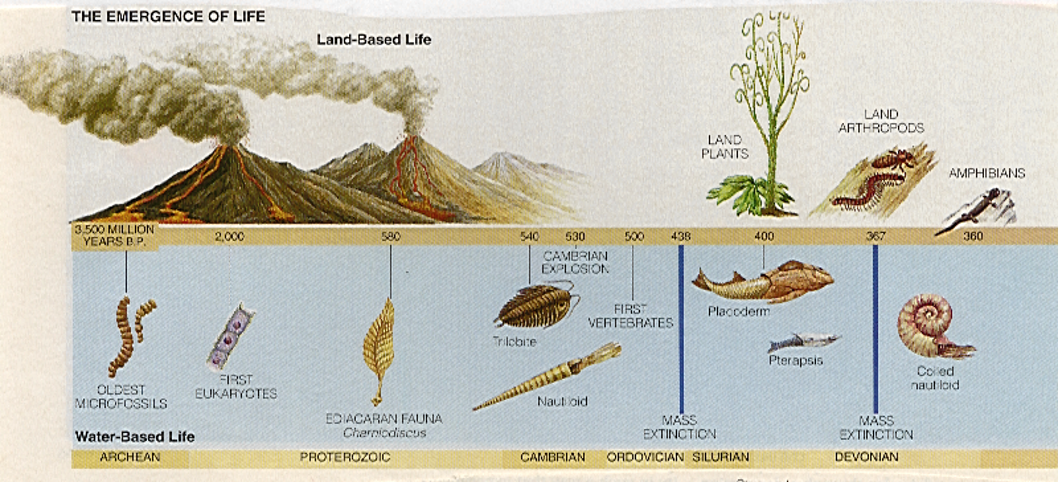
First aquatic plants, then aquatic insects (followed by predators) evolved. Same for land plants, land arthropods, and predators. Same for flighted insects and their predators.
20
New cards
Tracing insect-people interactions through art and literature
•The earliest cave drawings included insects
•People stealing honey from bees (6000 BC)
•China and silkworms (4,700 BC)
•Egypt and honeybees, scarab beetles (3,500 BC)
•People stealing honey from bees (6000 BC)
•China and silkworms (4,700 BC)
•Egypt and honeybees, scarab beetles (3,500 BC)
21
New cards
Early Entomologists
Aristotle (384-322 BC) – Father of Zoology. *Historia Animalium*
•Theophrastus (380-287 BC). *First to catalog insect crop pests in Greece*
•Pliny the Elder (Roman) (23-79 AD). *Historia Naturales, Book 11*
•Theophrastus (380-287 BC). *First to catalog insect crop pests in Greece*
•Pliny the Elder (Roman) (23-79 AD). *Historia Naturales, Book 11*
22
New cards
**F. Johann Sperling** \n *Zoologia physica* (1661)
“After all, we know at least 40 species of beetles, 50 of caterpillars, 70 of flies and over 100 butterflies.”
23
New cards
**G. John Ray** \n *Historia Insectorum* (\~1700)
“Butterflies and beetles are such numerous groups that I believe we have at least 150 or more species of each in England. Together with larvae and pupae, that makes 900 species… The number of insects in the whole world, on land and water must be in the region of 10,000…”
24
New cards
What is a species? (Define in one sentence or less)
Group of animals that are reproductively isolated from one another.
25
New cards
How many species of insects are there?
1 million identified and named
26
New cards
J. B. S. Haldane, British Biologist
“I’ve deduced, that God is incredibly fond of beetles”
27
New cards
Taxonomy
The science of identifying, naming, and categorizing living organisms
28
New cards
What are some differences between similar species of insects?
A different species can look the exact same, except with one or two more hairs on the hind legs or a slightly smaller vein in a wing.
29
New cards
What’s the difference between insects and bugs?
We often use the word bug to mean any small creature with legs. That may include insects as well as many other animals that are not insects, such as spiders and centipedes. A true bug is a type of insect that has a mouth shaped like a straw. Insects belong to *Insecta* class while bugs belong to *Hemiptera* order.