Week 5- Confessions and Profiling
 Call Kai
 Learn
 Practice Test
 Spaced Repetition
 Match
 Flashcards
 Knowt Play
1/18

There's no tags or description
Looks like no tags are added yet.
19 Terms
conviction rate for confessions and eyewitness ID
conviction rate low-pressure, high pressure, no confession
Confessions: 73% conviction rate
Eyewitness identification: 59% conviction rate
Low-pressure confession: 62% conviction rate
High-pressure confession: 50% conviction rate
No confession: 19% conviction rate
How many suspects confess?
between what % and what of suspects make full confessions?
approx % of suspects make full or partial confessions?
Between 39% and 48% of suspects make full confessions Approx. 55% of suspects make a full or partial confession
False confessions
lead to how much % of wrongful convictions? US cases between what to what
in % the defendant under 18 or/and disabled
Lead to wrongful convictions in 25% of cases (US rate between 35-600 per year)
In 35% the defendant was 18 years old or younger and/or developmentally disabled
Reasons for voluntary false confessions
Protect a friend/relative (problem for juveniles?)
Pathological need for fame, acceptance, recognition or self punishment
Fact/fantasy confusion
Instrumental motives
Coerced Compliant False Confessions
what are they
why
police need to be coercive?
Occur in order to escape/avoid an aversive interrogation or to gain a promised reward
Why?
Short term benefits (of confessing) outweigh long term costs (e.g. prosecution, incarceration) •
Confession is to avoid or escape intense pressure, exhaustion, or imminent stress
Police can be extremely coercive in the context of large power discrepancies (”I want to help you”; “if you don’t tell me what happened…”)
Coerced Internalised False Confessions
what is it
why
police need to be coercive?
factors that increase risk
Where an innocent person comes to believe during interviewing/interrogation that they committed the crime
May permanently alter the suspect’s memory of an event
why
Often involves hypotheticals used in interrogations – “Imagine how you think it would’ve happened…”
• May also involve false evidence claims
Again, police can be extremely coercive in the context of large power discrepancies (”I need you to help me figure this out”)
Factors that increase risk – prolonged time and isolation, fatigue and sleep deprivation
Kassin & Kiechel (1996) Study,
Does presentation of false evidence to vulnerable people result in them confessing, internalising and confabulating?
Crime: Pressing the ‘ALT’ key and losing their data
• Would participants:
• Sign a false confession (comply)?
• Privately describe the crime as if they had done it (internalise)?
• Elaborate on the details of the crime (confabulate)
Kassin & Kiechel (1996) - Results

Modern Safeguards
Police do not want to make people confess falsely, confession not the goal
• Interviews must be recorded
• High pressure tactics (Reid) replaced with evidence-based interview models (PEACE)
• “hold back” information
• Time limits, breaks, food requirements
• Warnings or cautions
• Mandatory legal counsel or support person for vulnerable interviewees
• Suggestibility training and awareness – avoid leading questions, false inducements or suggestions of, subtle coercion
Mr. Big Technique-Daniel Morcombe case
success rate and conviction rate
Undercover officers pose as members of organised crime gang and lure suspect into the gang by rewarding them for committing minor crimes. The gang ‘interviews’ the suspect for a bigger job, but first they must confess to any major crime they have committed, as either insurance or so Mr Big can make the problem disappear.
75% success rate; 95% conviction rate
Definitions of Criminal Profiling- Inductive and Deductive
as a projection of how they will be when found (inductive, trait oriented, experimental) or
• as an assessment of how they were at the time the crime was committed (deductive, state oriented, clinical)
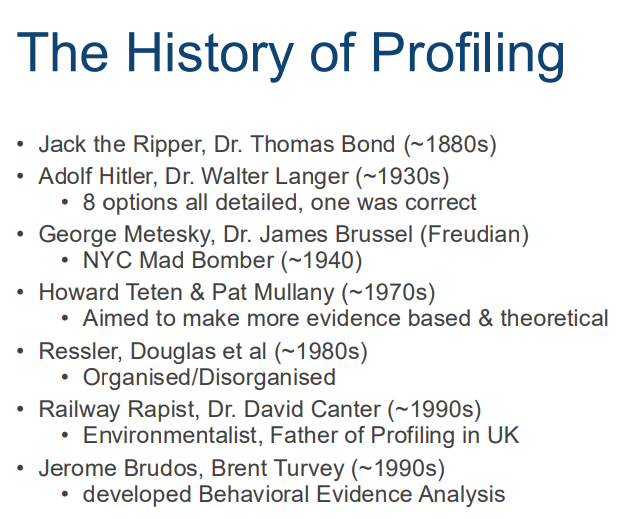
The History of Profiling *
Inductive and Deductive profiling with premises and conclusions
Both based on premises and conclusions- premises are reasons that support the main claim of the argument, conclusions are what is inferred from them
• In inductive logic conclusions are made probable by premises
• In deductive logic conclusions are made certain by premises
inductive profiles…
• Offer characteristics based on previous offenders and their behaviours
• Combine research on the crime type into a report
• May need to assume the research is valid or representative of this crime
• Offer offender characteristics which are probable
• Rely heavily on quality and relevance of previous research
The Problem of Induction (Karl Popper)*
Now it is far from obvious, from a logical point of view, that we are justified in inferring universal statements from singular ones, no matter how numerous: for any conclusion drawn in this way may always turn out to be false: no matter how many instances of white swans we may have observed, this does not justify the conclusion that all swans are white
Deductive Profiles…
• Discuss the behaviour in this crime, regardless of other offenders
• Try to fully outline/account for available physical evidence • Deduce offender characteristics from victimology and crime scene, not past research
• Deductive conclusions are limiting, and limited to what can be inferred from the physical evidence
• Research used for theory building
The Problem of Deduction
•If not enough information is available, no conclusion can be drawn
• More time consuming
• Proponents sometimes disregard or discount good research, forgetting that induction plays a major role in reaching deductive conclusions
• May involve more than just the FP. A criminologist, forensic scientist, pathologist, etc. may also be necessary ($$)
Profiling Methods Inductive and Deductive
Inductive:
• Criminal Investigative Analysis – (FBI) organised/disorganised typology
• Investigative Psychology – (UK) very research focused; statistics based
• Diagnostic Evaluations – specific to individual analyst (physicians, FPs, psychiatrists, psychics, etc).
• Geographic Profiling – (USA and CAN) areas an offender is familiar with
Deductive: • Behavioural Evidence Analysis - (USA) forensic science/crime reconstruction focused
Profilers-Employers? Qualifications?
• Profilers can work anywhere, private, Prosecutor’s office, media
• Anyone can call themselves a profiler and many do
• Little to no regulation
• Poorly defined, open to abuse
• Term has taken on a casual meaning to include crime analysts as well
• Some are forensic psychologists, many others are not