A&P I Lab 2 : Tissue Histology & Skin Anatomy
 Call Kai
 Learn
Learn Practice Test
 Spaced Repetition
 Match
Match Flashcards
 Knowt Play
1/49

There's no tags or description
Looks like no tags are added yet.
Name | Mastery | Learn | Test | Matching | Spaced | Call with Kai | Chat |
|---|
No analytics yet
Send a link to your students to track their progress
50 Terms
Simple Epithelia
single layer

Stratified Epithelia
multilayer

Squamous Epithelia
thin and flat
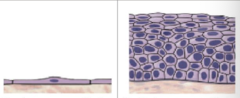
Cuboidal Epithelia
cube-shaped

Columnar Epithelia
column-shaped

Simple Squamous Epithelium
-single layer of flattened cells
-location : alveoli, blood vessels, serous membrane, kidney
-functions : filtration and diffusion

Stratified Squamous Epithelium Keratinized
-location : epidermis of skin
-function : protection

Stratified Squamous Epithelium Non-Keratinized
-location : lines mouth, esophagus, vagina, rectum
-function : protection

Simple Cuboidal Epithelium
-location : ducts of glands, kidney tubules, thyroid
-function : secretion and absorption

Stratified Cuboidal Epithelium
-location : ducts of glands, rare
-function : protection, secretion

Transitional Epithelium
-location : bladder, ureters
-function : stretches

Simple Columnar Epithelium
-location : intestinal lining, stomach
-function : absorption, secretion

Stratified Columnar Epithelium
-location : salivary glands, rare
-function : protection

Pseudostratified Columnar Epithelium
-location : respiratory lining
-function : protection, secretion, ciliated (move fluid)

Characteristics of Connective Tissue
-relatively few living cells
-lots of material between cells
-vascular (except ligaments, tendons, cartilage)
-does not occur on exposed surfaces
Types of Connective Tissue
-areolar
-adipose
-dense regular (tendon)
-dense irregular (dermis)
-hyaline cartilage (trachea)
-fibrocartilage
Loose Areolar Connective Tissue
-location : under epithelial tissue; around joints, organs
-function : cushions organs, defense against pathogens

Loose Adipose Connective Tissue
-location : sides, buttocks, breasts; padding around eyes and kidneys
-function : insulates & cushions; stores energy

Dense Regular Connective Tissue
-location : tendon, ligaments
-functions : provides firm attachment; friction muscles; stabilization of bones

Dense Irregular Connective Tissue
-location : bone & muscle sheaths; dermis of skin
-function : strength from forces, helps prevent over-expansion of organs

Hyaline Cartilage
-location : trachea, ends of long bones
-function : support
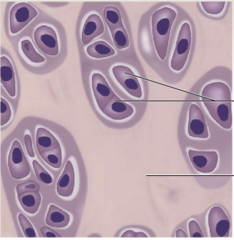
Fibrocartilage
-location : discs of knee joints, intervertebral discs
-function : tensile strength
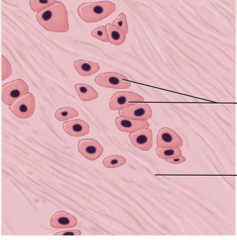
Elastic Cartilage
-location : epiglottis, ear
-function : maintains shape

Epidermis Five Layer
1. stratum corneum (most superficial)
2. stratum lucidum (thick skin only)
3. stratum granulosum
4. stratified spinosum
5. stratum basale (deepest layer)

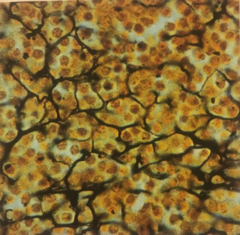
Loose Reticular Connective Tissue
-location : liver, kidney, spleen, bone marrow
-function : support
Dense Elastic Connective Tissue
-location : walls of blood vessels, between vertebrae
-function : recoil & strength

Types of Cellular Modifications
-cilia
-microvilli
-goblet cells
-keratin
Cilia
hairlike modification on the outside of cells that help movement

Goblet cells
modification that secretes mucus

Microvilli
modification that increase the cell's surface area

Keratin
modification outside of epidermis

Stratum Corneum
outermost layer of epidermis

Stratum Lucidum
2nd layer of epidermis found only in the thick skin

Stratum Granulosum
3rd layer of the epidermis

Stratum Spinosum
4th layer of the epidermis

Stratum Basale
deepest layer of epidermis

Papillary layer (Dermis)
outer layer of the dermis, directly beneath the epidermis

Reticular layer (Dermis)
inner layer

Subcutaneous layer (Hypodermis)
lowest layer of skin that is composed largely of fat

Epidermis
outermost layer of skin
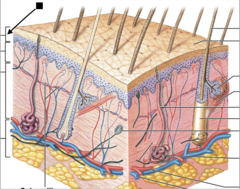
Hair shaft
portion of hair that projects above the epidermis

Sebaceous gland
oil-secreting gland in the dermis that is associated with hair follicles

Arrector pili muscle
muscle fiber attached to the underside & base of the hair follicle

Hair follicle
sac within which each hair grows

Lamellar corpuscle
detects pressure deep in the dermis

Eccrine sweat gland
glands that secrete sweat
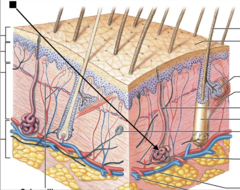
Fat
adipose

Subpapillary vascular plexus
network of small arteries in papillary layer

Cutaneous vascular plexus
lower network of blood vessels

Free Nerve Ending
generate sensations
