Axis/Fascicular Blocks/BBB
 Call Kai
 Learn
Learn Practice Test
 Spaced Repetition
 Match
Match Flashcards
 Knowt Play
1/23

There's no tags or description
Looks like no tags are added yet.
Name | Mastery | Learn | Test | Matching | Spaced | Call with Kai | Chat |
|---|
No analytics yet
Send a link to your students to track their progress
24 Terms
axis
direction of depolarization through the heart
vector
general direction of movement of depolarization
why does more energy go towards the left ventricle compared to right one
due to increased muscle mass
mean QRS vector
average of small ventricular vectors
a normal mean QRS vector points...
normally points DOWNWARD & to the patient's LEFT due to depolarizations of the LEFT VENTRICLE
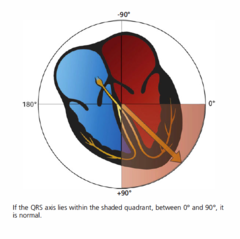
2hat is a normal axis?
0-90 degrees where positive measurements are on the bottom, negative on top
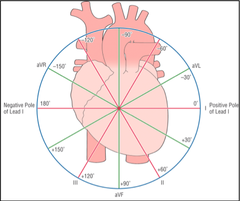
how is the heart displaced in tall, skinny pts?
heart displaced to the right
how is the heart displaced in obese or pregnant pts?
heart displaced to the left
how does the mean QRS vector change direction in a hypertrophied heart?
axis gets pulled in direction of the hypertrophy
How does the mean QRS vector change direction in an infarcted heart?
dead tissue does not depolarize so it swings the average of the mean QRS vector to the opposite side, away from the infarction
measuring the mean QRS vector can tell you...
-the position of the heart
-indication of any hypertrophy (points toward)
-information regarding infarction (points away)
when determining an axis, what leads are used?
lead I and aVF
using the "thumb" method, what thumb is what lead
lead I is right thumb and AvF is left thumb
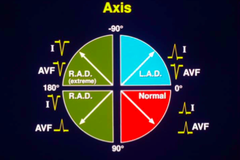
what is the thumb method for axis
-two thumbs up means normal axis
-right thumb up & left thumb down means left axis deviation
-right thumb down & left thumb up means right axis deviation
-two thumbs down means extreme right axis deviation
extreme right axis deviation can indicate a rhythm that is...
ventricular in origin or your limb leads are reversed
hemi-block/fascicular block
block in conduction through the heart
what are some potential causes of right axis deviation
-possible left posterior hemiblock
-normal in small children and thin adults
-severe RB hypertrophy
-PE
-advanced pulmonary lung disease
If there is a right axis deviation in a patient, and there is no reason for it (hypertrophy/PE/COPD), one should assume there is a...
left posterior hemiblock
if one has a left axis deviation without hypertrophy, one should assume that there is a...
left anterior hemiblock
how can one prove that there is a left anterior hemiblock with LAD?
look at lead II and if QRS is negative, it is definitely left anterior hemiblock
bundle branch block
conduction system block of the left or right bundle branch
what are some criteria to diagnose a BBB?
-supraventricular in origin
-QRS >0.12
what does BBB look like in EKG
rabbit ears
what is the indictor method to determine what side a BBB is on
-you look at a T wave and go down backwards
-if V1 is facing down, then it is left
-if V1 is facing up, then it is right