Walking Gait Cycle
 Call Kai
 Learn
 Practice Test
 Spaced Repetition
 Match
 Flashcards
 Knowt Play
1/45

There's no tags or description
Looks like no tags are added yet.
Name | Mastery | Learn | Test | Matching | Spaced | Call with Kai | Chat |
|---|
No analytics yet
Send a link to your students to track their progress
46 Terms
prior to assessing someones gait, we should first assess their
body posture
body posture is defined by
the alignment of body segments or the position of segments in relation to an activity or task
what is a plumb line
line down the center of the body dividing it in right and left halves- helping to determine if it is symetrical
cephalocaudal order
approaching posture assessment from head to toe
when assessing an individuals posture we should assess for symmetries
anteriorly, posteriorly and latterly
gait can be defined as
a manner or style of walking
stance phase
60% of gait cycle
1. heal strike
the heel makes contact with the ground
2. leading response
the entire plantar surface of the foot is on the ground
3. midtance
the weight of the body is positioned over the foot
4. terminal stance
the heel begins to lift off the ground
5. toe off
toe leaves the ground
swing phase
40% of gait cycle
6. Initial Swing
foot no longer in contact with the ground
7. mid swing
tibia is perpendicular with the ground
8. terminal swing
the heel prepares to make contact with the ground
posture assessment
1. assess alignment before motion
2. know what to look for while in motion
foot ankle assessment
position/direction of feet
arch type (visual observation & foot mapping)
calcaneal alignment
femoral anteversion
"Toe in"
Femoral Retroversion
"Toe Out"
femoral anteversion may be present in individuals with
cerebral palsy
both femoral retroversion and anteversion cause an increase in
articular cartilage and labrum becoming more prone to tearing
people with femoral retroversion and anteversion may experience
general knee pain
osteoarthritis of the hip
patellofemoral maltracking
joint instability
difficulty walking/ running
increased likelihood of tripping or falling
rearfoot/ calcaneal valgus
eversion of calcaneus
-pronator
rearfoot/ calcaneal valgus causes
elevated hip right, medial rotation, increased pressure in patellofemoral joint, depressed left hip
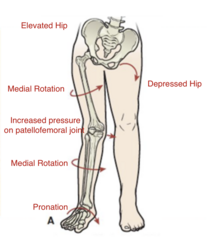
rearfoot/calcaneal varus
calcaneal inversion
-supinator
rearfoot/calcaneal varus causes
elevated/ depressed hip, lateral rotation, increased pressure of patellofemoral joint, supination

pes cavus
high arch
pes planus
flat foot
normal patellar tracking
superior and inferior pole of the patella "sits" close to the femur and above the tibia
patella baja
inferior pole of patella sits on tibial tuberosity
patella alta
superior and inferior pole of the patella sit above the distal aspect of femur (look for camel sign)
Insall-Salvati Ratio Normal
normal: Patella length = tendon length
Insall-Salvati Ratio Alta
tendon length > patella length
Insall-Salvati Ratio baja
tendon length < patella length
grenu valgum
knock knee
Genu Recruvatum
lock knee - knee hyper extension
genu varum
bow legged
Hip Postural Assessment
neutral pelvis
anterior tilt
posterior tilt
forward shifted pelvis
anterior pelvic tilt "lordotic back"
pelvis tilts forward pulls lumbar spine into hyper-lordosis
posterior pelvic tilt "flat back"
pelvis tilts backwards pulls lumbar spine flat
forward shifted pelvis "swayback"
upper truck shifts backward to compensate, hip joints hyper-extended, pelvis shifts forward, knees hyper-extended
anterior pelvic tilt
associated with tight hip flexors and weak abbs
posterior pelvic tilt
associated with tight ebbs and tight hamstrings
forward shifted pelvis swayback
tight hamstrings, weak abbs, knee ligament laxity, weak gluteus Maximus
Adam's forward bending test
definitive clinical screening test for scoliosis