Minoan, Mycenaean lecture video (Module 2)
 Call Kai
 Learn
Learn Practice Test
 Spaced Repetition
 Match
Match Flashcards
 Knowt Play
1/23

There's no tags or description
Looks like no tags are added yet.
Name | Mastery | Learn | Test | Matching | Spaced | Call with Kai | Chat |
|---|
No analytics yet
Send a link to your students to track their progress
24 Terms
Homer on Minoans
(Homer was writing in the 9the century so post facto):
On the island of Crete, lived King Minos.
Had a pretty sick palace
sponsored sport of bull-dancing (went into combat w/ bulls and survived by dancing over their backs)
Got people to participate (battling the minotaur) by having it as a mandatory tax for each island he controlled
minotaur was imprisoned in a labyrinth (build by architect Dadalus)
Theseus from Athens got help from the daughter of King Minos(Adradne)
killed minotaur
used thread he left behind to get out

Palace of Knossos, Crete, ca. 1700- 1400 BC:
Physical Attribute:
over 1,000 rooms
corridors connecting them looking like a labyrinth
Not fortified
probably because it's an island so all you need is to protect the shoreline
Minoan column
Arthur Evans sound sockets and partial columns figured that they were made of wood and were red
435 (top and bottom flipped)
all of the whole columns rn are re-constructed
post and lintel construction
(from top to bottom): Capital -> Shaft -> base
entasis = change in diameter of shaft from base to top (smaller @ bottom, larger @ top)
"cushion" capital
minotaur - composite form that represents a successful bull dancer
Arthur Evans - Brtisih archeologist that worked on the excavation of the Palace of Knossos (1900-1905)


King Minos’s throne room, labrys
Labrys = Axe
Tool Minoans used
Not used as a weapon
Stone making/carving
Construction
"labrys" maybe equals "labyrinth"??
On either side of the throne
Symmetry for the hero/rule
represents the opposite of chaos (controll)


(very basic)
Composite form: peacock/lion
symbolize King Minos

What Arthur Evans thought it would've looked like

Queen’s chamber: “dolphin” fresco:
Arthur Evans figured based on the size of the room it must've been for the monarch or queen
tail/fin
One of many references found to the fact that Crete is an Island
Realistically represented (swimming w/ other fish)
See how they went from swirls to flowers?
stages of development overtime


“Toreador fresco,” Knossos, 1450-1400 BC:
profile view
still a frontal eye
multiple pieces put together
showing the steps
Gold coins of this
Screenshot 2026-09-28 at 11.07.59 AM.png
Schema
entasis of Minoan Column
Archietecture in the human form
post and lintel


Snake goddess, Knossos, 1600 BC:
Many of these images
Minoan Column entasis?
Gold coins of this
outstretched hands
subduing of the snacks

“Cupbearers procession” fresco, Knossos, 1400 BC:
Arthur Evans found a little bit of detail and finished it
Bringing an offering in
walking forward
profile view w/ frontal eye
ritualized object to celebration
Schema
entasis of Minoan Column
Minoan content in Art:
Nature
Seasons
Celebrations
"everyday life"
Safe, prosperous island life


“Springtime” fresco, Thera, 1650 BC:
Physical Attributes:
Beautiful island life
Iris is growing
birds flying

“Fisherman” fresco, Thera, 1650 BC:
not a consistent profile view
maybe to emphasize how good of a fishing session he's had
Schema
Minoan Column

“Wrestlers” fresco, Thera, 1650 BC:
Physical Attributes:
Still some general beauty
deers
Overlapping (wrestlers)
convincing realism
Schema
yep the column again

Octopus vase, 1500 BC:
Physical Attributes:
made of clay
referencing their islands existance
their an island so octopus is fitting
octopus conforms to the curves of the vase
not frightening

Harvester’s vase, 1500 BC:
Physical Attributes
made of clay
clay is carved
sunken relief
people going to the harvest
olive harvest
smiling
celebration
More schema of columns

Citadel, Mycenae:
Fortified
only one entrance
warrior culture
walls 20ft thick
Heinrich Schliemann
Archaelogist of Mycenae and Troy
originally owned the Knossos site but Arthur bought it at his death
career focus on finding Troy and proving Homer
1876-1878

shaft grave circle, 1400 –1200 BC:
inside the city
fortified walls
Massive stones (took it very seriously)
90ft in diameter
shaft graves
burial w/ full sets of armor and weapons
Warrior culture
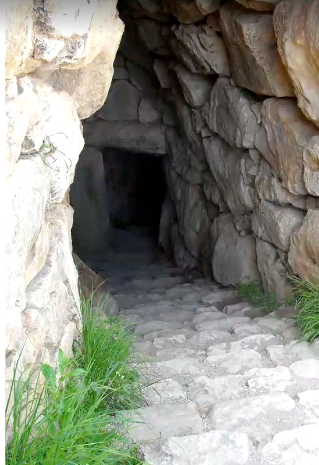
The pathways and even ceilings had these massive stones
Corbeled gallery, 1300-1250 BC
Achieved this w/ corbel; corbelling
190
179
moving away from post and lintel

Lions Gate, 1300-1250 BC:
Lion is symbolic to protecting the city
- propagandistic
Lion also representing the quality of the Mycenaen people (warrior)
Many lion references found throughout
Another civilization tried to erase the lions a bit
The column between the lions is a Minoan column
represents the defeat of the Minoan civilization
Arthur Evans used this as proof
Screenshot 2026-09-28 at 11.52.27 AM.png
propagandistic


“Treasury of Atreus,” Mycenae, 1300-1250 BC:
Named by Schliemann
Atreus
a king of Mycenae
father of Agamemnon, Menelaus
Sub-terrainian
Corbelling
Lintel stone above doorway (120 tons)
probably used leverage
410
inside
48 ft diameter
50 ft highest point
Beehive tomb
corbelled in the round
Many artifacts buried inside (below)


Funeral Masks, 1600-1400 BC:
Zoomorphism
- lion/human
- mane of the lion
Many found buried w/ people
Found in the Grave Circle
Repousse:
metal working technique
sheet of gold hammered against a form (wooden)
transfered over
clearly the gold is soft

Warrior vase, 1200 BC:
composite view
Handle is a lion's head
Really focused in on their armor and weapons and shields, etc (because that was really important to them)
avoided making it look Minoan and their schema

Dagger Blades, 1400 BC:
Ceremonial
never sharpens and made of bronze
Bronze w/ gold, silver inlay
found in grave circles
2 different people worked on these
Lions represented differently
One Minoan gold worker(looked better)
Mycenaean gold worker
Schema of the minoan human form
battle against Minoans
Overlapping
Motion

Vaphio cups, 1400 BC (found in Mycenae, crafted by Minoan metalworkers):
"How to capture a bull"
to dance or to battle with the bull
one above it shows a human being trampled by the bull
Success: one brings in a cow to distract the bull
then the human ties the bull
Repousse technique
Closing
Arthur Evans
practice archaeology of restoring
trying to keep it as close to the original condition as possible
Criticized for it
Heinrich Schliemann
**archaeology of preserving
maintaining the artifact in the condition it was found during excavation
Connoisseurship
making judgments about quality, skill, or excellence