Drug properties & optimization II 03 (3/3)
 Call Kai
 Learn
 Practice Test
 Spaced Repetition
 Match
 Flashcards
 Knowt Play
1/17

There's no tags or description
Looks like no tags are added yet.
18 Terms
Structure Property Relationships (SPR)
- How molecular structure influences key drug properties & performance
↳ Solubility, permeability, pKa, lipophilicity (LodP/LogD)
Correlate properties to structure
Understand how structural features influence molecular behaviour.
↳ Adding polar groups → may ↑ aq solubility
↳ ↑ing hydrophobic surface → can improve memb permeability
↳ Introducing EWG/EDG can shift pKa
Process of drug optimization
1. Start w a lead compound
2. Design & synth analogs: change 1 structural feature at a time
3. Measure potency & key D properties
4. Analyze results: identify which regions tolerate mod. & which changes impr/reduce biolo activity
5. Repeat process to optimize lead compound
Strategies used to optimize a lead compound
1. Addition/deletion of f-groups
2. Substitution of atoms or f-groups
3. Chain extension or contraction
4. Ring expansion/contraction
5. Structure simplification
Additions/deletions
- Add or remove atoms or f-groups from a lead compound
- Examine how these changes affect biolo activity & D properties
- Identify structural features important for activity

Substitutions
- Replace an atom or f-group
- Investigate effects on potency, selectivity & physicochem properties
- Sub's may change acidity, ionization, solubility or permeability

Isosteres
- Atoms or groups that maintain similar biolo activity & improve properties (ex: solubility, selectivity, metabolic stability
- Uses: f-group replacements, bioisoteric replacements
- Types: Classical and Non-classical

Classical isosteres
- Atoms or groups w similar valence e- arrangements and comparable size or bonding charac's
- Purpose:
↳ Investigate if a f-group is important for binding or biolo activity
↳ Explore changes in chem properties while retaining structural similarity

Non-classical isosteres
- Atoms or groups that may differ in size, shape, or electronic structure
- Can prod similar biolo int's despite structural diff's
- Purpose: maintain biolo activity while improving D properties

Chain extensions/contractions
- Add or remove atoms from a chain connecting 2 f-groups
- Changes distance & orientation btwn binding groups
- Purpose: Improve alignment w T's binding regions & ↑ biolo activity

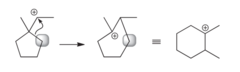
Ring expansion/contraction
- ↑ or ↓ # of atoms in a ring
- Ring size changes can affect molecular geometry + flexibility, orientation of binding groups & biolo activity
Structure simplification
- Simplify a lead compound by removing/modifying structural features not essential for activity
- Retain important binding features while ↓ing molecular complexity
- Benefits: easier synth & lower prod costs
- Ex: procaine has simpler structure than cocaine

Chirality (stereocentres)
Enantiomers may differ in potency, selectivity, metabolism or toxicity

Stereocentres can complicate drug development
- May require stereoselective synth or separation
- Can ↑ manufacturing complexity
Racemic mixtures (stereocentres)
- Equal amounts of 2 enantiomers
- Individual enantiomers should be evaluated

Importance of testing stereoisomers
- Biolo systems contain chiral molecules, ex: enzymes, receptors
- Enantiomers may interact diff. w these chiral T's
- Evaluate individual enantiomers for biolo activity & D properties
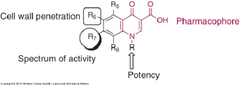
Pharmacophore
- 3D arrangement of features important for int. w a biolo T, not just individual contact points
- Identified via SAR & molecular modeling
- Guides D design
Use of pharmacophores
Diff molecular structures can share important pharmacophoric features & prod similar biolo effects (cocaine and procaine)
