Human Parasitology Exam 1 - M1-3
 Call Kai
 Learn
Learn Practice Test
 Spaced Repetition
 Match
Match Flashcards
 Knowt Play
1/58

There's no tags or description
Looks like no tags are added yet.
Name | Mastery | Learn | Test | Matching | Spaced | Call with Kai | Chat |
|---|
No analytics yet
Send a link to your students to track their progress
59 Terms
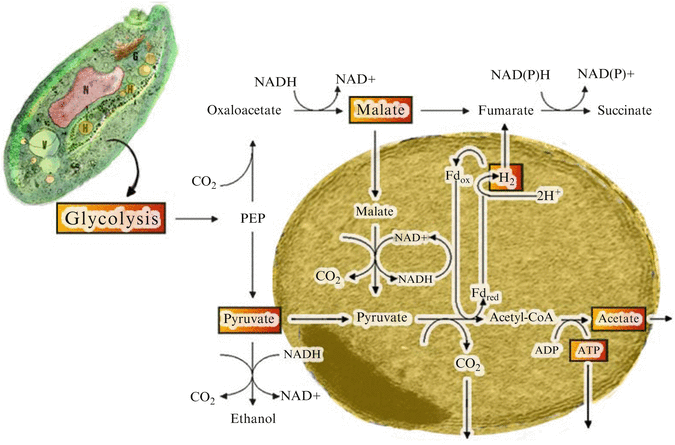
Hydrogenosome
Double membrane organelle in trichomonas parasites that performs anaerobic respiration with H+ as acceptor. Has hydrogenase which reoxidizes ferredoxin. ATP and acetate are produced as products
→ TRICHOMONAS
Metronidazole
Drug used to treat anaerobic parasitic infections (E. histolytica, G. lambila, and Trichomonas) that produces a toxic intermediate that destroys DNA and other macromolecules.
→ Activated by ferrodoxin-like flavo proteins or flavoprotein-like proteins
→ Reacts by maintaining the proton gradient that drives the drug’s uptake

Syngamy
Union of the enter cell when gametes fuse. Occurs in plasmodium
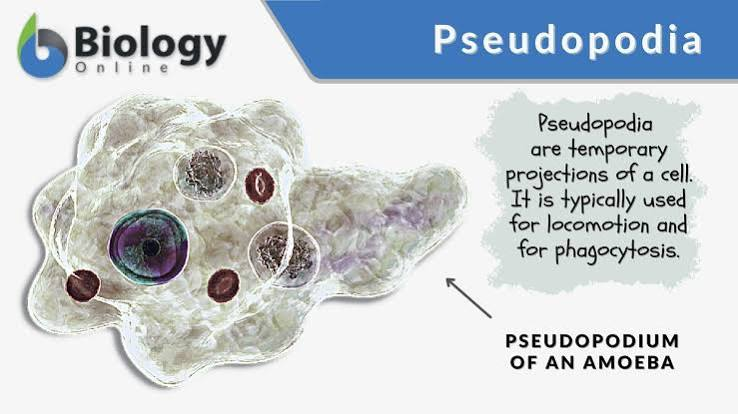
Pseudopod
Temporary arm-like projection of cell membrane that is filled with cytoplasm. Consist of actin filaments and may also contain microtubules and intermediate filaments
→ in ameabos
Plasmalemma (pellicle)
Thin Plasma Membrane found in mosts parasites. Also known as the ectoderm or outer membrane
Microtubules in the membrane
Found in the outer membrane and in most of the cytoskeleton. Helps provide structural support
Ectoplasm/Endoplasm
Type of cytoplasm found out and in organelles respectively.
Cytosome
The “cell mouth”. Found in balantidium. Specialized for phagocytosis, usually in the form of a microtubule-supported funnel or groove.

Contractile Vacuoles
Vacuoles seen in bacteria and other host cells. In Sarcodina and ciliates. Involved in water regulation.
Structures that mediate cell movement (3)
Flagella, Cilia, Pseudopodium
Flagella
Structure that mediates movement
May form auxiliary membrane attached to cell or are free standing structures on cell surface. Found in trypanosomes and giardia
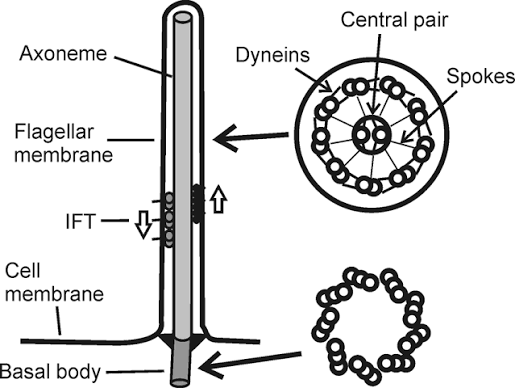
Flagellum/Cilia
Structure that mediates movement
Both have same composition and are continuous with the PM. Have tube with 9 doublets of microtubules and basal body. Radial spokes connect doublets while diene arms extend from the tubules.
4 Types of Pseudopodia
1 Filopodia 2 Lubopodia 3 Rhizopodia 4 Axopodia
Axostyle
Supplementary structure embeded along the longitudinal axis of the cytoplasm (some flagellates)
Costa
Rod-like structure that runs along the base of the undulating membrane
Pelta
Crescent shaped membrane in some flagellates (Trichomonas)
Cyts Functions (3)
1 Protect against unfavorable conditions
2 Site for morphogenesis and nuclear division
3 Infective or transmissible form
Vesicular Nucleus
Nucleoli-like body called the Karyosome that lacks DNA and is present in parasidic amoeba (like entamoeba histolytica). DNA is contained in ant compartments and has scattered chromatin inside
Compact Nucleus
Densely packed chromatin in nucleus, similar to higher order eukaryotes. In genus balantidium/ciliates
Major groups of E parasites (3)
Protozoa, Trematodes (Cestodes), Nematodes
Cyst Functions (3)
1 Protect against unfavorable external conditions
2 Site for morphogenesis and nucellar division
3 Invective or transmissible form
Vesicular Nucleus
Nucelli-like body with karyosomes that lack DNA. In parasitic amoeba, contains DNA in anticomplexans. Has scattered chromatin inside
→ Entamoeba histolytica
Compact nucleus
Densely packed chromatin, similar to structures in higher eukaryotes. Ciliates have macronucleus and micronucleus
→ genus Balantidium
Fission
Division that follows a sequence. 1 Organelles 2 Nucleus 3 Cytoplasm
Binary Fission
fission where each parent gives rise to two progeny and may result in Endodyogeny or schizogony
Endodyogeny
Type of binary fission where two daughter cells are produced inside of a mother cell.
→ Toxoplasma.
Schizogeny
Rapid organelle and nuclear divisions occur peripherally. Cytoplasm segments to form separate organism called Merozoites. Multinucleated cell is called the Schizoint or segmenter
→ Plasmodium
Conjugation
Type of sexual reproduction where specialized cellular reproduction involving nucellar exchange and union
→ ciliates
Syngamy
Type of sexual reproduction where union of the entire cell where gametes fuse
→ Plasmodium
Serology
Type of diagnosis technique where anti-amoebic antibodies are detected in the blood or serum or feces. (typically only works of the parasite has entered the blood stream)
Hyperplasia
Disease where excessive cell replication thickens cell mucosa
→ E. histolytica

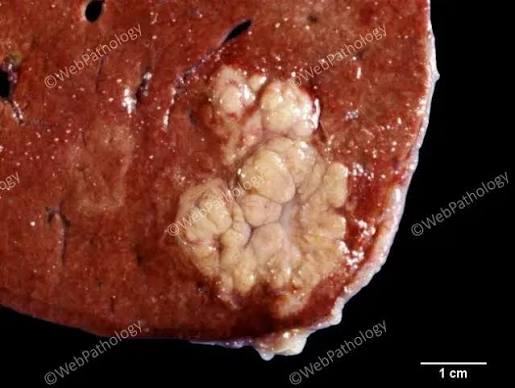
Amebic Liver Abscesses
Where trophozoite cells destroy hepatic (liver) cells. Carriers can be asymptomatic to this.
→ E. histolytica

Pulmonary Amebiasis
When trophozoites travel from liver to lungs and destroy lung cells.
→ E. histolytica
Brain Abscess
When trophozoite cells make their way to the brain and destroy brain cells
→ E. histolytica

genitourinary amoebiasis
RARE - infection of the kidneys, bladder, or genitalia
→ E. histolytica
Galactose-N-acetylglucosamine (Gal-NAc) BINDING LECTIN
Lectin expressed on the surface of some parasites (E. histolytica) that make parasites more mobile when they contact epithelial cells.
-triggers epithelial cell death from amoebic cytotoxicity
-Only in pathogenic species
-Leads to recruitment of neutrophils (further destroys colonic mucosa)
Gal-NAc
terminal carbohydrate forming the antigen of blood group A in HUMAN CELLS.
-involved in cellular communication
-Extra exposure can inhibit endocytosis
Transmembrane proteins OR GpI-anchored proteins
Surface proteins that mediate pathogenies by targeting cell lysis acter direct contact with epithelial cells.
-EX: galactose / N-acetyl galactose inhibitor lectin

Amoebapores
Ionophore-Like proteins that induce pore-formation in neutrophils and epithelial cells. Released from intracellular vesicles controlling other mediators (like cytosol prokinase)
Cysteine proteases
Proteins released by trophozoites that cleave host cell proteins
Acid phosphatases
Proteins released by trophozoites that target host cell phospho-proteins (like SAP and MAP)
Primary amebic meningoencephalitis
Brian infection that causes headaches, fever, and stiff neck (typical meningitis sympotoms)
Short incubation of 5-7 days
→ Naeglaria flowery
Amebostomes
specialized sucker-like appendages that nibble away at host cells. Known to release proteolytic enzymes.
→ Naegleria fowleri
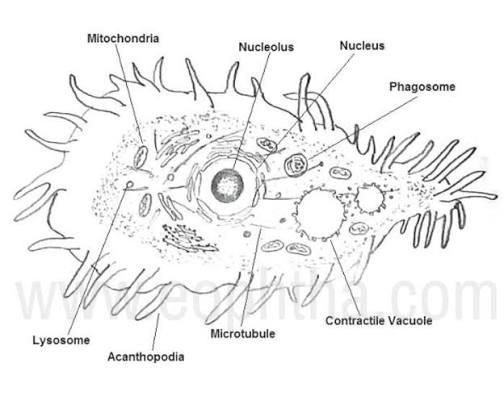
Acanthopodia
Pointed pseudopodia expressed in Acanthamoeba trophozoites

Acanthamoeba Keratitis
RARE eye infection of the cornea caused by a microscopic, free-living single-celled amoeba
→ acanthamoeba
Granulomatous amoebic encephalitis
life-threatening central nervous system (CNS) infection caused by exposure of amoeba through skin contact
→ Acanthamoeba
IgA in parasitic infections
IgA mediates some cellular response to parasitic infections like Giardia. IgA is secreted and translocate through intestinal lumen when its produced by Intestinal Epithelial cells
-IgA is gut antibody isotype
-Expression activated when alert cells release cytokines and L6

Lamina Propria
Thin layer of connective tissue that forms part of the moist linings known as mucous membranes or mucosae, which line various tubes in the body (Gastrointestinal tract)
Nitric Oxide and Antimicrobial peptides
Molecules released by cells to help mediate response to giardia
IgA Protease
Proteases released by Giardia to help deal with host antibodies
CD59-like molecules
Molecules expressed on the surface of E. histolytica that disguise them as human WBC/H-cells
Variable surface proteins
Allow cells to vary their response to antigens and avoid existing antibodies and respond to immune pressure/secretions
-Giardia
Giardia Arginine Consumption
Giardia consume/compete for Arg with host in Jejunum
-Arg enduces encystation
-Arg needed for giardia cell wall
-Arg needed in host to make NO
Trichomonas vaginalis immune resistance
Trichomonas resists host immune response of complement and neutrophils. resists Neutrophil oxidative burst and results in vaginal disharge, vuvovial soreness and irritation
Dysuria
Swelling of the male prostate gland
→ Trichomonas vaginalis
Gestational trichomoniasis
Vaginal Emphysematosa
gas-filled pockets to form in the walls of the vagina
→ trichomonas vaginalis
metronidazole
Drug to treat anaerobic parasites: E. histolytica, G. lambila, Trichomonas
Activated when reduced by FERRODOXIN-like proteins or flavoprotein-like proteins. Produces a toxic intermediate and maintains a electrochemical gradient by this reduction that drives more drug uptake
Balantidal dysentery
acute or chronic gastrointestinal illness caused by Balantidium coli which causes Intermittent watery diarrhea with blood or mucus in stool