Chapter 11: Language
 Call Kai
 Learn
 Practice Test
 Spaced Repetition
 Match
 Flashcards
 Knowt Play
1/56

There's no tags or description
Looks like no tags are added yet.
57 Terms
True or false: the primary brain region involved in understanding speech is Broca’s area
False
Which allows for a speaker to convey more than what they actually say?
Pragmatics
Which refers to the concept of teasing apart complex phrases?
Parsing
Drawing a conclusion by connecting an object in one sentence to an object in another sentence
Anaphoric inference
Drawing a conclusion about methods that occurs while reading text or listening to speech
Instrument inference
Drawing the conclusion that events described in one sentence were prompted by events in a previous sentence
Casual inference
System of communication that enables us to express our feelings, thoughts, ideas, and experiences
Language
Idea that there are principles specifying the permissible ways for arranging words and phrases in a system of communication
Rule-based nature of language
Field concerned with the mental and emotional study of language
Psycholinguistics
Knowledge of what words mean, how they sound, and how they relate to other words
Lexicon
Meanings of words and sentences in a language
Semantics
Meaning of words
Lexical semantics
Phenomenon of faster reading time for words that are highly common compared with unusual words
Word frequency effect
Process of perceiving individual words with the continuous flow of words
Speech segmentation
Situation when a word can have more than one meaning
Lexical ambiguity
Situation where some definitions of words occur more frequently than others
Meaning dominance
Situation when a word has more than one meaning and one meaning is more likely
Biased dominance
Situation when a word has more than one meaning and all meanings are equally likely
Balanced dominance
Set of rules for combining words into sentences
Syntax
Condition characterized by labored ungrammatical speech and difficulty in understanding some types of sentences
Broca’s aphasia
Mental grouping of words in a sentence into phrases
Parsing
Group of words that appears to mean one thing but ends up meaning something else
Garden path sentence
Situation in which the meaning of a sentence is unclear because multiple meanings are possible
Temporary ambiguity
“Rule of thumb” that provides a best-guess solution to a problem
Heuristic
Principle that a person encountering a new word assumes it’s part of the current phrase
Late closure
Determining how subjects process information in a scene while responding to specific instructions about it
Visual world paradigm
Information in one part of a text is related to information in another part
Coherence
Process by which readers create information that is not explicitly stated in the text
Inference
Mental representation of what a text is about
Situation model
Idea that a speaker should construct sentences that contain both known information and unknown information
Given-new contract
Set of knowledge, beliefs, and assumptions shared between two speakers
Common ground
Synchronization between partners in a conversation
Entrainment
Idea that a statement with particular construction leads to a subsequent statement being similarly constructed
Syntactic priming
Ability to understand what others think, feel, or believe
Theory of mind
Pattern of intonation and rhythm in spoken language
Prosody
First note of a scale in a particular key
Tonic
Condition, present at birth, in which people have problems with music perception
Congenital amusia

Determine whether each example represents the principle of late closure or the constraint-based approach to parsing

True or false: disfluencies only disrupt communication
False

Determine whether each example represents simultaneous or sequential bilingualism

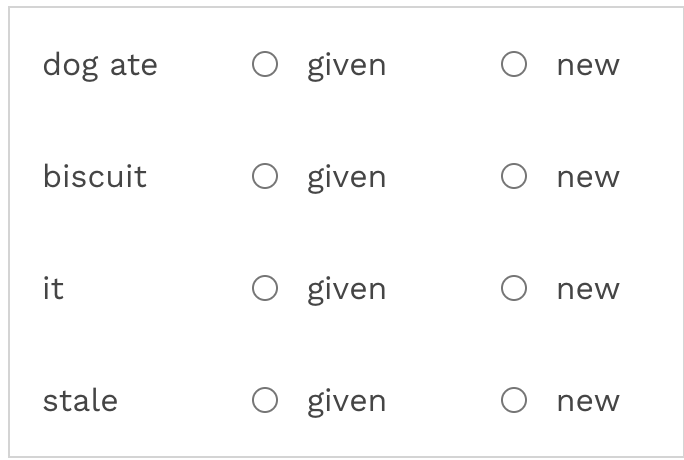
Determine whether each piece of information is “given” or “new” in the following sequence: The dog ate a biscuit. It was stale.


According to the graphs shown in the image, which is true about bilingualism?
Accents and grammar were negatively impacted by the age of learning a second language
Which of the following are cognitive advantages of bilingualism?
Cognitive reserve
Code switching
Which species has the brain physiology required to create and comprehend complex language?
Humans
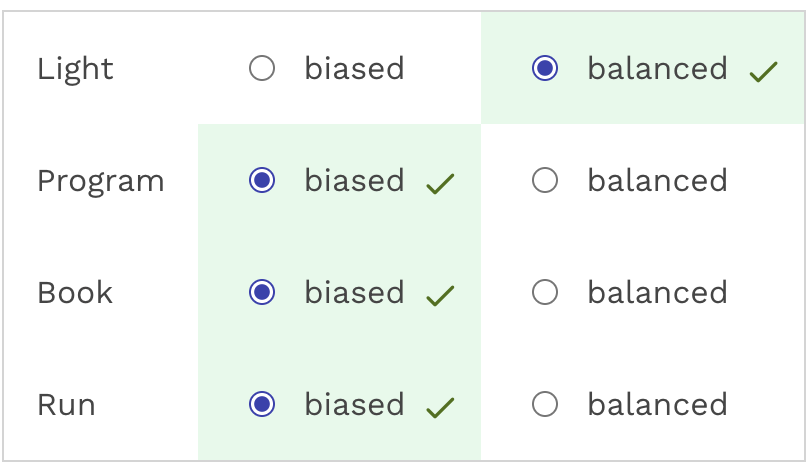
Determine whether each word has biased or balanced dominance
Light, program, book, run
To correctly group words in a sentence, which type of punctuation is used?
Comma
Haley has just woken from a restful night of sleep and greets her mother by uttering, “Hi, Mama! Want cereal.” Based on what is known about language development, how old is Haley?
24 months


Which brain region has been shown to activate in both language and music?
Broca’s area
Based on the observation, “Ever since I can remember, the sun has risen every morning” and the conclusion “The sun is going to rise tomorrow,” which of the following type of reasoning can be inferred?
Inductive reasoning


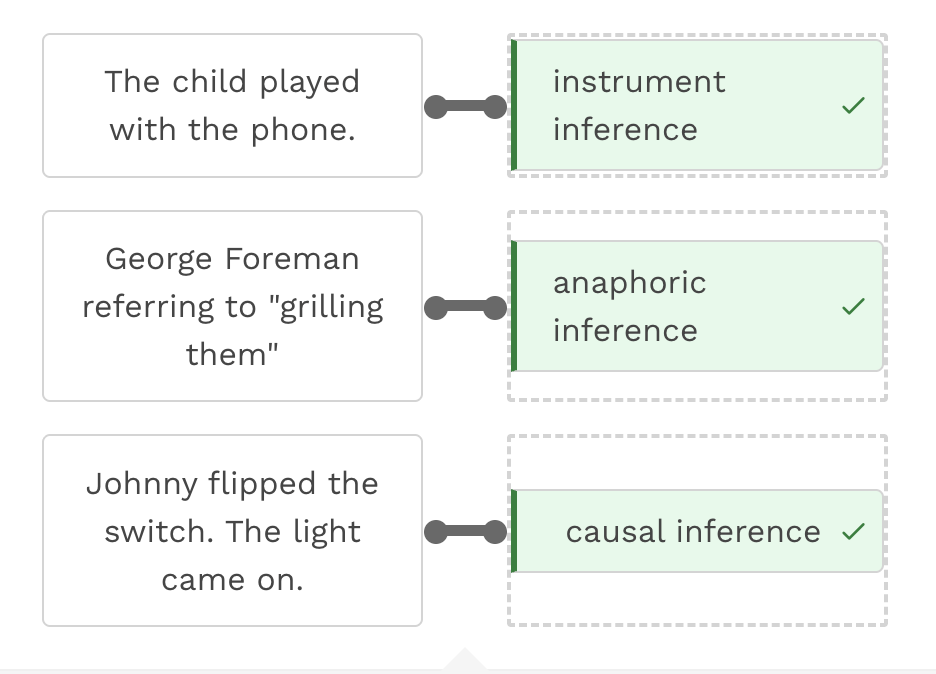
Determine what type of inference is provided in each example
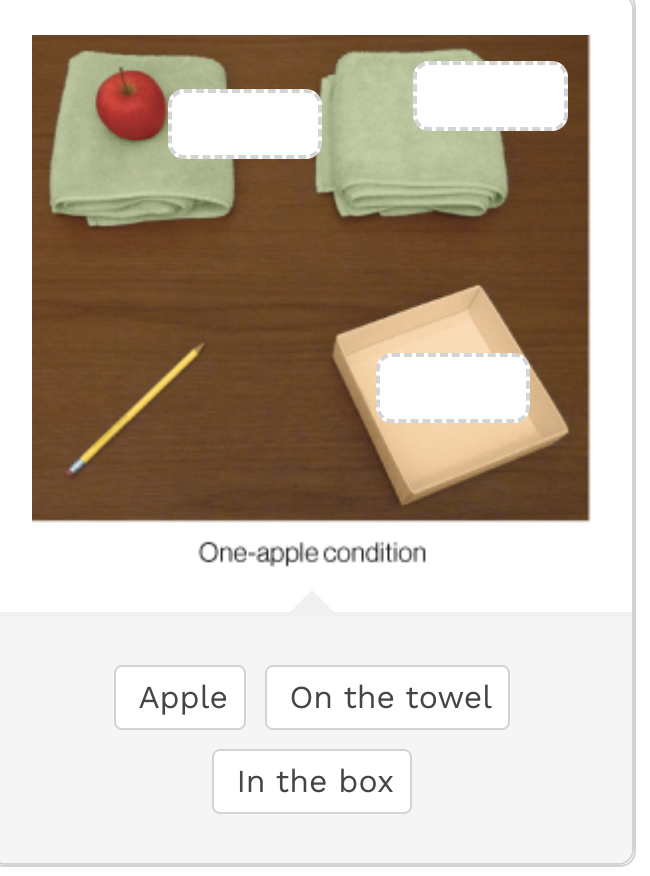
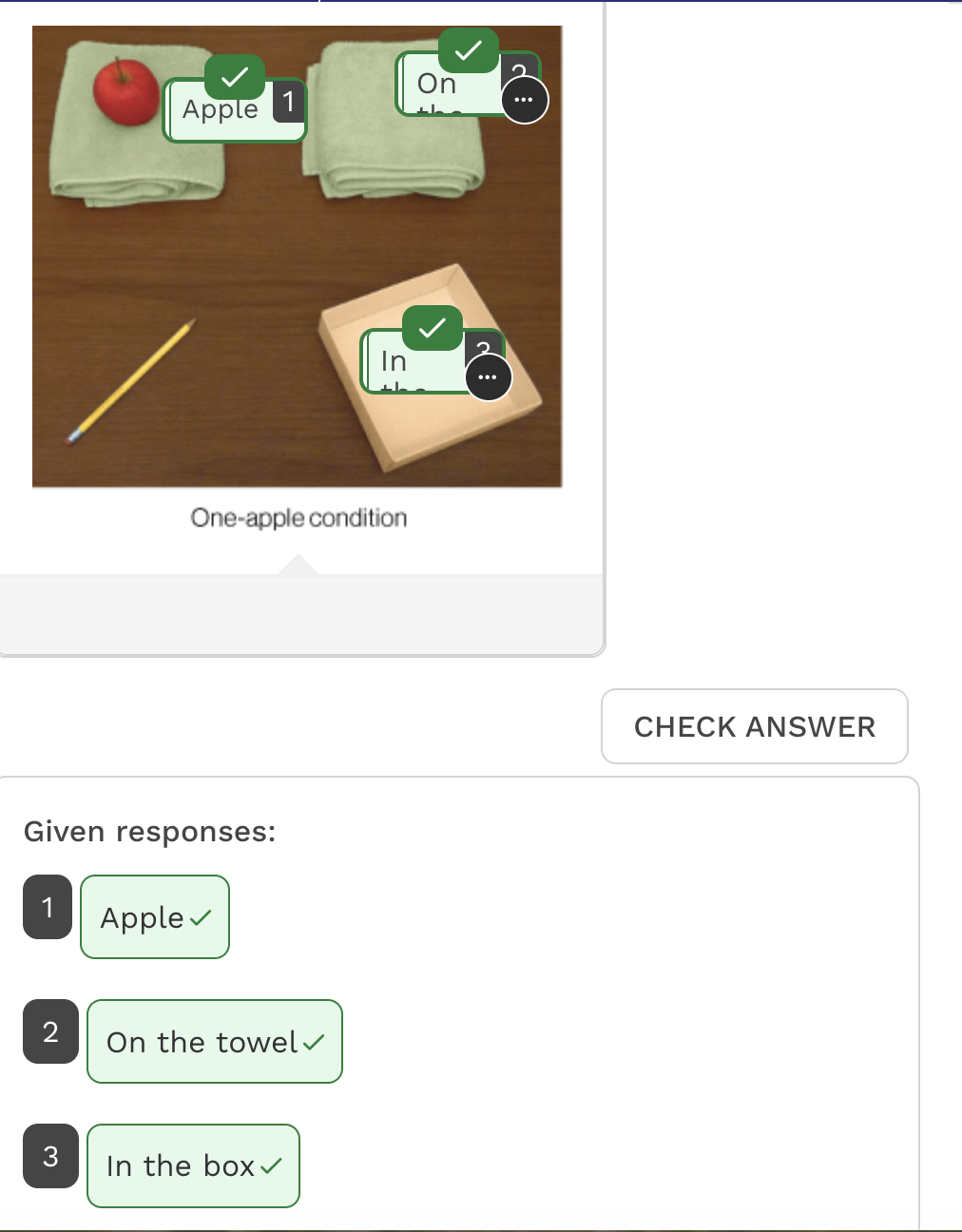
Label the location of eye movements in the image when participants were told to “Put the apple on the towel in the box.”
Which phrase will be parsed more quickly? Defendant examined or evidence examined?
Evidence examined
Which are features of entrainment?
Gestures
Body position
Grammar


True or false: syntactic coordination involves only the use of voice inflection in spoken conversations
False