Human Factors midterm
 Call Kai
 Learn
Learn Practice Test
 Spaced Repetition
 Match
Match Flashcards
 Knowt Play
1/55

There's no tags or description
Looks like no tags are added yet.
Name | Mastery | Learn | Test | Matching | Spaced | Call with Kai | Chat |
|---|
No analytics yet
Send a link to your students to track their progress
56 Terms
Definition of Psychology – Module 1a
Science of Behavior and mental processes of
humans.
Definition of Aviation Psychology
Human behavior and performance in an aviation setting.
Specific goals of Aviation Psychology
-Safety - To reduce errors by humans in aviation settings.
-Efficiency - To increase productivity.
-Comfort - To increase the comfort of both the workers and
their passenger
APA’s definition of Scientific Method
“the set of procedures used for gathering and interpreting objective information in a way that minimizes error and yields dependable generalizations.”
Different psychological approaches
Behaviorist Approach – How the environment affects behavior?
Cognitive Approach – Studies mental processes and is concerned with understanding
how people think, remember, and reason.
Biological Approach – Studies internal physiological processes and how they influence
behavior.
Social Approach – How we interact with other people and emphasizes the individual
factors that are involved in social behavior, along with social beliefs, and attitudes.
Developmental Approach – Emotional development, social development, cognitive
development, and interactions between them.
Humanistic Approach – Focuses on individual experiences, rather than people in
general.
What is a Model?
Simplified representation of reality
SHEL Model
SHEL Model
Originated by Edwards (1988)
Later Modified by Hawkins (1993)
Components:
Software – Procedures, Manuals, Checklists, and Literal Software
Hardware – The physical system (aircraft, ship, operating
suite) and its components
Environment – The situation in which other elements (L, H,S) operate, including working conditions, weather, organizational structure, and climate
Liveware – The people (pilots, flight attendants,
mechanics, etc)
b. Dreyfus & Dreyfus (1986) – Levels of developing expertise
Novice – Learns basic facts, terminology, and rules and how
they are applied in well-defined circumstances
Advanced Beginner – Begins to develop a feel for rules
through repeated practical application. The student begins to
understand the use of concepts and rules in situations that
are similar to those in prior examples.
Competence – Has a deep enough understanding of the rules
to know when they are applicable and how to apply them in
novel situations.
Proficiency – Has a refined and internalized sense of rules.
Expert – Produces increasingly abstract representations and
can map novel situations to the internalized representations.
c. Fitts & Posner (1967) – Phases of Skill Acquisition
Three Phases to Skill Acquisition:
Cognitive Phase: Characterized by slow, declarative learning
or primarily verbal information.
Associative Phase: Characterized by the detection and
elimination of errors in performance, and the strengthening of
connections.
Autonomous Phase: Characterized by automated and rapid
performance, requiring less deliberate attention and fewer
resources.
d. Wickens Model
Wickens Model
Discrete Stages for the processing of information Provision of both a working memory and a long-term memory
-Continuous Feedback Stream
-Attention resource component
Limited attention store – Humans must allocate among all
the ongoing tasks.
Attention – Selective Nature
8. Accident Causation Model - Swiss Cheese Model – Module 1b

1. Basic Research Vs. Applied Research – Module 2a
Basic Research – How a human brain perceives and
processes information?
Applied Research – How that understanding could be
used in the design of display systems or developing tests
2. Independent Vs. Dependent Variables
Independent variable (IV): The variable you change or use to explain or predict something.
Dependent variable (DV): The variable you measure to see whether it changes in response to the independent variable.
Example (aviation): Studying how fatigue affects pilot performance.
Independent variable: Amount of sleep a pilot gets.
Dependent variable: Pilot performance.
Continuous Vs. Categorical Variables –
Continuous variables: Numerical measurements that can take many different values, including decimals.
- Examples: Flight time (2.5 hours), temperature (18.7°C), reaction time (1.42 seconds).
Categorical variables: Variables that place information into specific groups or categories.
- Examples: Pilot certificate (student, private, commercial), aircraft type (Diamond, Cessna, Piper), weather conditions (VFR, IFR).
4. Experiments – Textbook Section 2.7.1 Page 29
An experiment is a study in which researchers deliberately change or manipulate an independent variable to see how it affects a dependent variable.
Example (aviation): Researchers randomly assign pilots to get either 4 or 8 hours of sleep, then measure their reaction times in a flight simulator
5. Quasi-Experiments – Textbook Section 2.7.2 Page 30
A quasi-experiment is a study that examines the effect of something without randomly assigning participants to groups.
Example (aviation): Researchers compare the performance of pilots who get 4–5 hours of sleep with pilots who get 7–8 hours of sleep.
6. Correlation – Textbook Section 2.7.3 Page 30
Correlation describes the relationship between two variables. It tells you how they change in relation to each other.
There are three main types:
Positive correlation: Both variables tend to increase together. Example: More flight experience is associated with higher performance scores.
Negative correlation: One variable increases while the other tends to decrease. Example: More fatigue is associated with slower reaction times.
No correlation: There is no clear relationship between the variables. Example: A pilot's shoe size and their flight performance.
Descriptive Statistics –
Measures of Central Tendency
Mean - Average
Median – Ranked Data
Mode - Frequency
Continuous Scale – Mean & Median
Categorical Scale – Mode
Measures of Variability
Standard Deviation – Average deviation from the mean
Variance – Squared differences
Correlations
Relationship between two variables
Both variables – Continuous
Varies between -1.0 to +1.0
Inferential Statistics – Module 2
Inferential statistics use information from a sample to draw conclusions about a larger population.
-A p-value below 0.05 is a commonly used cutoff for statistical significance.
Definition of Physiology – Module 3a
a branch of biology that deals with the functions and activities of life or of living matter… and of the physical and chemical phenomena involved
Definition of Aviation Physiology – Module 3a
the study of human systems’ integrated functions and the processes by which they maintain bodily functions
Normal environment Vs. Environmental conditions – Module 3a
Normal Environment – at sea level and no unusual forces
Environmental conditions – an airplane at an altitude, with g-forces exerting loads
in unusual directions
Person: Drugs, alcohol marijuana
Altitude effects: Lack of Oxygen and Pressure – Module 3a
Hypoxia.
Partial pressure of oxygen decreases – The human body has
increasing difficulties in absorbing sufficient oxygen to
maintain bodily functions
Time of Useful Consciousness (TUC) – Module 3a
TUC – Maximum time that a pilot has to make and carry out
decisions at a given altitude without supplemental oxygen.
-As altitude increases above 10,000 feet – the symptoms of
hypoxia increase in severity and the TUC decreases
6. Table – Effect of Altitude on TUC – Module 3a

7. Causes of hypoxia – Module 3a
Pilots who had been flying for some time or just above 10,000 feet without
supplemental oxygen.
• Malfunctioning or misuse of supplemental oxygen.
8. Symptoms of hypoxia – Module 3a
Cyanosis (Blue fingernails and lips)
• Headache
• Decreased reaction time
• Impaired judgement
• Euphoria
• Visual Impairment
• Drowsiness
• Lightheaded or dizzy sensation
• Numbness
9. Types of hypoxia – Module 3a
Hypoxic Hypoxia, Hypemic Hypoxia, Stagnant Hypoxia, Histotoxic Hypoxia
10. Stages of hypoxia – Module 3a

11. Blocked Eustachian Tube – Module 3b
Expansion of gas trapped in the middle ear – Ear and Sinus Pain Temporary reduction in hearing
12. Sinus block – Module 3b
-FREQUENT DURING DESCENT. DONT FLY IF SICK, Slowing or stopping the
descent until the pressure inside the sinus equalizes with the external pressure
13. Decompression sickness – Module 3b
Decompression sickness – Dissolved nitrogen is released resulting from a decrease in atmospheric pressure
-At least a 4-hour waiting period after scuba
diving (no required decompression before flying
to a cabin altitude of 8,000 feet or less
• 24-hour wait after dives requiring
decompression for altitudes above 8,000ft
14. Definition of Fatigue – Module 3b
“Difficult to define”, BUT on the slide show quotes this: “a condition characterized by increased discomfort with lessened capacity for work, reduced efficiency of accomplishment, loss of power or capacity to respond to stimulation, and is usually accompanied by a feeling of weariness and tiredness
15. Chronic Vs. Acute Sleep Deprivation – Module 3c
Chronic sleep deprivation – Accumulative effects of
restricting sleep to less than 8 hours daily over an
extended period
• Acute sleep deprivation – A single period of enforced
wakefulness (24-36 hours)
16. Symptoms of Fatigue – Module 3c

17. Circadian Rhythms – Mo
your body's natural 24-hour internal clock that coordinates physical, mental, and behavioral changes
1. Definition of Ability – Module 4a
Definition – Developed skill, competence, or
power to do something, whether mental or
physical (Coleman, 2001)
2. Definition of Intelligence – Module 4a
Intelligence – an aggregate of many different but interrelated,
cognitive processes and abilities
3. Fluid and Crystallized Intelligence – Module 4a
Fluid Intelligence – Capacity to reason and solve novel problems, independent of
any knowledge from the past.
Crystallized Intelligence – Capacity to use skills, knowledge, and experience
Crystallized Intelligence – One’s vocabulary and general knowledge with regard to
their age
4. Three strata of Cattell-Horn-Carroll Theory of Cognitive Abilities – Module 4a
Stratum I: Includes narrow, specific abilities
Spelling ability Speed of reasoning
Stratum II: Includes group-factor abilities
Fluid Intelligence Crystallized Intelligence
Stratum III: A single general intelligence factor
5. Top-rated pilot ability on USAF pilot ratings – Module 4a
Situational Awareness 4.88
6. Abilities of RPV operators – Module 4a
Oral and written
comprehension Communication
. Definition of Personality and Traits
Merriam-Webster Dictionary – “the totality of an individual’s
behavioral and emotional characteristics.”
Dictionary of Psychology – “The sum total of the behavioral
and mental characteristics that are distinctive of an
individual.”
Personality - the sum of a large number of personality traits –
Habitual patterns of behavior, thoughts, and emotions.
Traits – relatively stable over time – Differ across individuals,
and they influence behavior.
8. Eysenck (1997) Model – Three major personality traits – Module 4b
Personality – Three major traits
Neuroticism – an individual’s tendency to become upset or emotional
Extraversion – the outward projection of one’s personality through
gregarious, outgoing, sociable behavior
Psychoticism – personality pattern typified by aggressiveness and
interpersonal hostility
9. Five-factor model – Five Basic Dimensions- Module 4b
Extraversion
Agreeableness
Conscientiousness
Neuroticism
Openness to Experience
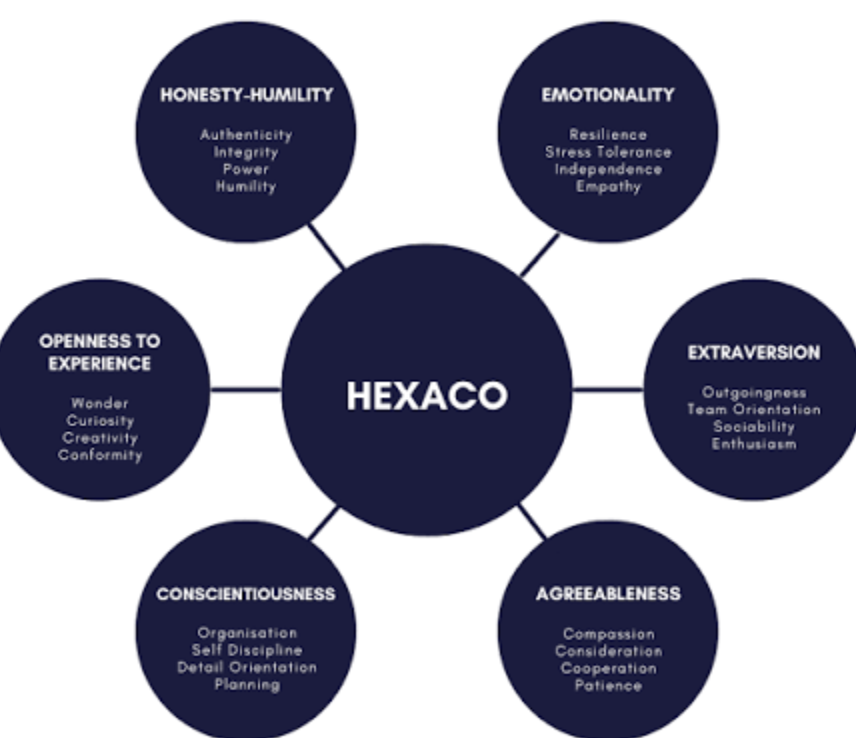
10. HEXACO Model – Six dimensions – Module 4b
job description
activities or tasks to be performed
Person specification
Skills, Expertise, Knowledge, and other physical/personal qualities
Civilian Pilots
Cognitive abilities, psychomotor and sensory abilities
Cooperative/social skills domain – Stress, communication,
decision-making
Military Pilots
Most important – situational awareness, memory, motivation,
reasoning
Least important – reading comprehension and writing
Both military and civilian pilots
Cognitive and Social Skills - Important
Leadership – low rating for military pilots
Civilian pilots – cooperative and social skills – High rating
UAV/RPA Pilots
Same abilities, skills, and traits as regular military pilots
Two additional abilities
Time-sharing ability
Person-environment fit
Work-Sample Test –
Less comprehensive approach
Candidate – performs a similar task or the same task as the person would do as part of the job
Prediction of behavior
Best practices: Standardized scoring rules - performance
Predictors – Pilot Selection
Written tests
Knowledge of aviation regulations
Flight procedures
Scenario-based assessment in flight simulation training device
(FSTD)
Airlines
Off-the-shelf computerized tests
In-house custom-developed assessments
Four types of reliability
Test-retest reliability – the degree to which scores on an instrument
at time 1 and time 2 are similar
Parallel form of reliability – the degree to which scores on version 1
and version 2 of an instrument are similar
Internal consistency – the degree to which the items comprising the
instrument are homogenous and consistent with one another
Inter-rater reliabilit
Selection Process Utility
Utility: How useful a hiring test is for helping an organization reach its goals.
Employee success: How many new employees successfully complete training and perform well on the job within a set time.
False positive rate: How often a hiring test incorrectly predicts someone will succeed when they actually do not.
Costs: The money required to create and administer the hiring test.
Performance monitoring: Management regularly checks employee performance and compares the benefits of the hiring test to its costs.
Fairness in Selection
Discrimination laws: Many countries have laws against discrimination based on gender, race, and other protected characteristics.
Fairness in pilot selection: Making sure pilot hiring and selection processes treat applicants fairly.
Predictive validity: A selection test should predict job performance equally well across different applicant groups.
Adverse-impact ratio: Compares the pass rates of minority groups with the pass rate of the majority group.
Formula: Minority group pass rate ÷ Majority group pass rate.
- Employer responsibility: Employers must evaluate whether their selection process creates unfair disadvantages for certain groups.
Best practices
Check pass rates for each demographic group based on the test's cutoff score.
Compare alternatives, such as changing cutoff scores or the weight given to different test sections, and examine how they affect predicted job performance and selection rates for each group.
Document why the cutoff scores were chosen and why the final selection method was used.