Genetics: Genetic Analysis
 Call Kai
 Learn
 Practice Test
 Spaced Repetition
 Match
 Flashcards
 Knowt Play
1/65

There's no tags or description
Looks like no tags are added yet.
66 Terms
genes
specific segment of DNA encoding for information
diploid
an organism containing two sets of chromosomes, one set inherited from each parent.
chromosomes
structures made of DNA that carry genetic information and exist in pairs in diploid organisms.
alleles
variants of genes with unique sequences that can result in different traits or characteristics.
autosomal recessive trait
both alleles are needed to display the phenotype
autosomal dominant trait
only one allele is needed for the phenotype to be displayed
genotype
genetic constitution that describes the specific genes the organism has
phenotype
physical characteristics from the genes (genotype)
DNA markers
particular region of genome seen to be inherited and linked to a trait
DNA mutation: point mutations
small-scale mutation: a change in a single base pair or small number of nucleotides
substitution (miss-sense, nonsense, silent), insertion, deletion, frameshift
DNA mutation: point mutation: missense
changing codes into a different amino acid
DNA mutation: point mutation: nonsense
changing into a premature stop codon resulting in a short, nonfunctional protein
DNA mutation: point mutation: silent/synonymous
changing the codon but it codes for the same amino acid so there is no change on the protein level
DNA mutation: point mutation: insertion
extra base pairs added
DNA mutation: point mutation: deletion
base pairs are removed
DNA mutation: point mutation: frameshift
insertions/deletions that are not in multiples of three so the reading frame shifts
DNA mutation: chromosomal mutations
large-scale mutation: altering large segments of DNA or the entire chromosome
duplication, inversion, translocation, chromosomal deletion
DNA mutation: chromosomal mutation: translocation
pieces of non-homologous chromosomes break off and swap places
germline mutations
mutation in egg or sperm cells and is hereditary
somatic mutations
mutation in non-reproductive body cells and are not inherited
Mendel Law of Dominance - Third Law
when there are two different alleles for a gene, one will determine the physical trait (and be dominant) over the other that has no noticeable effect (which is recessive)
Mendel Law of Equal Segregation - First Law
Every diploid organism has two alleles for each trait (one from each parent) and each gamete from this organism will have an equal probability of carrying one allele over the other
Mendel Law of Independent Assortment - Second Law
Unlinked genes for separate traits are assorted independently during forming gametes during meiosis (RY, Ry, rY, ry)
test cross
R? x rr to determine what the ? is in the individual with the dominant phenotype (it can be RR with kids 100% R phenotype or Rr with 50:50 Rr:rr)
dihybrid cross
cross between individuals with heterozygous genes (9:3:3:1)
Mendelian/simple inheritance
trait is controlled by a single gene with clear dominant/recessive patterns (not needing many genes and environmental factors)
independent events
events where the outcome of one doesn’t impact the other (similar to inheritance of unlinked genes)
product rule
product rule for producing inheritance
probability of 2+ independent events can be determined by MULTIPLYING individual probabilities of each event
P(A and B) = P(A) * P(B)
e.g. rolling a 3 and then a 5 with one dice
example question to predict inheritance: in a cross between AabbCC x AaBbcc, what is the probability an offspring is AAbbCc assuming unlinked genes?
1/8
Aa x Aa for AA = ¼
bb x Bb for bb = ½
CC x cc for Cc = 1
¼ x ½ x 1 = 1/8
mutually exclusive
events where only one or the other even can occur at one time
or two events occurring at the same time but not affecting each other’s outcomes
addition rule
addition rule for predicting inheritance
probability that any of several mutually exclusive event will occur is the sum of the event
P(A or B) = P(A) + P(B)
e.g. rolling a 3 or 5 on one die
example question to predict inheritance: in a cross of AabbCC x AaBbcc what is the likelihood an offspring has all dominant traits?
3/8
Aa x Aa for AA or Aa = ¼ + ½ = ¾
bb x Bb for Bb = ½
CC x cc for Cc = 1
¾ x ½ x 1 = 3/8
Addition Rule for NOT mutually exclusive events in predicting inheritance
not mutually exclusive means they overlap and we need to subtract the probability of both occurring
P(A or B) = P(A) + P(B) - P(A and B)
e.g. Huntington’s disease and Marfan syndrome = possible to have one or the other, or both
pedigree
trace inheritance patterns and determine the type of inheritance
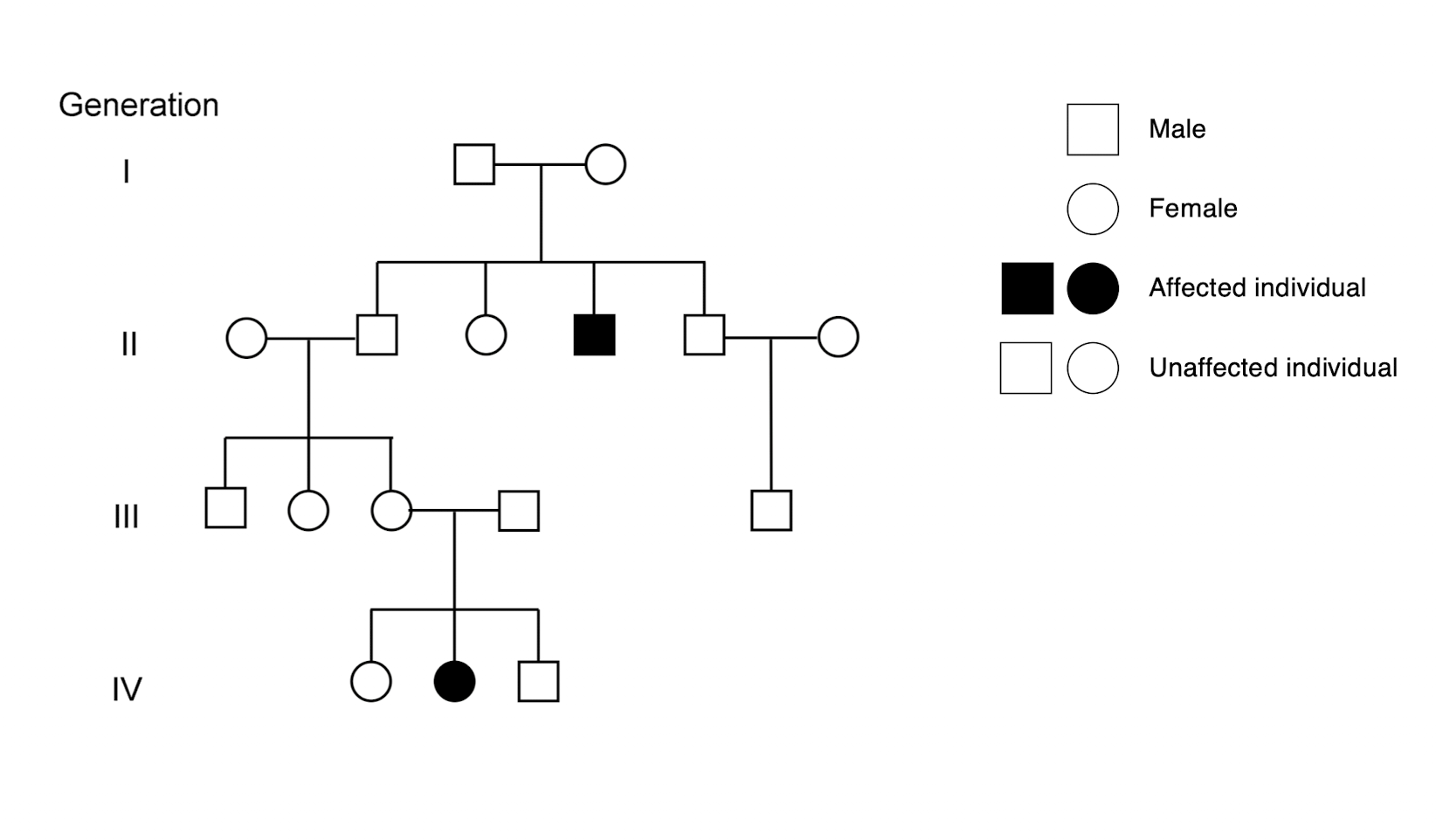
What kind of inheritance is the trait?
Recessive Autosomal Inheritance (horizontal inheritance)
many generations without the trait
unaffected individuals may have multiple affected offspring
males/females are equally affected
Recessive Autosomal Inheritance
(horizontal inheritance)
many generations without the trait
unaffected individuals may have multiple affected offspring
males/females are equally affected
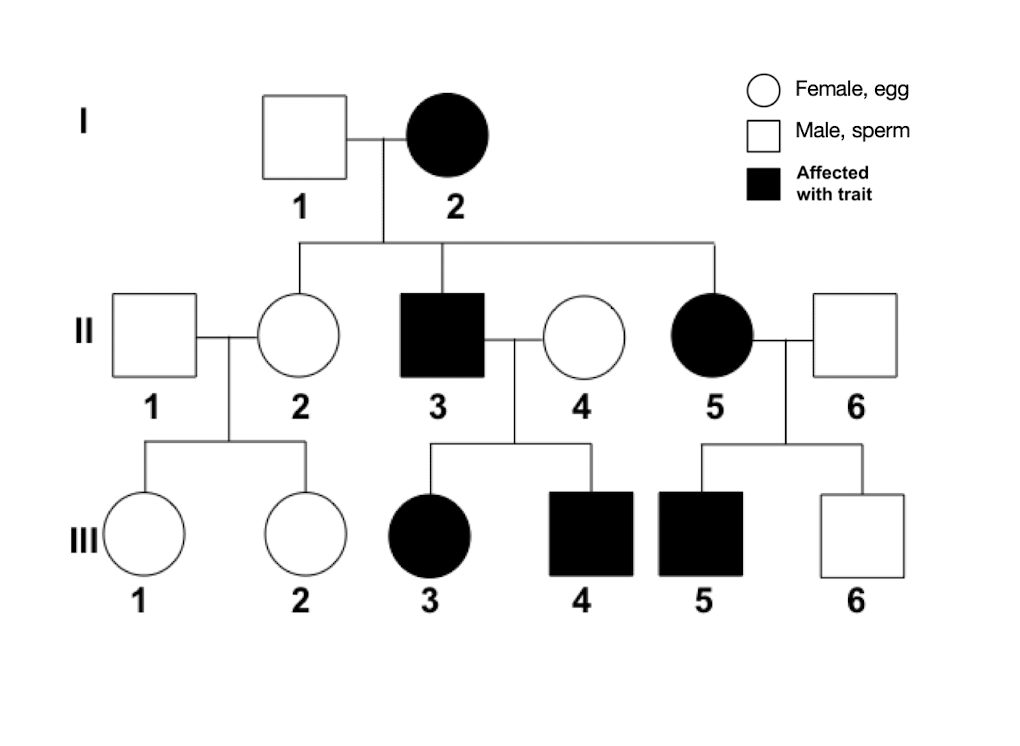
What kind of inheritance is the trait?
Dominant Autosomal Inheritance (vertical inheritance)
individuals in every generation affected
males and females equally affected
Dominant Autosomal Inheritance
(vertical inheritance)
individuals in every generation affected
males and females equally affected

What kind of inheritance is the trait?
X-linked Recessive Inheritance
trait appears more commonly in XY individuals, may appear every generation
affected offspring of unaffected females
all XY offspring of an affected XX will be affected (XY individuals are hemizygous)
hemizygous
only having one copy of a gene or chromosome segment in a diploid organism instead of two
e.g. XY because only the X can have a trait but they lack a second X copy
X-linked Recessive Inheritance
trait appears more commonly in XY individuals, may appear every generation
affected offspring of unaffected females (skip generations via carrier mothers)
all XY offspring of an affected XX will be affected (XY individuals are hemizygous)
X-linked Dominant Inheritance
affected male pass the trait to ALL DAUGHTERS
males more likely to be affected than females

What kind of inheritance is the trait?
dark circle = affected female
white circle = unaffected female
dark square = affected male
white square = unaffected male
X-linked Dominant Inheritance
affected male pass the trait to ALL DAUGHTERS
product rule genetics
for 2+ independent events occurring together, multiply the probabilities of each
addition rule genetics
any several mutually exclusive events where only one can occur at one time or both occurs at once but doesn’t affect each other
independent events
events where the outcome of one does not impact the othere
independent event example
what kind of event is the inheritance of unlinked genes
mutually exclusive event example
only one or the other can occur at one time OR where two things can occur at the same time but not affect each other’s outcomeserticalv
vertical inheritance example
dominant autosomal inheritancever
vertical inheritance
genetic material inherited from parents to offspring with asexual/sexual reproduction
horizontal inheritance example
recessive autosomal inheritance
horizontal inheritance
lateral gene transfer where the movement of genetic material isn’t the typical vertical inheritance from parent to offspringe-s
sex-linked inheritance
transmutation of traits through genes on the sex chromosome (X or Y) instead of autosomes/non-sex chromosomes
hemizygous organism
having only one allele/gene copy for a specific gene instead of the usual pair of alleles
sex-linked genes on X/Y chromosomes for males
allele
one of the different forms of a gene on a single locus
variants in DNA sequence
mutation causes
mismatched DNA or environmental exposure
pyrimidines
type of nitrogenous base that builds DNA/RNA
C, U/T: single 6-membered carbon-nitrogen ring with TWO nitrogen atoms
purines
type of nitrogenous base that builds DNA/RNA
A, G: two fused carbon-nitrogen rings with four nitrogen atoms
hydrogen bonds between nitrogenous bases
3 H bonds for CG
2 H bonds for AT/AU
CG requires a higher temperature to separate the bonds than AT/AU
pyrimidine dimer
DNA damage caused by UV light
results from DNA mutations
transcription, translation, RNA and protein processing, protein activity and stability, and more
somatic cell
body cells
germline cells
leads to the production of gametes
somatic cell mutation
not inherited
a clone of cancer cells in an otherwise healthy individual
gremlin cell mutation
inherited mutations