Animal Diversity BIOL 206 102 study guide
 Call Kai
 Learn
Learn Practice Test
 Spaced Repetition
 Match
Match Flashcards
 Knowt Play
1/47

There's no tags or description
Looks like no tags are added yet.
Name | Mastery | Learn | Test | Matching | Spaced | Call with Kai | Chat |
|---|
No analytics yet
Send a link to your students to track their progress
48 Terms
Key note:
50% of reptiles are birds!
Evolution of Feathers:
•Feathers are lightweight but strong
•Provided insulation first and later served as flying surfaces (example of exaptation)
•Bones are hollow with internal struts; lightweight but strong. The sternum forms a large, vertical keel to which the flight muscles are attached.
•Amniotes are animals that have _______eggs.
terrestrially adapted
•The major derived character of this clade is an _________ (amnion is a private pond in which the embryo develops; shell prevents desiccation and allows air exchange)
amniotic egg
what contributes to amphibians decline today?
•Habitat destruction
•Habitat degradation
•Increased UV radiation
•Pesticide pollution
•Pathogenic fungus (i.e., Chytridiomycota)
Challenges for life on land
•Mass and Structural Support
•Locomotion
•Air Breathing
•Feeding
•Sensory
•Water Balance
•Reproduction
what are tetrapods?
four-limbed vertebrates; (key note) Limbs capable of movement on land evolved from the shores, muscular fins of aquatic ancestors.
Coelacanths
deep sea dwellers
lungfish
live in stagnant water, gulp air
Tetrapods
animals with four limbs
Forelimb comparision
•(top left) Humerus of one of the last alive lobe-limbed fish (Coelacanths); they have fleshy limb-like fins
•It is compared to humerus of human and lack of humerus in ray-finned fish (top right)
•This single bone attaches the fin to the rest of the skeleton
•Humerus is adapted for each species of limbed vertebrate group
Ray- finnded fish are....
a) Most abundant vertebrate group!
b) Least abundant vertebrate group!
a) Most abundant vertebrate group!
Ray-finned fishes include 30,000 species.
a) true
b) false
a) true
key note about Ray-finned fishes:
Abundance of behavioral adaptations
Male pufferfish construct these nests to attract females
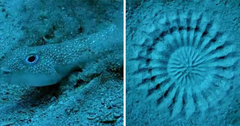
what do you call this?
Anchovies or Sardines in_________ formation which provides safety for individuals
schooling
Our Own Phylum, Chordata, Is Distinguished By Four Features:
a)Pharyngeal Gill Slit
b)Dorsal Nerve Cord
c)Notochord
d)Post-Anal Tail
in humans:
notochord = soft, jelly-like center of intervertebral disks between backbones; dorsal nerve cord = central nervous system; pharyngeal gill slits = components of head, neck, and ear.
key note:
Sometimes, a structure may only be present in an embryonic form and not an adult form, or vice versa - but it does develop at some point in the organism's life cycle.
Deuterostomes
Phylum Chordates
Subphylum: Vertebrate
e.g., Vertebrates (~66,000 species)
•Class Fish ~30,000 spp
•Class Birds >12,000 spp
•Class Reptiles >11,00 spp
•Class Amphibians >8,000 spp
•Class Mammals >6,700 spp
Classification of Vertebrate
Warm blooded: Mammals, Birds
Cold blooded: Reptiles, Amphibians and Fishes
What are tight junctions?
Connections between adjacent animal cells that prevent leakage of extracellular fluid.
What are anchoring junctions?
Connections that fasten animal cells together into sheets.
What are gap junctions?
Channels that allow molecules to flow between adjacent cells.
How do animal cells interact with each other?
hey communicate, interact, and adhere through specialized junctions (adjacent)
How do gap junctions help the heart?
They provide rapid electrical communication between heart cells.
What are the three types of animal symmetry?
Asymmetry, radial symmetry, and bilateral symmetry.
What are characteristics of animals with asymmetry?
They lack defined tissues or organs, as seen in sponges.
What is radial symmetry?
A circular body plan with no clear left or right sides.
What is bilateral symmetry?
A body plan with clear left and right halves that are mirror images of each other.
What is an advantage of bilateral symmetry?
It helps animals seek food, stalk prey, and avoid predators.
what do you call this? (Invertebrates): during embryonic development, mouth forms first.
a)Protostomes
b)Deuterostomes
a)Protostomes
what do you call this? •(Vertebrates and others): during embryonic development, anus forms first, mouth forms later from an opening in embryonic gut (second opening)
HINT: means 'second mouth' in Greek
a)Protostomes
b)Deuterostomes
b)Deuterostomes
What is the blastopore?
the first opening that forms during embryonic development; its fate helps distinguish protostomes from deuterostomes.
What are protostomes commonly called?
Invertebrates; most animals belong to this diverse group, and they lack a backbone.
What are deuterostomes?
A group that includes vertebrates and other chordates.
What are vertebrates?
animals with a bony or cartilaginous backbone
Most animals are Protostomes
•Often called "invertebrates"
•Highly diverse
•Lack backbone
Dueterostomes include
Vertebrates
•Animals with a bony or Cartilaginous backbone
•Phylum Chordates
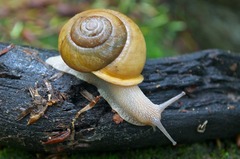
What are mollusks?
Soft-bodied invertebrates that generally have a hard shell; examples include slugs, snails, and clams.
What are annelids?
Segmented worms, such as earthworms and leeches.
How do earthworms benefit soil?
They create passageways that allow air and water to enter the soil.
What are arthropods?
The most abundant invertebrates, characterized by segmented bodies, jointed appendages, and hard exoskeletons.
What are the functions of an arthropod's exoskeleton?
It protects against predators and water loss and provides structure and support for movement.
What are the three main body regions of an insect?
head, thorax, abdomen
how many legs does a insect have?
6 jointed legs
What are chordates?
Animals belonging to the phylum Chordata; vertebrates are part of this group.
What are the five major vertebrate groups listed in the slides?
Fish, birds, reptiles, amphibians, and mammals.