Marine Geology
 Call Kai
 Learn
Learn Practice Test
 Spaced Repetition
 Match
Match Flashcards
 Knowt Play
1/9

There's no tags or description
Looks like no tags are added yet.
Name | Mastery | Learn | Test | Matching | Spaced | Call with Kai | Chat |
|---|
No analytics yet
Send a link to your students to track their progress
10 Terms
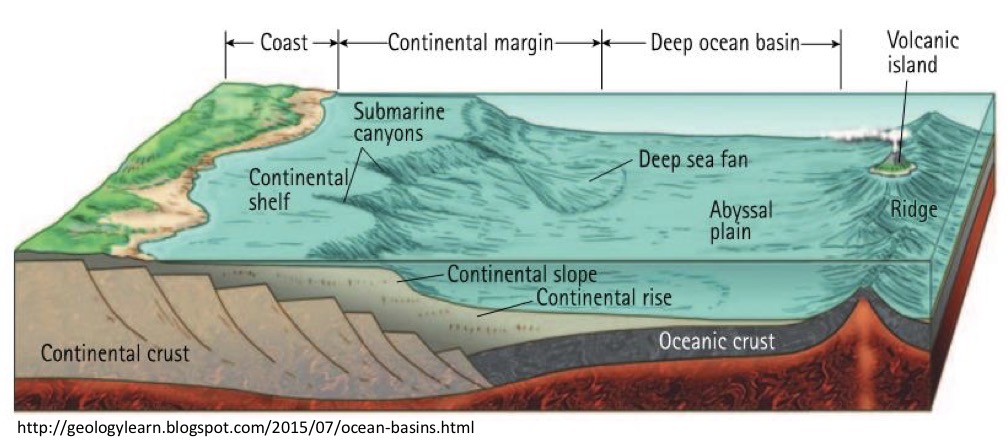
Continental Margin
Submerged beneath water edges of continents
Active continental margin
Oceanic subduction, narrow continental shelf, sites of tectonic activity (earthquakes, volcanism, mountain building, formation of igneous rock)

Passive continental margin
Plates spreading, wide continental shelves, minimal tectonic activity, causes accumulation of sediment

Continental shelf
Shallow part of continental margin with gentle slopes, avg width is 75km, wider in Arctic + narrow in W. SAmerica, 7.5% submerged areas

Continental Shelf limits
Upper limit: equinoctial low tides
Lower limit: shelf break (140-200m depth)
Inner: 0 to 40m depth
Middle: 40 to 80m
Outer: > 80m
Inner Continental Shelf
Wave actuated, sediments are sandy and terrigenous, salinity and temp vary, available light at surface for life

Energetic barriers on continental shelf
Littoral: breaking area
Transactional shelf break: breaking of internal waves, pycnocline
Period of low sea level
Glaciations/ice ages, shelves exposed to sub-aerial processes, dunes formed, shelves dissected by rivers and collect fluvial deposits
Periods of high sea level
Interglacial, rivers deposit on inner shelf so fewer particles transfer to continental slope, depressions filled with sediment
Shelf break
Transition between continental shelf and slope (smooth to steep slope), energetic area (internal waves, upwelling, downwelling, contour currents), deeper in polar areas from weight of ice