Lecture 2 -Oral Facial Dev & Tooth Dev
 Call Kai
 Learn
 Practice Test
 Spaced Repetition
 Match
 Flashcards
 Knowt Play
1/75

There's no tags or description
Looks like no tags are added yet.
76 Terms
What develops in the lower face?
mandible
What develops in the upper face?
frontonasal process
What develops in the midface?
maxillary process
What is the primitive mouth?
stomodeum
What causes the stomodeum to initially be seen as a shallow depression before developing?
oropharyngeal membrane disintegrates
Facial development depends on the ____ (number) major facial processes.
5
What week do the major facial processes form?
4th
Give the 5 major facial processes and the single/paired status.
1 frontonasal, 2 maxillary, 2 mandibular
Which arch is responsible for forming most of the face?
mandibular

Give the top large structure.
frontonasal process

Give the purple and blue processes respectively.
maxillary, mandible

What is the center structure?
oropharyngeal membrane

What is the center black structure?
stomodeum

What are the smallest gray structures?
lens placode
The tongue also develops from_______________
mandibular arch
While the mandibular arch is developing, ___________________ forms within
each side of the arch. Later, as most of the cartilage disappears, the mandible
forms by __________
meckels cartilage, intramembranous ossification
The muscles of _____________________ are derived from the mesoderm as
the primitive muscle cells differentiate, and later from the mandibular arch.
mastication
What is the FIRST part of the face to form after the stomodeum?
mandibular arch
Give the 2 structures that form following the stomodeum.
mandibular processes, mandible arch
What are the two bulges of tissue appear inferior to the
primitive mouth?
mandibular proceses
The mandibular arch will eventually develop into what facial structures?
lower face (lower lip, mandible, mandibular teeth)
What 3 structures do the branchial arches form?
nerves muscles bones
What 4 structures do the mandibular arch form?
V nerve (trigeminal), muscles of mastication, ear bones, sphenoid
What 3 structures does the hyoid form?
VII (facial nerves), facial muscles, ear bones

Give pink.
frontal process

Give black.
oral pit

Give yellow.
maxillary process

Give blue.
mandibular arch

Give orange.
hyoid arch

Give the top arrow.
nasal pit

Give the left structure.
eye
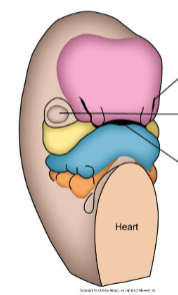
Give the bottom structure.
oral pit
What causes a cleft lip?
lack of mesenchymal growth
Each pharyngeal arches has what 4 components within each mesodermal core:
cartilage, nerve, vasculature, muscle
What are the first two paired arches that develop to the greatest extent?
mandible, hyoid
The first two pharyngeal arches form what parts of face?
middle and lower
The lower four pairs of pharyngeal arches form what?
larynx and neck
What palatal portions form in the 5-6th week?
intermaxillary segment from fused nasal
What palatal portions form in the 6-12th week?
fused palatal shelves from maxillary
What palatal portions form in the 12th week?
all three processes fuse
The 5-6th week forms the _____ palate, the 6-12th week forms the _____, the 12th week forms the ______ palate.
primary, secondary, final
The paired medial nasal processes fuse on the inside of the stomodeum, forming the _______ _______.
intermaxillary segment
The intermaxillary segment is involved in the formation of…
max. incisors, primary palate, nasal septum
Which arch(es) form the anterior, movable part of the tongue?
first branchial
Which arch(es) form the posterior, immovable part of the tongue?
2, 3, 4
What cranial nerves innervate the tongue?
5, 7, 9, 10, 12 (trigeminal, facial, glossopharyngeal, vagus, hypoglossal)
What week does the tongue finish developing?
8
Most congenital malformations of the head and neck occur when the brachial apparatus…
transforms into adult structures
Give the term for “tongue tied”. This is a short lingual frenum attachment.
ankyloglossia
Define macroglossia.
excessively large tongue
Define microglossia.
abnormally small tongue
What is an abnormally small tongue associated with?
underdeveloped mandible
What fails to occur that causes a cleft tongue?
fusion of lateral lingual swellings
Give the term for tooth development.
odontogenesis
Give the 5 stages of tooth development.
initiation, bud, cap, bell, apposition maturation
What kind of tissue is enamel?
calcified, deposited by ectodermal cells
Why does enamel not have a healing ability?
epithelial cells are lost, is acellular
What kind of tissue is dentin?
calcified CT
What direction does dentin grow appositional?
inward toward pulp
What kind of tissue is cementum?
calcified CT
What direction does cementum grow appositional?
outward
What kind of tissue is pulp?
uncalcified loose CT
Give the 4 stages of the life cycle for primary dentition.
development, eruption function, exfoliation
Give the 3 stages of the life cycle for secondary dentition.
development, eruption, function
What embryonic tissues are responsible for odontogenesis?
mesenchyme, ectoderm
What kind of tissue is mesenchyme? Give 3 types.
embryonic CT, dentin cementum pulp
What kind of tissue is ectoderm? Give 1 type.
embryonic epithelium, enamel
What two main events must occur during tooth development?
morphodifferentiation, cytodifferentiation
Define morphodifferentiation.
individual tooth shape
Define cytodifferentiation.
cell diff
Define odontoblasts.
dentin forms
Define ameloblasts.
enamel forms
Define cementoblasts.
cementum forms
Define fibroblasts.
pulp forms