Tax Unit 3
 Call Kai
 Learn
 Practice Test
 Spaced Repetition
 Match
 Flashcards
 Knowt Play
1/13

There's no tags or description
Looks like no tags are added yet.
14 Terms
standby charge
Employer owns the vehicle:
2% x (full original cost of vehicle incl. sales tax x # of months available when employer owned the vehicle)
Employer leases the vehicle:
2/3 x (lease PMTs for the year incl. tax x portion of lease PMTs made for insurance)
reduction in standby charge
reduced if the following all apply:
required to use vehicle for employment duties
used primarily (more than 50%) for employment purposes
personal-use km for the year is less than 20,004 (or 1,667 per month, if used for less than 12 months)
calculation:
personal-use km / (1,667 x # of months available)
operating cost benefit on employer-owned vehicle
when vehicle is used < 50% for employment purposes
personal km x prescribed rate ($0.34 in 2025, $0.33 in 2024)
when vehicle is used > 50% for employment purposes
lesser of:
personal km x prescribed rate
½ standby charge
operating cost benefit on employee-owned or employee-leased vehicle
determined if employee owns or leases vehicle & the employer pays the operating costs
(personal km / total km) x actual operating costs paid by employer
stock options - public company
exercise date: benefit = (FMV on exercise date - exercise price) x # of shares acquired
selling date: TCG/ACL = 50% x # of shares sold x (POD less FMV on exercise date)
conditions for Div C deduction: FMV of share on grant date <= exercise price (NOT IN THE MONEY)
timing of Div C deduction: year option is exercised (same as income inclusion)
stock options - CCPC
exercise date: no impact
selling date: employee benefit = (FMV on exercise date - exercise price) x # of shares sold; TCG same as public company
conditions for Div C deduction: FMV of share on grant date <= exercise price (NOT IN THE MONEY); OR FMV of share on grant date > exercise price (IN THE MONEY) & shares held for at least 2 years after exercised
timing of Div C deduction: year the shares are sold (same as income inclusion)
deductible home office expenses
home office expenses deductible if one of the following conditions are met:
place where individual principally (50% or more) performs their employment duties; OR
both of the following:
exclusively used for purpose of earning employment income during the period
used on a regular & continuous basis for meeting customers or other persons in the ordinary course of performing their employment duties
home office expenses potentially deductible
different categories depending on the type of employee

moving expenses
conditions
residence must be at least 40 km closer to new work/school location
expenses that exceed income
expenses must be paid and NOT reimbursed
qualified moving expenses, to extent income is earned in new location
travelling costs
transportation & storage costs
cost of meals & accommodations up to 15 days
lease cancellation on old residence
selling costs of old residence (if was owned & sold)
legal fees & title transfer of new residence (if old residence owned was sold)
simplified method for meals = flat rate of $23, daily max of $69, x per-km rate
spousal support
child support payments are not deductible to person making the PMT & are not taxable to the recipient (in-n-out transaction)
spousal support that is taxable/deductible to payer/recipient = total payments made in the year less amounts for child support
annual childcare expense limits for lower-income earner
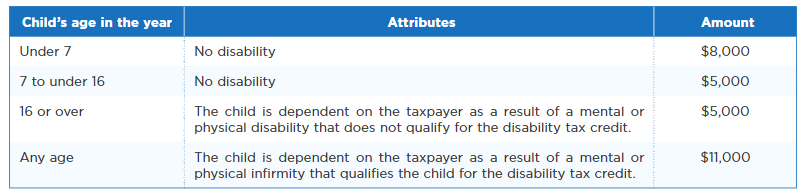
actual child care expenses incurred
actual amount paid must be substantiated by receipts, other than for boarding school or overnight camp + limited amount for boarding school or overnight camp
max amount that may be claimed for child attendance at board school/overnight camp:
$200/week for each child under age of 7
$275/week for child who is eligible for DTC
$125/week for other eligible children
max childcare deduction for lower-income earner
least of 3:
actual amount paid for childcare
total of annual limits
2/3 taxpayer’s earned income
max childcare deduction for higher-income earner
allowed to deduct childcare expenses for period where lower income earner was basically incapacitated (e.g., FT/PT school, hospitalized, prison lol)
max deduction is least of:
actual amount paid for childcare
sum of $200 x children under age of 7; $275 x # of children eligible for DTC; $125 x # of other eligible children
2/3 x taxpayer’s earnred income