Genetics 4
 Call Kai
 Learn
 Practice Test
 Spaced Repetition
 Match
 Flashcards
 Knowt Play
1/59

There's no tags or description
Looks like no tags are added yet.
60 Terms
Which type of chromosomal aberration results in recessive expression when there is only one copy of the recessive allele?
A heterozygous deletion
Which type of chromosomal aberration leads to a reduction in viable gametes due to the formation of a dicentric bridge and acentric fragment during meiosis?
A heterozygous paracentric inversion
What would cause two genes, which are known to be near each other on the same side of the centromere, to be separated by a great distance and on opposite sides of the centromere?
A heterozygous, pericentric inversion
Which type of chromosomal aberration would result in the apparent linkage of two genes that are known to be unlinked?
A heterozygous translocation
If a horse is heterozygous for three separate translocations, at what frequency would the animal produce viable gametes?
1/8
Which of the following effects is seen in a heterozygous inversion in female Drosophila?
50% sterility
Which of the following effects is seen in a heterozygous inversion in male Drosophila (no crossovers)?
no effect
Which of the following effects is seen in a heterozygous translocation in male Drosophila (no crossovers)?
50% sterility
Vestigial wings and ebony body are autosomal recessive loci on different chromosome pairs (not linked). A laboratory strain that is both vestigial and ebony is crossed to a wild-type fly caught near Bikini Island (the site in the South Pacific used for testing the hydrogen bomb). The F1 males from this cross are testcrossed to homozygous vestigial, ebony females. Among 1,000 progeny, 516 were phenotypically wild type and 484 were vestigial, ebony. No other phenotypes were observed. What sort of chromosomal rearrangement could cause these unusual results?
A heterozygous translocation

Examine the pedigree. If individual I-1 is a carrier for the Robertsonian translocation leading to Down’s syndrome, what is the chance that a grandchild (individual III-1) is also a carrier?
1/9

Known deletions (1–6) were crossed to each other. The following chart shows which crosses produced wild-type offspring (+) and which crosses produced no wild-type offspring (−). Point mutants (a–f) were then crossed to these deletions. The results of these crosses are shown in the second chart. What is the correct order of the point mutations?
bfaecd
A couple comes into a fertility clinic. A chromosome preparation is made for each and the male is found to have an aberrant karyotype. He is heterozygous for two sets of reciprocal translocations involving four different chromosome pairs. What proportion of his gametes are expected to be functional and viable?
1/4

Known deletions (1–6) were crossed to each other. The following chart shows which crosses produced wild-type offspring (+) and which crosses produced no wild-type offspring (−). Point mutants (a–f) were then crossed to these deletions. The results of these crosses are shown in the second chart. What is the correct order of the point mutations?
adfbec
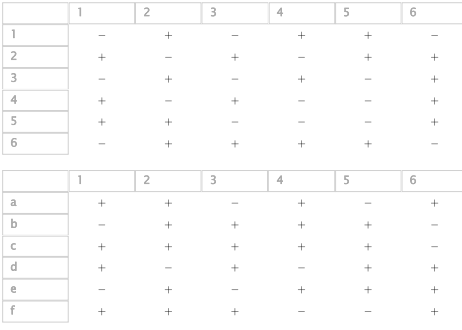
Known deletions (1–6) were crossed to each other. The following chart shows which crosses produced wild-type offspring (+) and which crosses produced no wild-type offspring (−). Point mutants (a–f) were then crossed to these deletions. The results of these crosses are shown in the second chart. Which two deletions have the greatest distance between them?
2, 6

Using the data from Question 9, what is the correct order of the point mutations?
dfaebc
To which carbon on deoxyribose sugar is the nitrogenous base attached?
1’
To which carbon is the phosphate group attached?
5’
What enzyme can form a phosphodiester bond in DNA without adding a base?
Ligase
Which enzyme is capable of polymerizing RNA?
Primase
Which enzyme is capable of removing RNA and replacing it with DNA?
DNA polymerase I
One strand of DNA double helix reads 5’ ATCGGTTA 3’. Which of the following is the correct partner strand?
3’ TAGCCAAT 5’
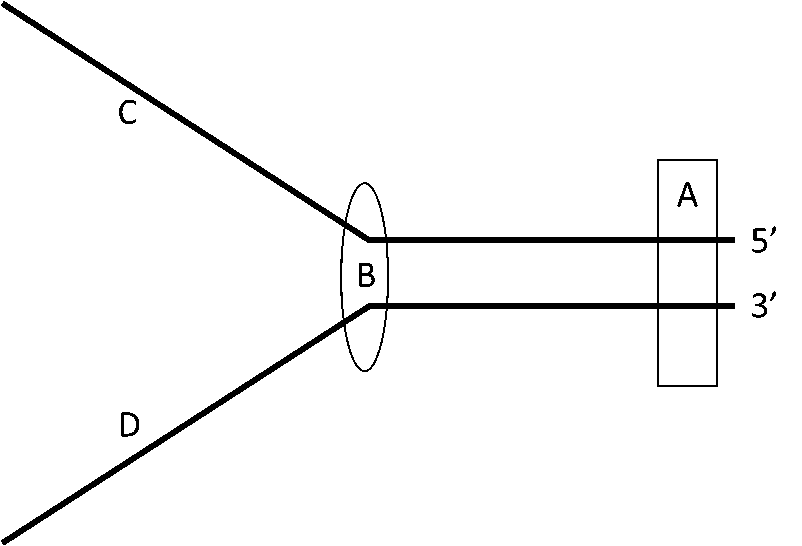
In the image of a replication fork, what is labeled A?
Topoisomerase

In the image of a replication fork, what is labeled D?
Lagging strand
Which of the following represents a DNA palindrome?
GAATTC

The double-stranded DNA sequence below is a six-base palindrome. Fill in the missing pairs. What is the circled base?
C

The double-stranded DNA sequence below is an eight-base palindrome. Fill in the missing pairs. What is the circled base?
T
One can denature or “melt” DNA by exposing DNA to a high temperature (about 100 degrees Celsius) or by exposing DNA to a strongly basic solution (about pH 11). What does the term “denature” mean in terms of DNA structure?
Denatured DNA has broken the hydrogen bonds holding the two strands together.
A template strand of DNA has 20% cytosine, 10% guanine, 30% adenine, and 40% thymine. What would you expect to find in the strand of DNA replicated from this template?
20% guanine, 10% cytosine, 30% thymine, and 40% adenine

Examine the DNA molecule, which base is labeled with a 1?
Adenine
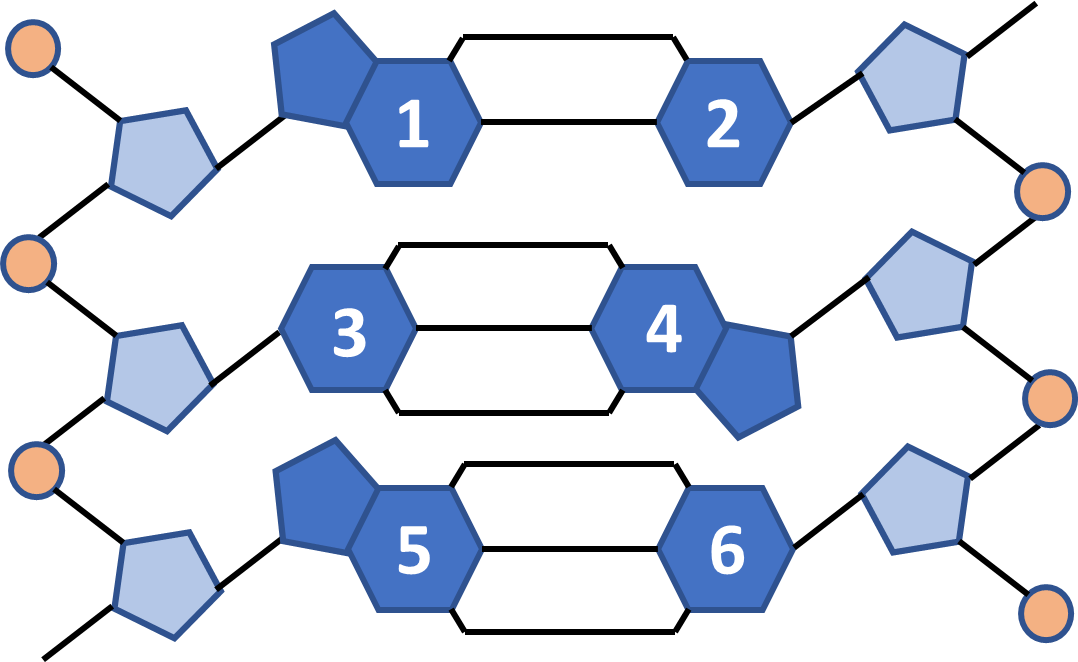
Examine the DNA molecule, which base is labeled with a 3?
Cytosine

If a DNA has the following coding and template strands, which mRNA will be produced?
5’ A U G C C C U A U C C G A C G U A G 3’
If the codon of an mRNA reads 5’ GAC 3’, what is the anticodon in the tRNA?
5’ GUC 3’

A protein of the following sequence and polarity is made from a messenger RNA, which, in turn, is templated from one of the strands of DNA in the gene. What is the sequence of the DNA strand that serves as a TEMPLATE for the mRNA that translates this peptide? Use the codons provided.
(carboxyl end) met-pro-his-met (amino end)
3' T A C G T A G G A T A C A C T 5'
Consider the messenger RNA sequence. What polypeptide could be transcribed from this sequence of messenger RNA? Use a codon chart.
5' A G U G A A U G G U U A G A U G U U A G U A U U 3'
NH3 – met – val – arg – cys – COOH
Which sequence is necessary for the initiation of translation?
5’ AGGAGGU 3’
A tRNA that could “read” the 5’CAU codon of histidine would have the anticodon:
5’ AUG 3’
Consider the following sequence of messenger RNA: What is the sequence (and polarity) of the CODING strand (NOT THE TEMPLATE strand) of DNA that encoded this mRNA?
5' A G U G A A U G G U U A G A U G U U A G U A U U 3'
5’ A G T G A A T G G T T A G A T G T T A G T A T T 3’
A protein is made from a messenger RNA of the following sequence. What is the sequence of amino acids for this protein? (Remember, a start and a stop codon are needed for a protein to be made. Use a codon chart.)
3' G C C G A U G G A U G A A G U U U U A A A G U A A U A G C A A U G G A G G A C 5’
NH3 – met – lys – phe – COOH
What is the function of the underlined sequence?
3' G C C G A U G G A U G A A G U U U U A A A G U A A U A G C A A U G G A G G A C 5'
To bind the small ribosome subunit and initiate translation
A protein of the following sequence and polarity is made from a messenger RNA. What is the sequence of this RNA? Use the codon chart provided in your notes.
(carboxyl end) met-arg-lys-ser-met (amino)
5' A U G A G U A A A A G G A U G U A A 3'
Consider the following sequence of messenger RNA: What was the sequence (and polarity) of the template strand of DNA that encoded this mRNA?
3' G A U A U G G G U G U A C C U G A 5'
5' C T A T A C C C A C A T G G A C T 3'
Consider again the messenger RNA sequence in the previous question (shown again below). What polypeptide could be transcribed from this sequence of messenger RNA? Use a codon chart.
3' G A U A U G G G U G U A C C U G A 5'
NH3 – met-trp-val – COOH
The amino-acyl synthetase system functions to:
Bind amino acids to their respective tRNAs
What is the structure that makes bacteria unable to properly read and make protein from human DNA?
Introns
The consensus sequence 5’ AAUAAA 3’ is found in eukaryotic mRNA. It is a signal for what posttranscriptional modification?
Poly-A tail
Which type of mutation is likely to correct (or revert) a transversion mutation?
transversion

What type of mutation results in the substitution of proline with threonine? Use a codon chart.
transversion
Intercalating agents are chemicals such as 9-amino- acridine, flavin, and dioxin that bind by inserting themselves between base pairs. This causes the DNA helix to expand and untwist, and, when replicated, a certain class of mutation is caused. What class of mutations do intercalating agents cause?
frameshift
The wavelength of electromagnetic radiation is important to geneticists because the wavelength of a radiation determines:
The energy of a photon of the radiation
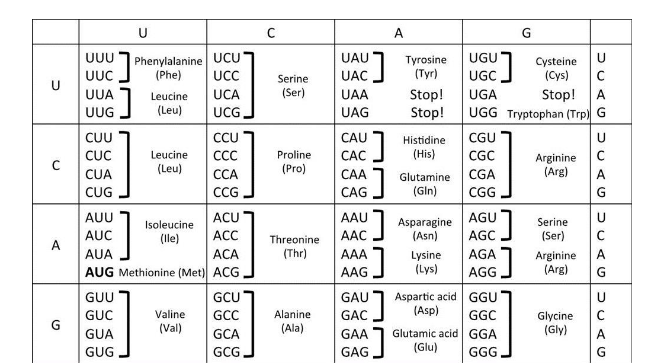
Nitrous acid causes all possible transitions (A←→G, C←→T). If a protein has a methionine at position 65, what amino acid(s) would be likely to replace methionine as a result of nitrous acid mutagenesis? Use a codon chart.
Isoleucine, threonine, valine