V. Using Analogy in Modeling
 Call Kai
 Learn
Learn Practice Test
 Spaced Repetition
 Match
Match Flashcards
 Knowt Play
1/30

There's no tags or description
Looks like no tags are added yet.
Name | Mastery | Learn | Test | Matching | Spaced | Call with Kai | Chat |
|---|
No analytics yet
Send a link to your students to track their progress
31 Terms
Use of Metaphor and Analogy
one of the most powerful intellectual methods for developing understanding
Generalized Variabes
abstractions of physical variables that allow similar functional relations between variables to bo constructed when dealing with physically different systems
What do generalized variables relations allow?
1. many different kids of systems to be analyzed according to a common set of procedures
allow analogies to be made such that well-developed methods in one-domain (e.g. engineering/mechanics) can be applied to solve problems in another domain (e.g physiology/circuits)
Effort Variable
a quantity that results from expenditure of energy, if unbalanced, causes something to move; requires a reference or a comparison between different locations
ex. force (mechanics), hydraulic pressure (fluid), voltage (electrical)
Generalized Flow, f (Flow variable)
the quantity that changes its location with time as a result of differences in the effort variable
ex. velocity (from force), volumetric flow (from hydraulic pressure), current (from voltage)
Derived Variables
can be derivatived from effort and flow; generalized dispalcement and momentum
Generalized Displacement
take flow variable and integrate

Generalized Momentum
integrate effort variable

Generalized Variables for Different Physical Systems Table Picture

Flow is always opposed by what?
some impedance
Hindrance of Flow
is by the impedence is overcome by effort
Generalized Impedance
the ratio of effort to flow

Impedance
generally not a constant; an intrinsic property of the system that defines the amount of effort needed to achieve a given flow; combines all constitutive relations of importance
What causes flow through an impedance?
the expenditure of energy always accompanies the application of effort
Power
the rate at which energy is applied
Generated Power
the work performed in applying the power to create a given

Generalized System Elements
can be defined by the manner in which effort is related to flow
Generalized Resistance Element, R
system element possesses a resiatance property if the effort is proportional to flow

Relationships for Generalized Resistance Elements
resistance increases w/ distance but decreases w/ SA and diffusion coefficient
resistance decreases w/ increasing kinetic rate constant and vessel volume

Generalized Potential Energy Storage Element
element stores PE when effort applied to system increases as a result of an increase in displacement
C - generalized capacitance
impedance is not a simple scale factor (Z* = e/f = (1/c * integral fdt) = h/c)
energy put into potential energy storage element is recoverable and equals the work performed on the element (w = integral (efdt) = integral (C dedt dt) = Ce²/2 = h²/2C
typical ex. capacitar and a spring

Generalized PE Stroage Element Relationships

Generalized Kinetic Energy Storag Element
an element stores KE when the effort applied to the system increases as a result of an increase in the rate of change of flow (e = L df.dt → f = 1/L integral e dt = 1/L P (L - generalized inertance???)
impedance is not a simple scale factor (Z* = e / (1/L * integral e dt))
energy put into a KE storage element is recoverable and equals the work performed on the element (w = integral ef dt = integral L df/dt f dt = L integral f df = (1/2) LF²
ex. resistor and mass (not found in chemical and thermal systems)

Balancing Techniques for Building Models of Systems with Interacting Passive Elements
need these to build dynamic eqns for systems of multiple passive elements
Balancing Laws
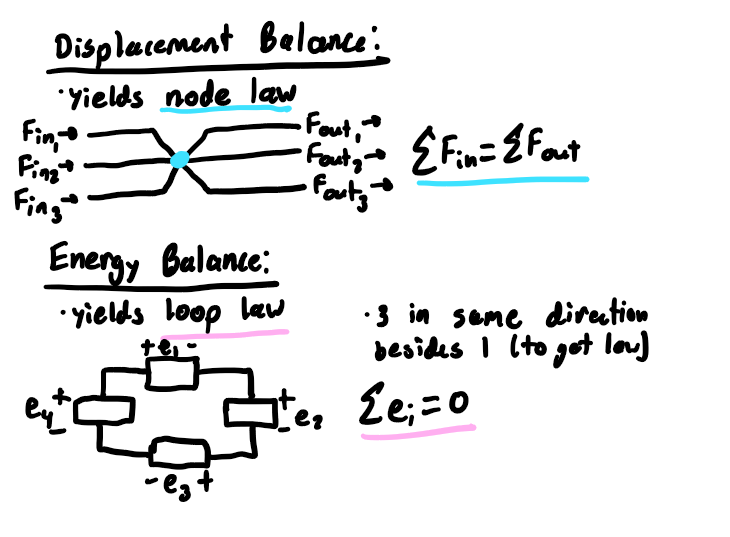
displacement balance yields generalized node law
energy balance yields generalized loop law
sign convention: flow is in the clockwise direction around the loop and the + pole of effort is at flow entry for all elements but the last
Passive Element Combinatiosn
series + parallel resistance elements
series + parallel PE storage elements
resistance + PE storage elements
series combination of all 3 elements
parallel connection of all 3 elements
system dynamic behavior depends on arrangement amongst elements as much as the dynamic behavior of the elements themselves
System dynamic behavior depends on what?
on the arrangement amongst elements as much as the dynamic behavior of the elements themselves
Series + Parallel Resistance Elements

Series + Parallel PE Storage Elements

Resistance + PE Energy Storage Elements

Series Combindation of all 3 of our Elements

Parallel Combination of the 3 Elements
