BIOC3021 #5 - Amino Acids
 Call Kai
 Learn
Learn Practice Test
 Spaced Repetition
 Match
Match Flashcards
 Knowt Play
1/40

There's no tags or description
Looks like no tags are added yet.
Name | Mastery | Learn | Test | Matching | Spaced | Call with Kai | Chat |
|---|
No analytics yet
Send a link to your students to track their progress
41 Terms
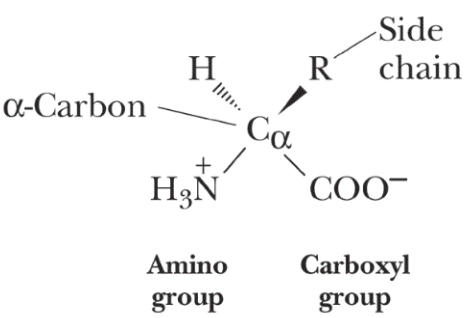
Components of an Amino Acid
An alpha-carbon covalently linked to:
Amino Group (-NH2)
Carboxyl Group (-COOH)
Variable Side Chain (R-group)
Hydrogen (-H)
Non-polar (hydrophobic) Amino Acids:
Alanine (Ala, A)
Valine (Val, V)
Leucine (Leu, L)
Isoleucine (Ile, I)
Phenylalanine (Phe, F)
Tryptophan (Trp, W)
Methionine (Met, M)
Proline (Pro, P)
Alanine (Ala, A)
Akyl chain R-group

Valine (Val, V)
Akyl chain R-group

Leucine (Leu, L)
Akyl chain R-group

Isoleucine (Ile, I)
Akyl chain R-group

Phenylalanine (Phe, F)
Aromatic ring

Tryptophan (Trp, W)
Aromatic ring

Methionine (Met, M)
Sulfur-containing

Proline (Pro, P)
Unusual cyclic structure

Polar (hydrophilic) Amino Acids
Glycine (Gly, G)
Serine (Ser, S)
Threonine (Thr, T)
Tyrosine (Tyr, Y)
Asparagine (Asn, N)
Glutamine (Gln, Q)
Cysteine (Cys, C)
Histidine (His, H)
Glycine (Gly, G)
Simplest R group (H) ➡ Cannot form H bonds

Serine (Ser, S)
Hydroxyl in R-group

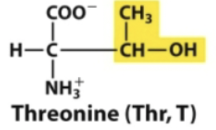
Threonine (Thr, T)
Hydroxyl in R-group
Tryosine (Tyr, Y)
Hydroxyl in R-group

Asparagine (Asn, N)
Amide in R-group

Glutamine (Gln, Q)
Amine in R-group

Cysteine (Cys, C)
Sulfur-containing ➡ ONLY amino acid that can form a disulfide bond

Histidine (His, H)

Acidic Amino Acids Definition
Amino acids that are negatively charged at pH = ~7.0
Acidic Amino Acids
Aspartic Acid (Asp, D)
Glutamic Acid (Glu, E)
Aspartic Acid (Asp, D)
Carboxyl in R-group

Glutamatic Acid (Glu, E)
Carboxyl in R-group

Basic Amino Acids Definition
Amino acids that are positively charged at pH = ~7.0
Basic Amino Acids
Lysine (Lys, K)
Arginine (Arg, R)
Lysine (Lys, K)
Positively-charged nitrogen-containing group

Argenine (Arg, R)
Positively-charged nitrogen-containing group

Uncommon, Chemically-Modified Amino Acids
5-Hydroxylysine: modified lysine
N-acetyllysine: modified lysine
Thyroxine: 2 modified tyrosine
Carboxyglutamic Acid: modified glutamic acid
5-Hydroxylysine
Modified lysine
Found in collagen

N-acetyllysine
Modified lysine
Found in histone proteins

Thyroxine
2 modified tyrosine
The thyroid hormone

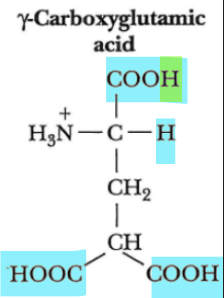
Carboxyglutamic Acid
Modified glutamic acid
Involved in blood clotting
A positive (low pH) Amino Acid contains:
-NH3+
-COOH

A neutral (pH = ~7.0) Zwitterionic Amino Acid contains:
-NH3+
-COO-

A negative (high pH) Amino Acid contains:
-NH2
-COO-

Reactions of Amino Acids
Formation of a peptide bond (condensation/dehydration reaction)
Formation of a disulfide bridge
The formation of a peptide bond (condensation/dehydration reaction) is…
Formed by the reaction of the carboxyl group (-COO-) of one amino acid and the amino group (-NH3+) of another ➡ CO - NH

Enantiomer
A pair of molecules that are non-superimposable mirror images
L- Amino Acid
An amino acid with its amino group (-NH2) on its left
All amino acids found in proteins are L-amino acids

D- Amino Acid
An amino acid with its amino group (-NH2) on its right

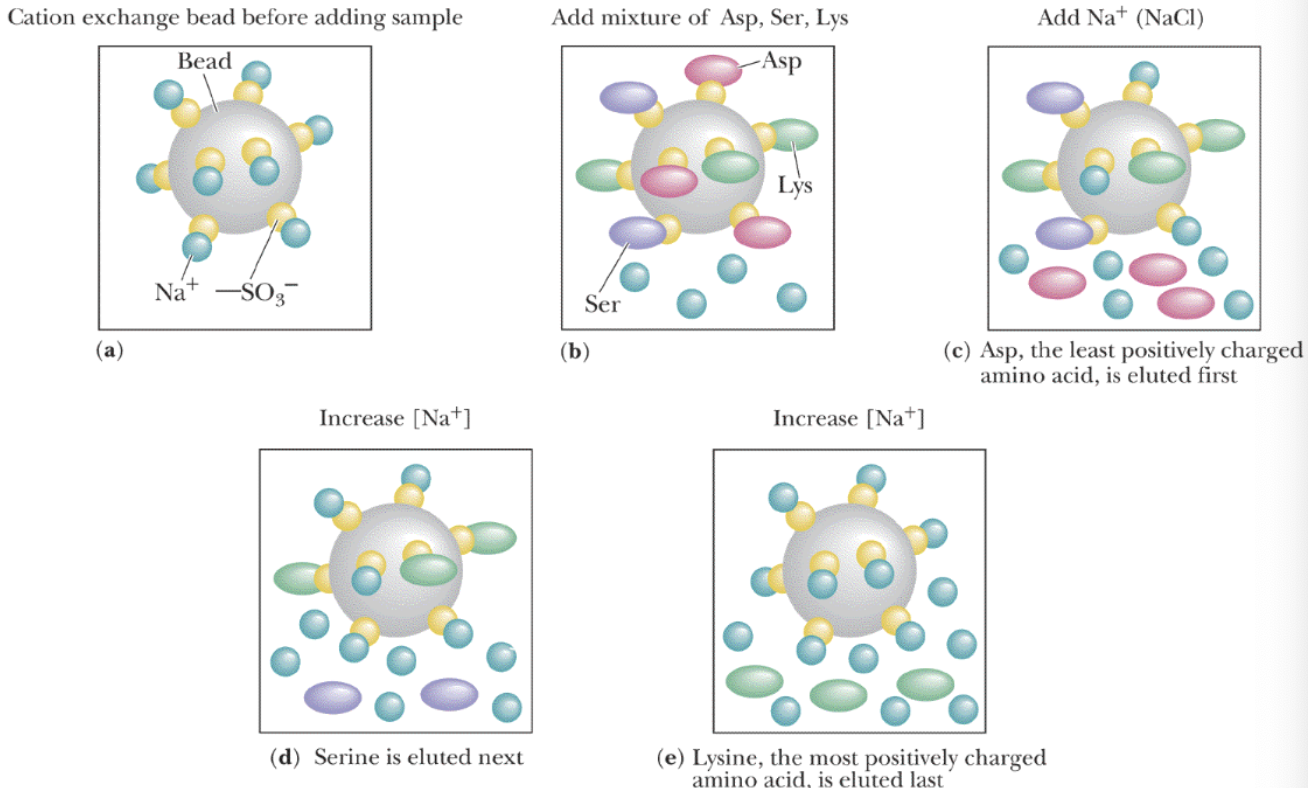
Separation of Amino Acids by Ion Exchange Chromatography
In a mixture, increasing Na+ concentrations DISPLACE the amino acids from LEAST positively charged to MOST positively charged