Surgical instruments & knot tying
 Call Kai
 Learn
 Practice Test
 Spaced Repetition
 Match
 Flashcards
 Knowt Play
1/21

Earn XP
Description and Tags
Surgical instruments & knot tying
22 Terms
Needle holders
Used for stabilizing your needle while passing suture material through tissues, and for attaching or removing scalpel blades.
Mayo-Hegar Needle Holders

Simple straight needle holder with no cutting edge and a ratchet
Olsen-Hegar Needle Holder

Simple straight needle holder with a cutting edge and a ratchet.
Fast and convenient, but must be careful to not cut suture material.
Gillies
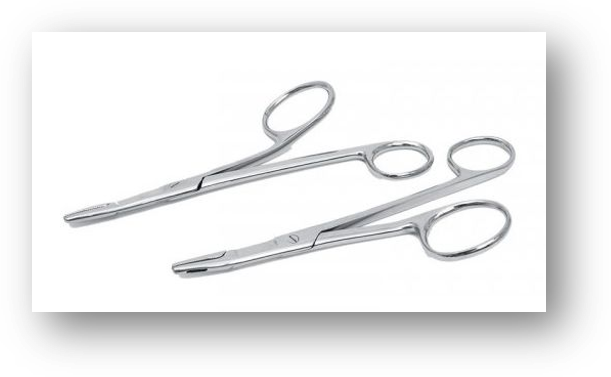
Asymmetrical instrument with a cutting edge and no ratchet
Scalpel Blades (with a scalpel handle)
Makes the sharpest cut, with less trauma to tissues than scissors. Skin incisions should always be made using a blade.
Scalpel handle sizing
No 3 handle for blade sizes beginning with 1 (e.g., 1, 10, 15)
No 4 for blade sizes beginning with 2 (e.g., 20, 21)
Scissors
Come in both straight and curved versions. Curved versions allow for more maneuverability and visibility within a wound (blade curves, shank is straight)
Mayo Scissors

Chunky tips and short shank
Used for cutting tough or fibrous tissue
Can be used to cut suture material (use a different pair to avoid blunting)
Metzenbaum Scissors

Slim tips and a longer shank
Used for delicate dissection or for sharp cutting of soft tissue
Should NOT be used to cut suture material.
Dressing Forceps
Used to hold gauze, cotton, and other material when dressing wounds
Can also be used to remove necrotic tissue or foreign bodies from wounds prior to dressing
Adson dressing forceps

Wide thumb grip and serrated tips
Tissue (or toothed) forceps
Used for stabilizing or holding tissue during surgical procedures
Interlocking teeth which allow for secure grip on tissue
More traumatic, should not be used on hollow organs because of risk of tissue damage/puncture
Adson tissue forceps

Wide grip and rat tooth tips
Treves tissue forceps

Narrower grip and rat tooth tips
Allis tissue forceps
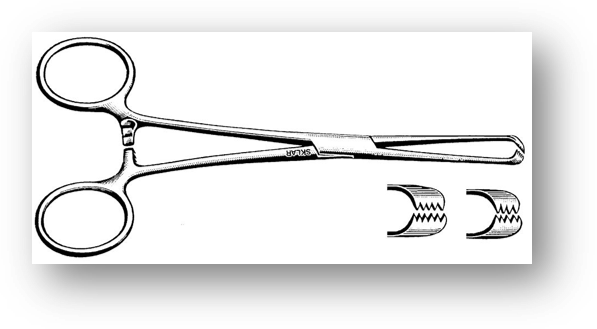
Ring handles and ratchet. Interlocking teeth.
Artery forceps
Used for haemostasis - control of bleeding from a vessel or tissue by occluding blood flow
Various sizes, and can be curved or straight
They have a ratchet which allows them to remain securely in place once closed
Halstead Mosquito artery forceps

Small with delicate serrated tips. Used to clamp small to medium vessels.
Spencer Wells artery forceps
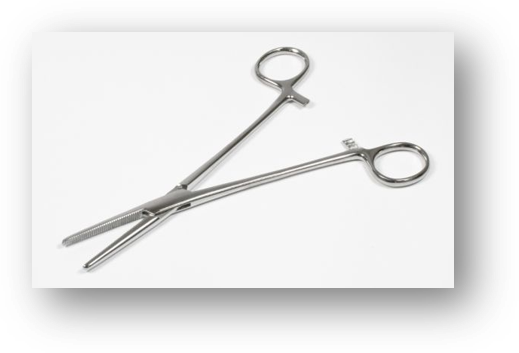
Chunky, with short jaws. Used to clamp small to medium sized vessels.
Rochester Pean artery forceps

Large with a long wide jaw containing transverse serrations. Used to clamp large blood vessels.
Towel Clamps
Designed to attach surgical drapes to the skin of the patient
Very sharp tips
pinpoint tip means blood flow to the area is maintained
apply tips with the curve downwards
Can be painful even under GA → alert anesthetist when placing!
The towel clamp in our kit are Backhaus towel clamps
types of cutting instruments
Scissors
Scalpel
Types of forceps
Tissue
Dressing
Artery