LECTURE 23: GENE EXPRESSION III – TRANSLATION + MUTATIONS
 Call Kai
 Learn
 Practice Test
 Spaced Repetition
 Match
 Flashcards
 Knowt Play
1/28

There's no tags or description
Looks like no tags are added yet.
29 Terms
What is the central dogma of biology?
The process of making proteins from information in DNA.
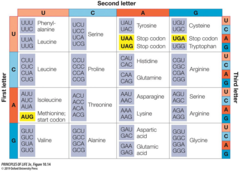
What is the first amino acid in the translation process?
Methionine.
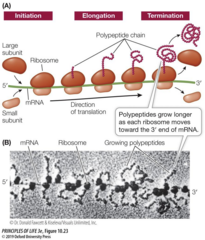
What happens during the initiation phase of translation?
The first tRNA attaches to the AUG codon, and the large subunit of rRNA binds.
How is protein synthesis amplified?
many rRNAs attach to one mRNA transcript
What is the role of the release factor in translation?
It binds to the stop codon, causing the ribosome to fall off the mRNA transcript.

What are the two main types of mutations?
Somatic mutations (not passed to offspring) and germ line mutations (passed to offspring).
What is a point mutation?
A change to one nucleotide in the DNA sequence.
What is a silent mutation?
A change in the DNA bases that does not alter the amino acid sequence.
What is a missense mutation?
A mutation that can result in a different amino acid being incorporated into the protein.

What is the difference between conservative and non-conservative missense mutations?
Conservative missense mutations maintain the same chemical properties, while non-conservative mutations change the chemical properties.

What is a nonsense mutation?
A mutation that introduces a stop codon, leading to a truncated protein.
What is a frameshift mutation?
A mutation caused by the addition or deletion of a DNA base, changing how the mRNA is read.
How do mutations affect protein function?
They can change the protein shape and thus its function.
What is the effect of a frameshift mutation on the final protein?
It can have significant effects, altering the entire amino acid sequence downstream of the mutation.
What is the role of transcription factors in gene expression?
They bind to control regions of genes to regulate transcription.
What happens to a tRNA after it releases its amino acid?
It moves to the E site and dissociates from the ribosome, allowing it to become charged again.
What is the significance of the AUG codon?
It is the start codon that signals the beginning of translation.
What occurs during the elongation phase of translation?
A charged tRNA enters the A site, and peptide bonds are formed between amino acids. Moves from A site to P site to E site and releases.
What is the impact of mutations on alternative splicing of mRNA?
Mutations can affect the splicing process, potentially leading to different protein isoforms.
How can DNA mutations impact transcription factor binding?
Mutations can alter the binding sites for transcription factors, affecting gene expression.
What is the result of a mutation that changes the mRNA sequence from 5' UCCAUGGGCUUU 3' to 5' UCCGAUGGGCUUU 3'?
It creates a protein with a different amino acid sequence.
What occurs during termination?
translation stops when codon enters A site. Release factor protein binds to stop codon and ribosome falls off mRNA.
What does the term 'amino acid sequence' refer to?
The specific order of amino acids in a protein, determined by the mRNA sequence.
What is the function of ribosomes during translation?
They facilitate the decoding of mRNA into a polypeptide chain.
What is the significance of the E site in ribosomes?
It is where the tRNA exits after releasing its amino acid.
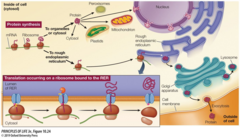
What is the role of the large subunit of rRNA during translation?
It catalyzes the formation of peptide bonds between amino acids.
What is the effect of somatic mutations on an organism?
They may affect the phenotype but are not passed to offspring.

What are mutagens?
Agents that cause changes in the DNA sequence, leading to mutations.
When are proteins modified and what do they modify too?
after synthesis/during post translational processing they are phospholyrated, glycosylated, or proteolysed.