Exam 4: Chp 7, 11, 12
 Call Kai
 Learn
Learn Practice Test
 Spaced Repetition
 Match
Match Flashcards
 Knowt Play
1/90

There's no tags or description
Looks like no tags are added yet.
Name | Mastery | Learn | Test | Matching | Spaced | Call with Kai | Chat |
|---|
No analytics yet
Send a link to your students to track their progress
91 Terms
Bulk transport
The engulfing of receptors to get a bulk of a specific substance
Amphipathic
Both hydrophobic and hydrophilic regions
Why are phospholipids amphipathic?
A stable boundary between two compartments because of the molecular arrangement
Fluid Mosaic Model
The membrane is a mosaic of protein molecules in and around the bilayer
Membrane fluidity
Even in low temperatures, due to the kinks in the unsaturated fats in the membrane, it will not solidify
How does cholesterol affect the membrane fluidity?
It is a fluidity buffer.
At high temperatures, it makes it less fluid by retaining movement
At low temperatures, it lowers the temperature for solidifying because it hinders the phospholipids to pack closely together
Intergral protein
Proteins that are within the membrane (can be partly in, or fully extend to both sides) that can have both hydrophobic and hydrophilic regions
Peripheral proteins
Proteins on the surface of the membrane
6 Functions of Membrane proteins
Transport, Enzymatic activity, signal transduction, cell-cell recognition, intercellular joining, and attachment to cytoskeleton and ECM
Transport protein
A protein that helps with the transport of a solute from one side of the membranes to another.
Types: finding a specific solute, changing solute shape, or using ATP to move solute
Enzymatic activity proteins
An enzyme protein with an active site that helps with membrane reactions
Signal transduction protein
A protein that changes shapes with a signaling molecule that binds to it. This change can relay a message inside the cell membrane.
Cell-cell recognition protein
Identification between cells
Intercellular joining proteins
Proteins on cells that hook onto each other
Protein attached to cytoskeleton and ECM
A protein where microfilament or elements of the cytoskeleton bind onto, helping with cell shape and stabilization of certain membrane proteins
2 Examples of cell-cell recognition
White blood cells: Membrane protein to communicate and identify foreign invaders
No CCR5 receptors, HIV will not affect the cells
Glycolipid
A carb binded to a lipid
Glycoprotein
A carb binded to a protein

Where is the Glycolipid?
The green chain on the phospholipid head

Where is the Glycoprotein?
The green chain on the protein

Where is the integral protein?
Any purple protein that is within the membrane

Where is the Peripheral Protein?
Any purple only on the surface of the membrane

Where is Cholesterol?
The yellow chains in the hydrophobic part of the membrane

Where are the ECM fibers?
The green fibers around the outside of membrane

Where are the Cytoskeleton microfilaments?
The orange chains in the cytoplasm
Channel protein
A hydrophilic channel that allows certain molecules or ions to use as a tunnel through membrane
Carrier protein
Changes the shape of proteins to move them across the membrane
Are transport protein specific?
Yes.
If the protein is not available for a certain molecule, it will not pass into the membrane
This only allows certain ions and molecules to pass through the membrane
Aquaporin
A channel protein that helps move water through the membrane
Diffusion
The movement of particle of any substance so that they spread out into the available space (no energy), high to low gradient
Concentration gradient
The region along which the density of a chemical substance increase or decreases (each substance has its own concentration gradient)
Passive transport
The diffusion of a substance across a biological membrane
Osmosis
The diffusion of free water (water that has the ability to move/has no solute; regular water) across the membrane
Turgid
A cell is firm (normal in plant cells, bursting in animal cell)
Flaccid
A cell is limp (Normal in animal cells)
Plasmolysis
Due to being placed in a hypertonic solution, the plasma membrane pulls away from the cell wall

How does diffusion work with two solutes?
Each of the two solutes will diffuse down its own gradient; they do not effect one another
Why does a plant cell not burst in a hypotonic solution?
A plant cell has a cell wall that will exert pressure back onto the cell, that will refuse more water intake
Facilitated diffusion
A protein that helps pass polar molecules and ions through the membrane with no energy
Ex. Channel protein, carrier protein
Active transport
Solutes moving against their gradient concentration (low to high) with energy
Only carrier proteins
ATP will give a phosphate group in order to change protein’s shape for ion

What is happening in 1?
Na+ from the cytoplasm binds to the sodium-potassium pump/transport protein

What is happening in 2?
The binding of all 3 Na+ ions stimulates phosphorylation by a kinase, using ATP (Phosphate is added to pump; ATP to ADP)

What is happening in 3?
Phosphorylation leads to a change in protein shape, and releases Na+ to the other side

What is happening in 4?
With the new shape, it attracts K+ and binds to the protein. The binding of the 2 K+ causes the phosphate group to be released

What is happening in 5?
The loss of the phosphate group restores the protein back to its shape, which does not attract K+

What is happening in 6?
The 2 K+ are released into the cytoplasm, the cycle repeats
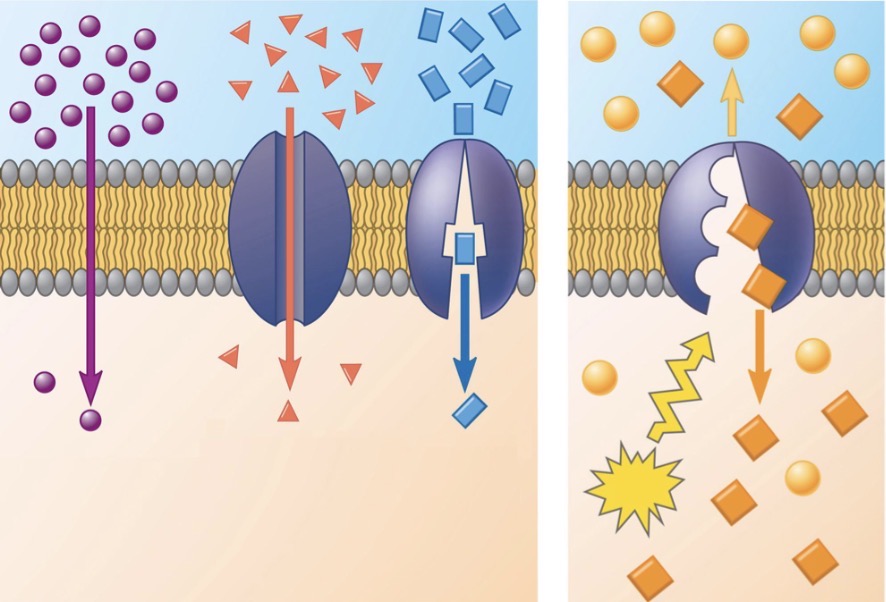
Which one is simple diffusion?
1/Purple

Which one is facilitated diffusion with a channel protein?
2/Orange

Which one is facilitated diffusion with a carrier protein?
3/Blue

Which one is active transport with a carrier protein?
4/Multi colored ions
Membrane potential
The voltage across a membrane
Which side of the membrane will have a positive charge?
The outside membrane, the membrane favors the passive transport of cations
What are the two forces that drive diffusion of ions across the membrane?
Chemical force and Electrical force
Chemical force
The ion’s concentration gradient
Electrical force
The effect of the membrane potential on the ion’s movement
Cotransport
A transport protein can couple the downhill diffusion of a solute and uphill transport of a second substance against its own gradient
How is Cotransport used in the treatment of diarrhea?
An animal cell uses Na+ and glucose together in intestinal cells.
Diarrhea expels water so rapidly, the colon cannot reabsorb sodium
Treatment: A drink containing Na+ and glucose together allows Na+/Glucose transporters on the surface of intestinal cells and pass through the cells into the blood
Exocytosis
A vesicle with proteins/substances merges with the cell membrane, releasing those proteins/substances out of the cells
Endocytosis
The cell takes in molecules and particles, forming new vesicles to take them into the cell
Receptor-mediated endocytosis
The engulfing of receptors to acquire bulk quantities of specific substances
Phagocytosis
Type of endocytosis; A cell a particle by extending around it and packing it within a membranous sac
Pinocytosis
A cell brings in extracellular fluid with solutes from outside of the membrane into the cell by engulfing around it
What type of transport is endocytosis, exocytosis, phagocytosis, and pinocytosis?
Active transport
Electrogenic pump
A transport protein that generates voltage across a membrane (Ex. Protein pump, translocates H+ out of the cells with the ATP)
Quorum sensing
Bacteria being able to sense each other from the signaling molecules they send out
Biofilms
A group of bacteria cells that combine into one once a certain density is met
Usually bacteria lacking nutrients
How are quorum sensing and biofilm lead to disease?
The communication and merge in of bacteria with antibiotic resistance can cause issue with fight the bacteria
What are the three steps in signal transduction pathway?
Signal reception
Signal transduction
Cellular response
How can chemical signals pass through adjacent animal cells?
Gap junctions
How can chemical signals pass through plant cells?
Plamosdesmata
2 more ways chemical signals pass through animal cells?
Local signaling and Long-distance signaling
Local signaling
Signaling molecules are secreted by the signaling cell (Short distance)
Long-distance signaling
Special cells that secrete hormones and bind to specific cells
3 ways of animal signaling molecules
Paracrine signaling, Synaptic signaling, Endocrine (hormonal) signaling
Paracrine signaling
A signaling cell acts on nearby target cells by secreting molecules of a local regulator
Synaptic signaling
An electrical signal along a nerve cell triggers the secretion of neurotransmitter molecule
Endocrine (hormonal) signaling
Specialized endocrine cells that secrete hormones into body fluid
Why are chemical signals received by specific cells?
The receptors of specific chemical signals are on/within the cell, that is how a response is enabled

Compete the signal transduction pathways
Signal reception
Signal transduction
Cellular response
Signal reception
The binding of a signaling molecule to the receptor on the cell’s surface
Signal transduction
converting the signal to form a specific cellular response (can be one or more steps)
Cellular response
The transducer signal finally trigger a specific cellular response
Ligand
The signaling molecule
3 categories of receptors
G protein-coupled receptors (GPCRs), Receptor Tyrosine Kinases (RTKs), and Ion channel receptors
How does a G-protein receive a signal?
The GPCR receives a single from the signaling molecule that binds from the outside of the cell. The GPCR binds to the G-Protein and is activated

What is happening here? (1)
All proteins are inactive
What is happening here? (2)
Signaling molecule binds to GPCR
GPCR will bind to G-protein
GPCR will displace GDP into GTP on the G-protein, activating the protein

What is happening here? (3)
G-protein will dissociate from the GPCR and move to the enzyme, binding to it and chasing it shape and activity
The enzyme will trigger the cellular response
At the same time, the signaling molecule will dissociate from GPCR

What is happening here? (4)
G-protein will hydrolyze its bound GTP to GDP and P, deactivating it
The enzyme will not longer be active
This allows the pathways to rapidly shut down
Why is it important that the G-protein is also a GTPase enzyme?
It hydrolyze GTP to GDP and P, deactivating it
Kinase enzyme