astronomy week 5: a celestial census
 Call Kai
 Learn
 Practice Test
 Spaced Repetition
 Match
 Flashcards
 Knowt Play
1/13

Earn XP
Description and Tags
activities 5.1 and 5.2, homework 5
14 Terms

Suppose Earth is situated "below" the image. In this position, Star A would be moving toward Earth at time 1. Complete this table indicating the Doppler shift from each star at each time (either bueshifted, redshifted, or neither).
Time 1 - Star A shift and Star B shift
Time 2 - Star A shift and Star B shift
Time 3 - Star A shift and Star B shift
Time 4 - Star A shift and Star B shift
Part one of question A
Time 1 - blueshifted and redshifted
Time 2 - neither and neither
Time 3 - redshifted and blueshifted
Time 4 - neither and neither
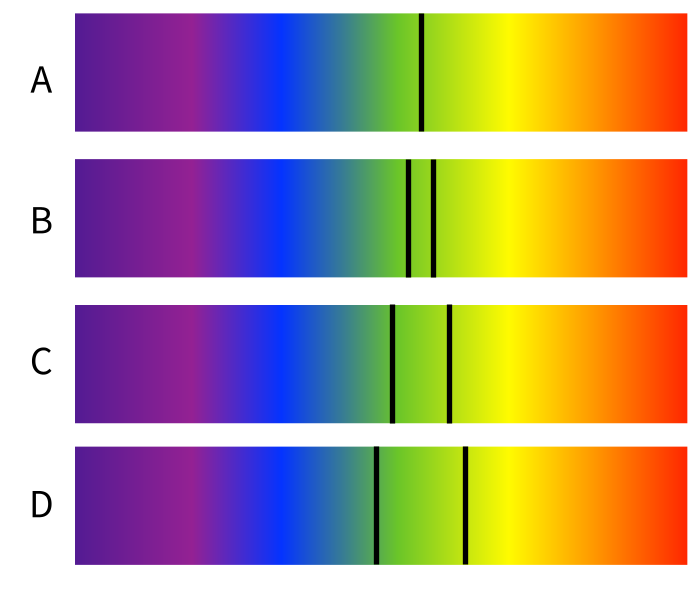
Suppose the stars are identical, and the binary system may be orbiting quickly or slowly. Which statements best match each spectrum?
Observed at time for any speed
Observed at time for a slow-moving pair
Observed at time for a fast-moving pair
Part two of question A
Spectrum A: Observed at time 4 for any speed
Spectrum B: Observed at time 3 for a slow-moving pair
Spectrum D: Observed at time 3 for a fast-moving pair
Describe the stars in each class in your own words. Use simple adjectives like 'hot', 'cool', 'red', 'blue', 'bright', 'dim', and similar descriptions.
Giants
Supergiants
White Dwarfs
Red Dwarfs
Main sequence
Giants: Red, cool, bright
Supergiants: Various colors, various temperatures, very bright
White Dwarfs: Various colors, dim
Red Dwarfs: Red, cool, dim
Main sequence: Various colors, various temperatures, various luminosities
The Sun's luminosity is one (since these are solar units) and its temperature is 5800K.
What type of star is the Sun?
Main sequence
If a star has the same temperature as the sun but has 100x its luminosity, what class is it?
Giant

At times 1 and 3, what type of Doppler shift does each star's spectrum have, and which star will show a larger shift in its spectrum when viewed from Earth?
Part 1 of question B
Time 1 - Star A shift: blueshift, Star B shift: redshift
Time 3 - Star A shift: redshift, Star B shift: blueshift
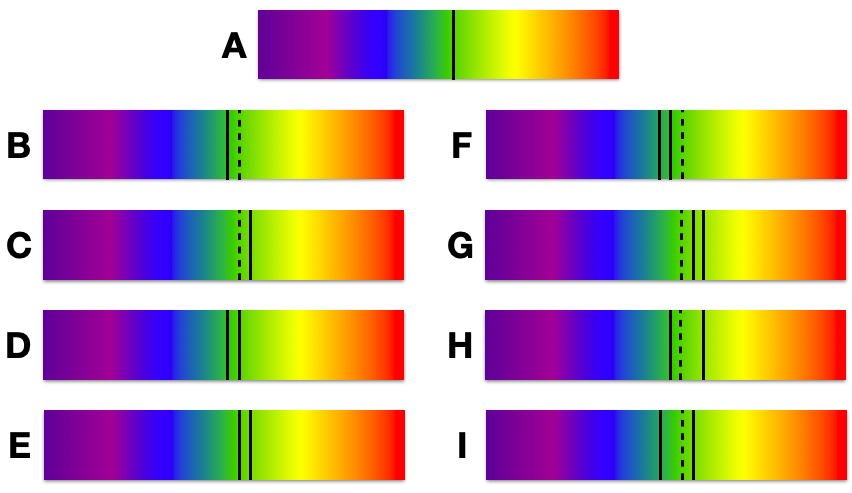
t each time, select what spectrum the Earth would seen when looking at the binary stars from afar. The dashed line shows the unshifted absorption line.
Time 1
Time 2
Time 3
Time 4
Time 1 - H
Time 2 - A
Time 3 - A
Time 4 - I

Using the H-R diagram above, which star is mostly likely in luminosity class I (Ia or Ib)?
Star B

Using the H-R diagram above, which star would be classified as an M2III star?
Star E
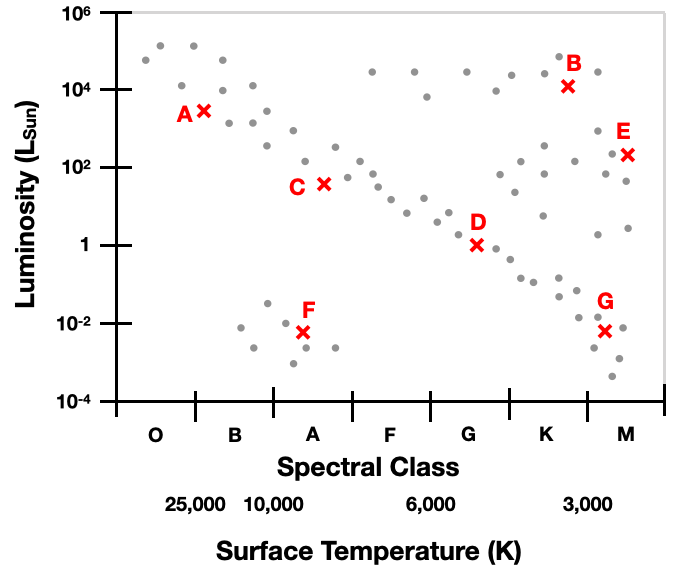
Using the H-R diagram above, which stars are on the main sequence?
Star A, Star C, Star D, Star G

Using the H-R diagram above, which star on the diagram is the Sun?
Star D
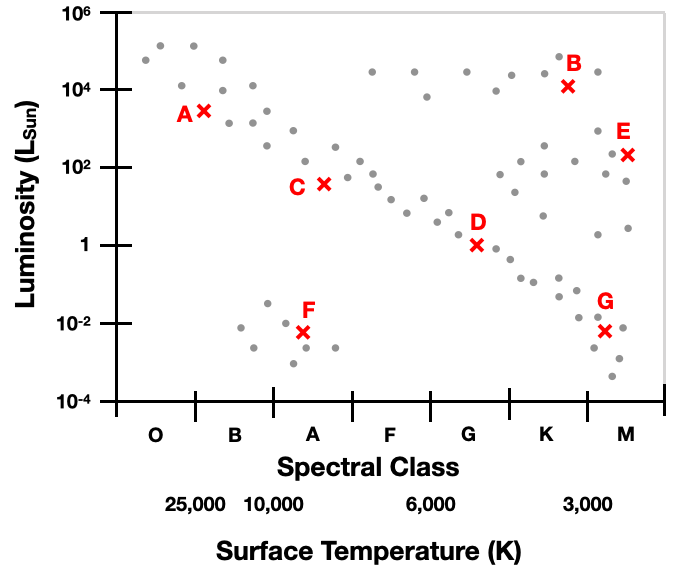
In the diagram, the largest star is [?] and the smallest is [?].
B and F

Suppose that you measure these four blackbody curves. Which stars on the H-R diagram below could these match?
Curve 1
Curve 2
Curve 3
Curve 4
Curve 1 - Star A
Curve 2 - Star D
Curve 3 - Star B
Curve 4 - Star C
Stars and Stellar Classes:
A - G2V
B - K2III
C - K2V
D - O2V
E - M2V
Star B is a [?] star and the rest are [?] stars.
The hottest star is Star [?] and the coolest is star [?].
Compared to Star [?], Star [?]'s temperature is cooler .
The most luminous star must be Star [?] and the least luminous must be Star [?].
Star [?] could be our Sun.
Star B is a giant star and the rest are main-sequence stars.
The hottest star is Star D and the coolest is star E .
Compared to Star B, Star C's temperature is cooler .
The most luminous star must be Star D and the least luminous must be Star E .
Star A could be our Sun.