AP Psych Unit 2: Cognition
0.0(0)
Studied by 0 people Call Kai
 Learn
 Practice Test
 Spaced Repetition
 Match
 Flashcards
 Knowt Play
Card Sorting
1/175

There's no tags or description
Looks like no tags are added yet.
176 Terms
1
New cards
Perception
The process of organizing and interpreting sensory information, enabling us to recognize meaningful objects and events.
2
New cards
Bottom-Up Processing
Analysis that begins with the sensory receptors and works up to the brain's integration of sensory information.
3
New cards
Top-Down Processing
Information processing guided by higher-level mental processes, as when we construct perceptions drawing on our experience and expectations.
4
New cards
Schemas
Mental frameworks or concepts that help us organize and interpret information based on past experiences.
5
New cards
Perceptual Set
A mental predisposition to perceive one thing and not another, heavily influenced by expectations, context, emotion, and motivation.
6
New cards
Attention
The cognitive process of selectively concentrating on one aspect of the environment while ignoring other things.
7
New cards
Selective Attention
The focusing of conscious awareness on a particular stimulus.
8
New cards
Cocktail Party Effect
The ability to attend to only one voice among many, while still being able to detect personally relevant stimuli like your own name in an unattended conversation.
9
New cards
Inattentional Blindness
Failing to see visible objects when our attention is directed elsewhere.
10
New cards
Change Blindness
Failing to notice changes in the environment after a brief visual interruption.
11
New cards
Gestalt Psychology
An organized whole; Gestalt psychologists emphasized our tendency to integrate pieces of information into meaningful wholes.
12
New cards
Closure
The Gestalt grouping principle that we fill in gaps to create a complete, whole object.

13
New cards
Figure and Ground (figure-ground)
The organization of the visual field into objects (the figures) that stand out from their surroundings (the ground).

14
New cards
Grouping
The perceptual tendency to organize stimuli into coherent groups using rules like proximity, similarity, continuity, and closure.
15
New cards
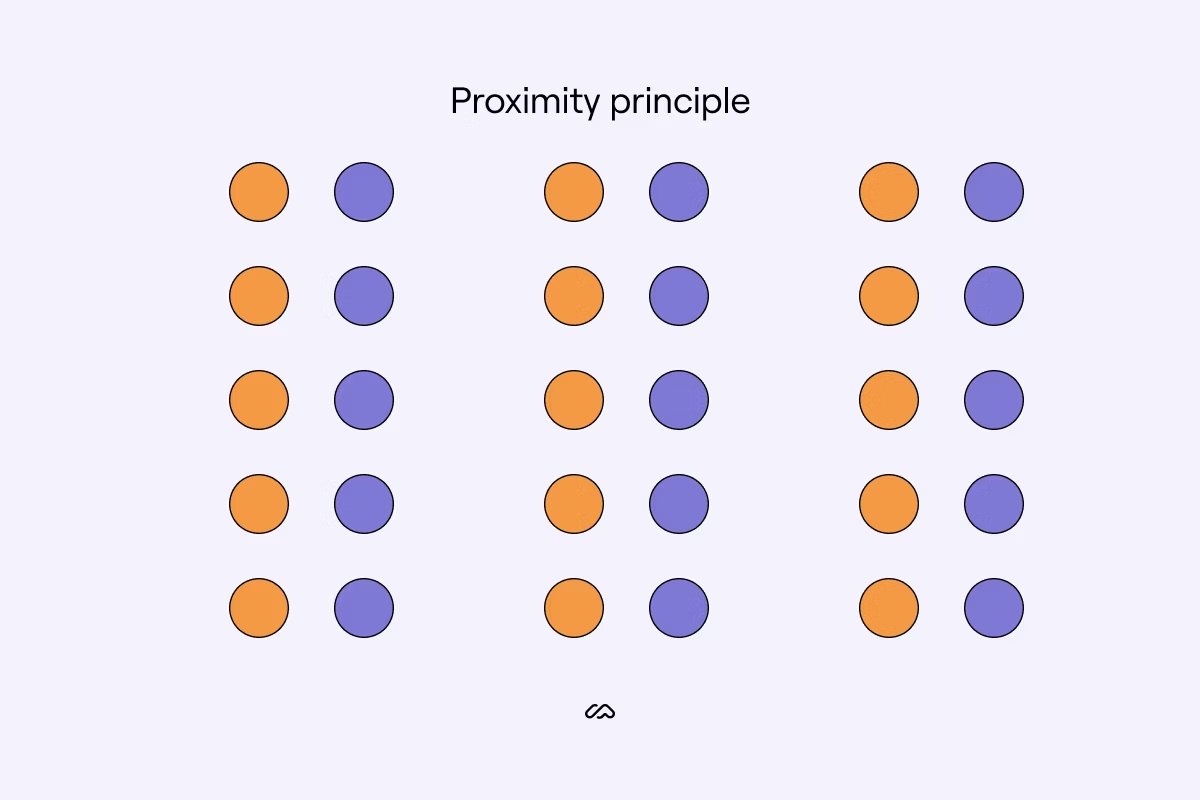
Proximity
The Gestalt grouping principle that we group nearby figures together.
16
New cards
Similarity
The Gestalt grouping principle that we group similar figures together.

17
New cards
Depth Perception
The ability to see objects in three dimensions although the images that strike the retina are two-dimensional, allowing us to judge distance.
18
New cards
Visual Cliff
A laboratory device for testing depth perception in infants and young animals, consisting of a solid glass surface over a patterned drop-off. It demonstrated that infants develop depth perception by the time they can crawl.
19
New cards
Binocular Cues
Depth cues, such as retinal disparity and convergence, that depend on the use of two eyes.
20
New cards
Convergence
A binocular cue for perceiving depth; the extent to which the eyes turn inward when looking at an object, with greater inward strain signaling a closer object.

21
New cards
Retinal Disparity
A binocular cue for perceiving depth; by comparing images from the retinas in the two eyes, the brain computes distance, where greater disparity indicates a closer object.

22
New cards
Monocular Cues
Depth cues, such as interposition and linear perspective, available to either eye alone.
23
New cards
Relative Clarity
A monocular depth cue in which hazy or blurry objects are perceived as farther away than sharp, clear objects.
24
New cards
Relative Size
A monocular depth cue in which, if we assume two objects are similar in size, most people perceive the one that casts the smaller retinal image as farther away.
25
New cards
Texture Gradient
A monocular depth cue in which a gradual change from a coarse, distinct texture to a fine, indistinct texture signals increasing distance.
26
New cards
Linear Perspective
A monocular depth cue in which parallel lines appear to meet in the distance, with sharper convergence indicating greater distance.

27
New cards
Interposition
A monocular depth cue in which an object that partially blocks our view of another object is perceived as closer.
28
New cards
Perceptual Constancies
Perceiving objects as unchanging (having consistent shapes, size, brightness, and color) even as illumination and retinal images change.
29
New cards
Color Constancy
Perceiving familiar objects as having consistent color, even if changing illumination alters the wavelengths reflected by the object.
30
New cards
Perceptual Adaptation
The ability to adjust to changed sensory input, including an artificially displaced or even inverted visual field.
31
New cards
Apparent Motion
An illusion of movement created when stationary objects are presented in rapid succession or under specific lighting conditions.
32
New cards
Stroboscopic Movement
An illusion of continuous motion created when the brain perceives rapid series of slightly varying images as moving, such as in flipbooks or movies.
33
New cards
Phi Phenomenon
An illusion of movement created when two or more adjacent lights blink on and off in quick succession.
34
New cards
Autokinetic Effect
The perceptual illusion in which a stationary point of light in a completely dark room appears to move due to tiny, involuntary eye movements.
35
New cards
Cognition
All the mental activities associated with thinking, knowing, remembering, and communicating.
36
New cards
Metacognition
Awareness and understanding of one's own thought processes, often described as "thinking about thinking."
37
New cards
Concept
A mental grouping of similar objects, events, ideas, or people.
38
New cards
Prototype
A mental image or best example of a category that provides a quick and easy method for sorting items into groups.
39
New cards
Schema
A concept or framework that organizes and interprets information based on past experiences.
40
New cards
Assimilation
Interpreting our new experiences in terms of our existing schemas.
41
New cards
Accommodation
Adapting our current understandings (schemas) to incorporate new information.
42
New cards
Executive Functions
Higher-level cognitive processes that enable planning, forethought, goal-directed behavior, working memory, and impulse control.
43
New cards
Algorithm
A methodical, logical rule or procedure that guarantees solving a particular problem, though it often takes more time than a heuristic.
44
New cards
Heuristic
A simple thinking strategy or mental shortcut that often allows us to make judgments and solve problems efficiently, though it is more error-prone than an algorithm.
45
New cards
Representativeness Heuristic
Judging the likelihood of things in terms of how well they seem to represent, or match, particular prototypes, which may lead us to ignore other relevant information.
46
New cards
Availability Heuristic
Estimating the likelihood of events based on their availability in memory; if instances come readily to mind, we presume such events are common.
47
New cards
Mental Set
A tendency to approach a problem in one particular way, often a way that has been successful in the past.
48
New cards
Priming
The activation, often unconsciously, of certain associations, thus predisposing one's perception, memory, or response.
49
New cards
Framing
The way an issue is posed; how an issue is framed can significantly affect decisions and judgments.
50
New cards
Nudge
A subtle environmental cue or change in how choices are presented that gently steers people toward a particular decision without restricting their freedom of choice.
51
New cards
Gambler’s Fallacy
The mistaken belief that if something happens more frequently than normal during a given period, it will happen less frequently in the future (or vice versa) in independent events.
52
New cards
Sunk-Cost Fallacy
The tendency to continue investing time, money, or effort into a losing endeavor simply because of the resources already invested that cannot be recovered.
53
New cards
Functional Fixedness
The tendency to think of things only in terms of their usual functions, which acts as an impediment to problem solving.
54
New cards
Insight
A sudden realization of a problem's solution, contrasting with strategy-based solutions.
55
New cards
Confirmation Bias
A tendency to search for information that supports our preconceptions and to ignore or distort contradictory evidence.
56
New cards
Fixation
The inability to see a problem from a new perspective, acting as an impediment to problem solving.
57
New cards
Intuition
An effortless, immediate, automatic feeling or thought, as contrasted with explicit, conscious reasoning.
58
New cards
Overconfidence
The tendency to be more confident than correct—to overestimate the accuracy of our beliefs and judgments.
59
New cards
Belief Perseverance
Clinging to one's initial conceptions after the basis on which they were formed has been discredited.
60
New cards
Creativity
The ability to produce novel and valuable ideas.
61
New cards
Divergent Thinking
Expanding the number of possible problem solutions; creative thinking that diverges in different directions.
62
New cards
Convergent Thinking
Narrowing the available problem solutions to determine the single best solution.
63
New cards
Intelligence
Mental quality consisting of the ability to learn from experience, solve problems, and use knowledge to adapt to new situations.
64
New cards
General Intelligence (g)
A general intelligence factor that, according to Charles Spearman and others, underlies specific mental abilities and is therefore measured by every task on an intelligence test.
65
New cards
Factor Analysis
A statistical procedure that identifies clusters of related items (called factors) on a test; used to identify different dimensions of performance that underlie a person's total score.
66
New cards
Fluid Intelligence (Gf)
Our ability to reason speedily and abstractly, as when solving novel logic problems; tends to decrease with age, especially during late adulthood.
67
New cards
Crystallized Intelligence (Gc)
Our accumulated knowledge and verbal skills; tends to increase with age.
68
New cards
Cattell-Horn-Carroll Theory (CHC)
A comprehensive model of intelligence proposing that human cognitive abilities are organized into a three-tier hierarchy, combining general intelligence (g), broad abilities (such as fluid and crystallized intelligence), and narrow, specific skills.
69
New cards
Multiple Intelligences
Howard Gardner's theory that people do not have just an intellectual capacity, but have many kinds of intelligence, including musical, interpersonal, spatial-visual, and linguistic intelligences.
70
New cards
Savant Syndrome
A condition in which a person otherwise limited in mental ability has an exceptional specific skill, such as in computation or drawing.
71
New cards
Grit
In psychology, passion and perseverance in the pursuit of long-term goals.
72
New cards
Emotional Intelligence
The ability to perceive, understand, manage, and use emotions.
73
New cards
Stanford-Binet
The widely used American revision (by Lewis Terman at Stanford University) of Alfred Binet's original intelligence test.
74
New cards
Intelligence Quotient (IQ)
Defined originally as the ratio of mental age (ma) to chronological age (ca) multiplied by 100 (thus, IQ = ma/ca × 100). On contemporary intelligence tests, the average performance for a given age is assigned a score of 100.
75
New cards
Mental Age
A measure of intelligence test performance devised by Alfred Binet; the chronological age that most typically corresponds to a given level of performance.
76
New cards
Wechsler-Adult Intelligence Scale (WAIS)
The most widely used intelligence test; contains verbal and performance (nonverbal) subtests and yields an overall intelligence score as well as separate scores for verbal comprehension, perceptual organization, working memory, and processing speed.
77
New cards
Psychometrics
The scientific study of the measurement of human abilities, attitudes, and traits.
78
New cards
Standardization
Defining uniform testing procedures and meaningful scores by comparison with the performance of a pretested group.
79
New cards
Normal Curve
The symmetrical, bell-shaped curve that describes the distribution of many physical and psychological attributes. Most scores fall near the average, and fewer and fewer scores lie near the extremes.
80
New cards
Valid
The extent to which a test measures or predicts what it is supposed to.
81
New cards
Content Validity
The extent to which a test samples the behavior that is of interest (such as a driving test that samples driving tasks).
82
New cards
Construct Validity
The degree to which a test or measure actually assesses the theoretical psychological construct (such as intelligence or anxiety) it claims to measure.
83
New cards
Predictive Validity
The success with which a test predicts the behavior it is designed to predict; it is assessed by computing the correlation between test scores and the criterion behavior.
84
New cards
Reliable
The extent to which a test yields consistent results, as assessed by the consistency of scores on two halves of the test, on alternate forms of the test, or on retesting.
85
New cards
Test-Retest Reliability
A method for determining the reliability of a test by comparing a test-taker's scores on the same test taken on two different occasions.
86
New cards
Split-Half Reliability
A measure of internal consistency reliability obtained by dividing a test into two equal halves (such as odd-numbered vs. even-numbered items) and comparing the scores on both halves.
87
New cards
Stereotype Threat
A self-confirming concern that one will be evaluated based on a negative stereotype, which can impair performance on tests or tasks.
88
New cards
Stereotype Lift
A boost in performance on a test or task caused by the awareness that an outgroup is negatively stereotyped, leading an individual to feel confident about their own group's abilities.
89
New cards
Flynn Effect
The worldwide phenomenon showing that intelligence test performance has been rising steadily over time across generations, requiring tests to be periodically restandardized.
90
New cards
Cross-Sectional Study
A research method in which people of different ages are compared with one another at a single point in time.
91
New cards
Longitudinal Study
A research method in which the same people are restudied and retested over a long period of time.
92
New cards
Cohort
A group of people from a given time period or generation who share common historical, cultural, and environmental experiences (which can act as a confounding variable in cross-sectional studies).
93
New cards
Achievement Tests
Tests designed to assess what a person has already learned (such as the AP Psychology exam or a final unit test).
94
New cards
Aptitude Tests
Tests designed to predict a person's future performance; aptitude is the capacity to learn (such as the SAT or ACT).
95
New cards
Fixed Mindset
Carol Dweck's concept of the belief that intelligence and abilities are static, unchangeable traits that you are born with, often leading individuals to avoid challenges to prevent failure.
96
New cards
Growth Mindset
Carol Dweck's concept of the belief that intelligence and abilities are changeable and can be developed through effort, practice, and learning from mistakes.
97
New cards
Memory
The persistence of learning over time through the encoding, storage, and retrieval of information.
98
New cards
Explicit Memory
Conscious, intentional recollection of facts and personal experiences (declarative memory), processed primarily by the hippocampus and frontal lobes.
99
New cards
Episodic Memory
A subtype of explicit memory for personally experienced events tied to a specific time and place.
100
New cards
Semantic Memory
A subtype of explicit memory for general world knowledge, facts, and vocabulary independent of personal experience.