Bsci 207 Unit 4
 Call Kai
 Learn
 Practice Test
 Spaced Repetition
 Match
 Flashcards
 Knowt Play
1/64

There's no tags or description
Looks like no tags are added yet.
65 Terms
Time for signaling molecule to diffuse 100 cm

Evolutionary challenge of becoming large
Need to evolve ability to:
move
sense and catch food
eat food
avoid predators
evolve ability to send signals long distances from existing proteins/ cells structures
Evolutionary challenge answer: the neuron
evolve cell with axon for rapid, long distance communication
action potentials move quickly down axons
propagation velocity ~m/s Time to go 1 meter = 10 ms
Common themes in sensory response systems
Three step process: Sensing-integration-response
SIR system
Evolution of electrical signaling
all organisms respond to environmental stimuli
electrical signals depend on voltage gated channels that evolved in early life
fast-moving signals called action potentials have arisen in several lineages, including plants
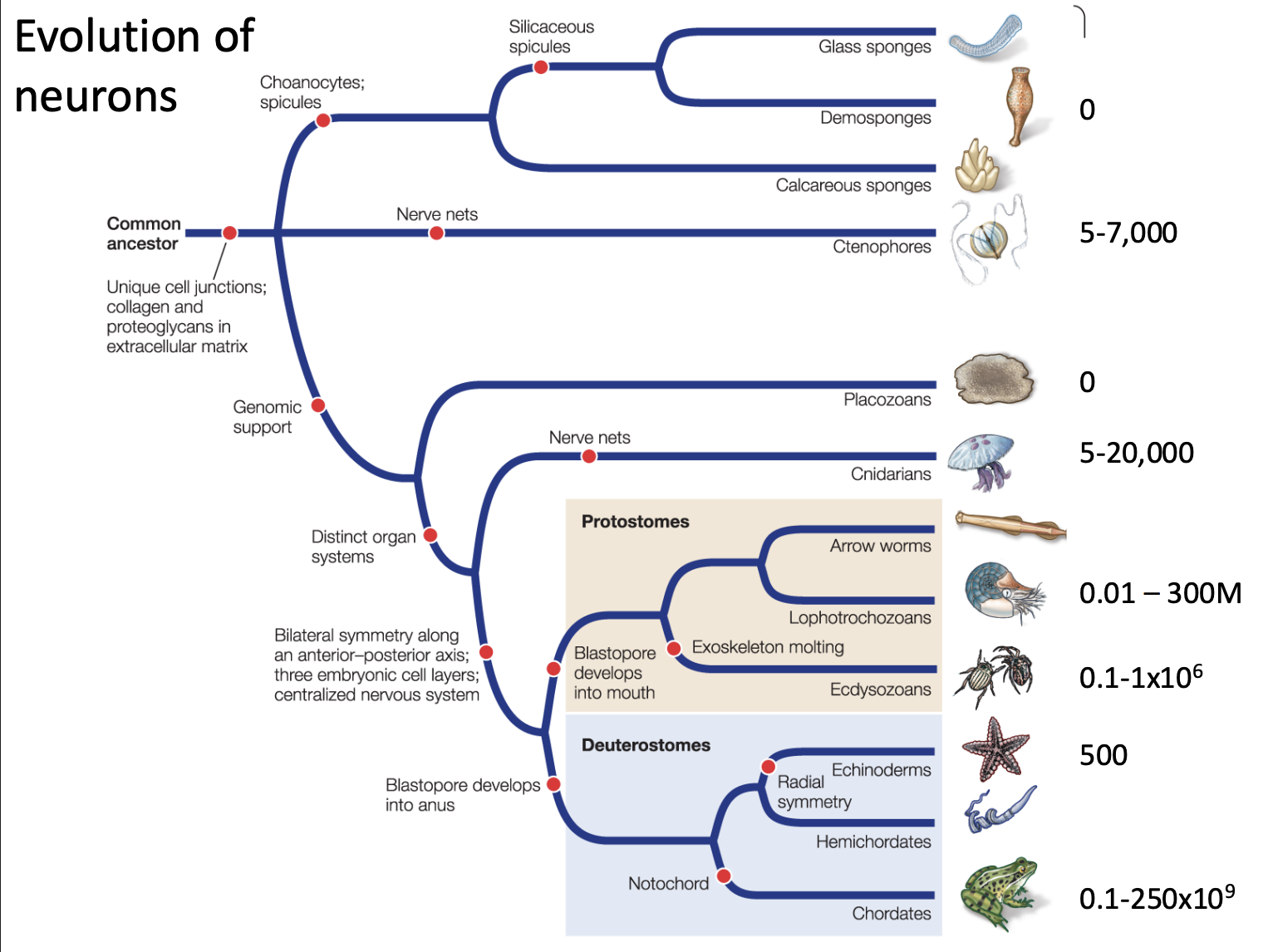
Evolution of neurons
The hierarchy of electrical signaling in animals
Molecular level: transmembrane ion flowers
cellular level: lateral electrical signaling
tissue level: cel to celll signaling
organ level: complex signal processing
system level: perception, integration, and response
higher-order phenomena: consciousness, learning, memory, etc.
Neuron: receiver and sender of signals
Dendrites: collect electrical signals
Cell body: integrates incoming signals and generates outgoing signal to axon
axon: passes electrical signals to the dendrites of another cell or to another effector cell
synapse: chemicals released

Electrochemical gradient
ion concentration differences are set up by sodium potassium pump (this takes energy)
this sets up the concentration gradient ( outside high NA and Cl conc, and inside is high K and A conc)
IF there are open K+ channels, K+ ions will move across the membrane until the chemical (diffusion) and electrostatic forces are balanced
ion movement across membrane causes charge difference across membrane
What if there are NO ion channels for an ion to move thorugh
nno ion movement
no membrane charge
no membrane potential
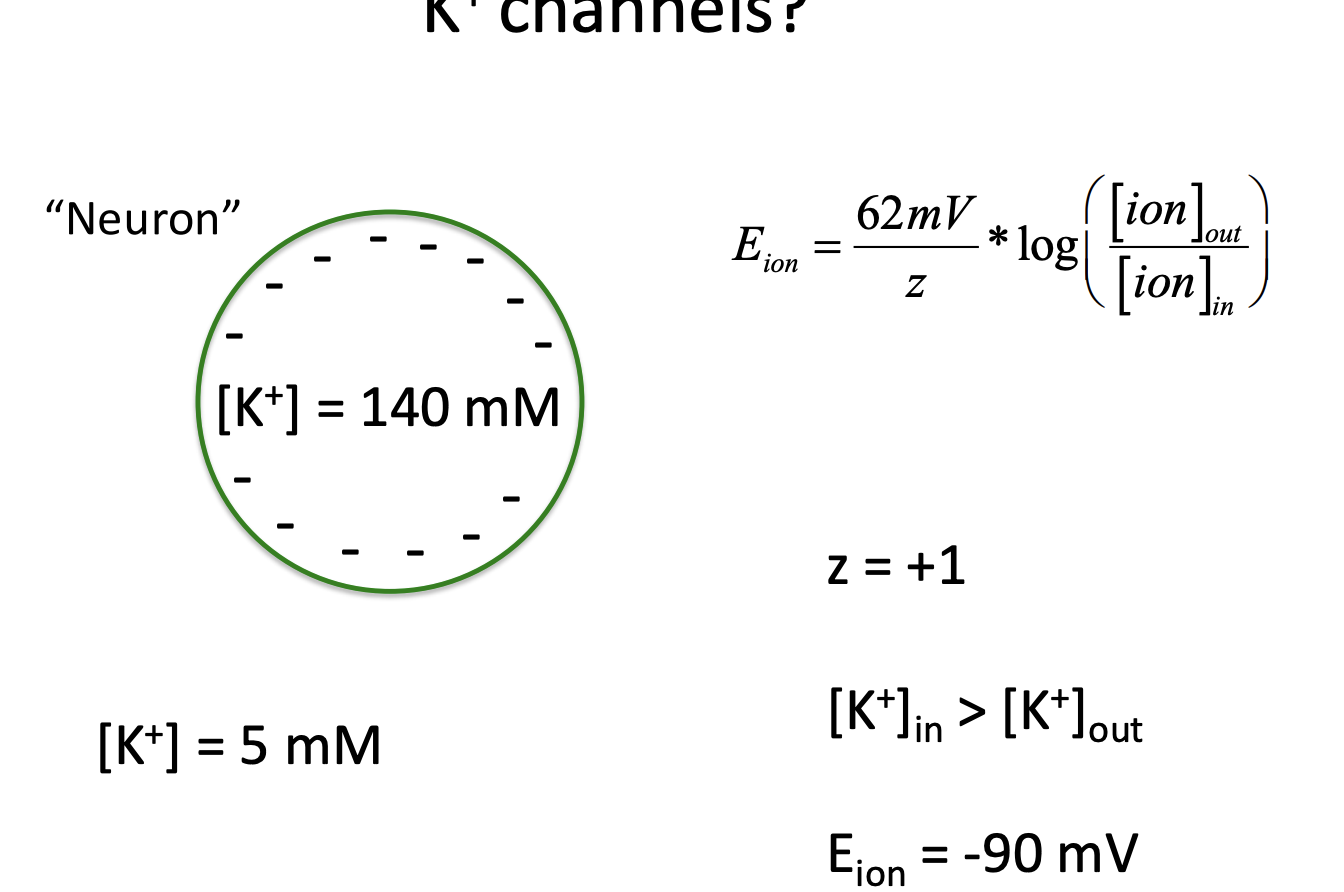
What is sign of charge to maintain K+ conc IF there are open K+ channels?
if K+ conc are reversed, EK+= positive, and K+out >K+in

What is the sign of the charge inside neuron that balances the inner and outer Cl- IF there are open Cl- channels?

How is the membrane potential established?
Cation pumping - Na+/K+ pump in animal cell membranes, or H+
pump in cell membranes of other organisms
Passive diffusion of ions (especially K+) in “leaky” channels down
their net electrochemical gradients
Na/K pump K + leak channel→ resting membrane potentia;
Na/K pump → initial chemical gradients
Leaky channels → electrical gradient = resting membrane potential
Quantifying the membrane potential (at equilibrium)
the diffusion of ions due to conc differences = movement of ions due to electrical potential

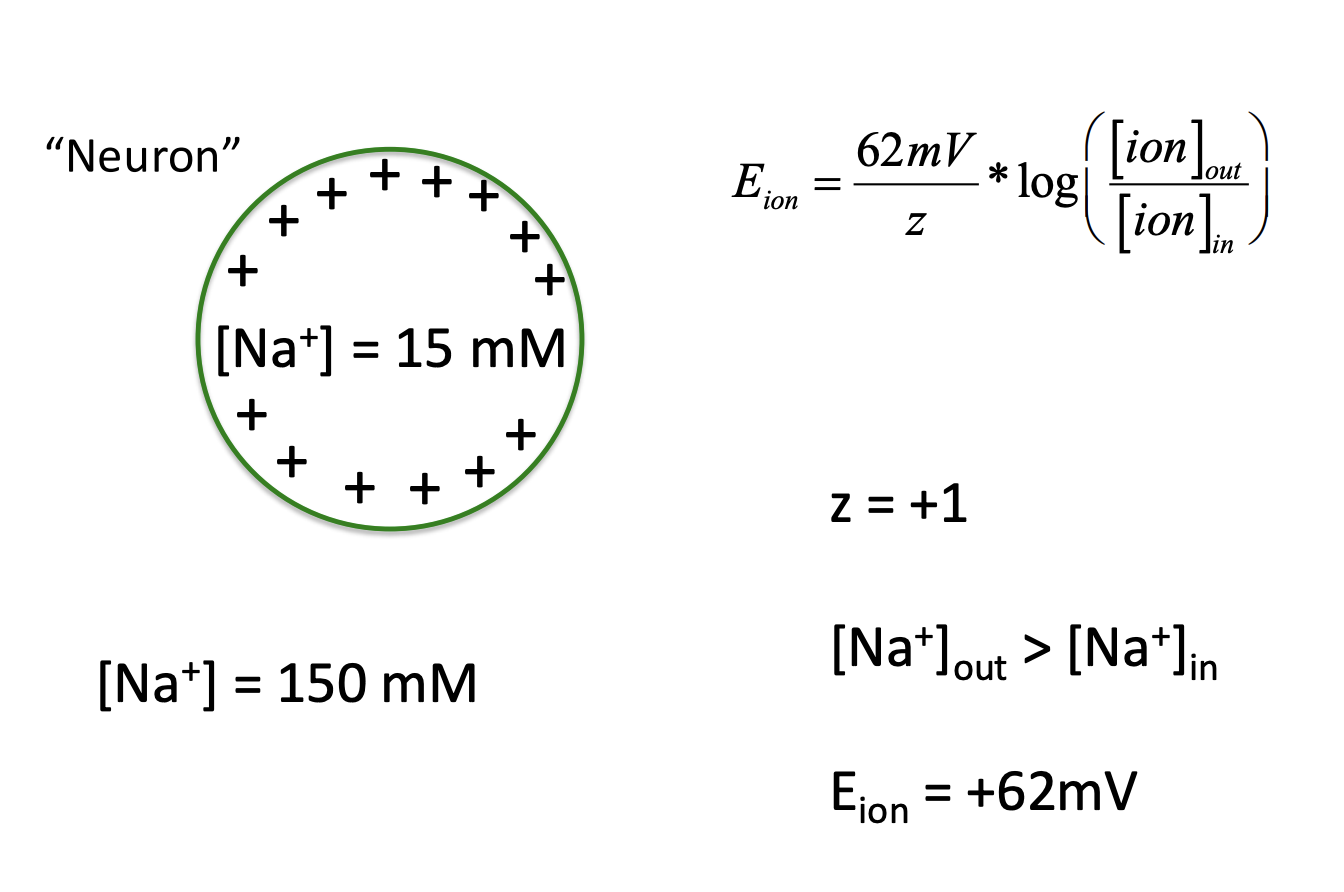
Nernst Equation
determines resting membrane potential
can solve for equilibrium/resting membrane potential that results from concentration differences

prefix value depends on temperature

How big is E for a typical neuron wth Na+ Channels
How big is E for a typical neuron wth K+ Channels
Leak channel proteins
act to establish the resting membrane potential
Channels
form aqueous pores with selectivity filters that alow particular solutes/ions to diffuse down their EC gradients
leak channels: always open, “resting” membrane potential
voltage gated channels: open under certain conditions, action potential
ligand gated channel: opens in response to a signal, triggers neuron
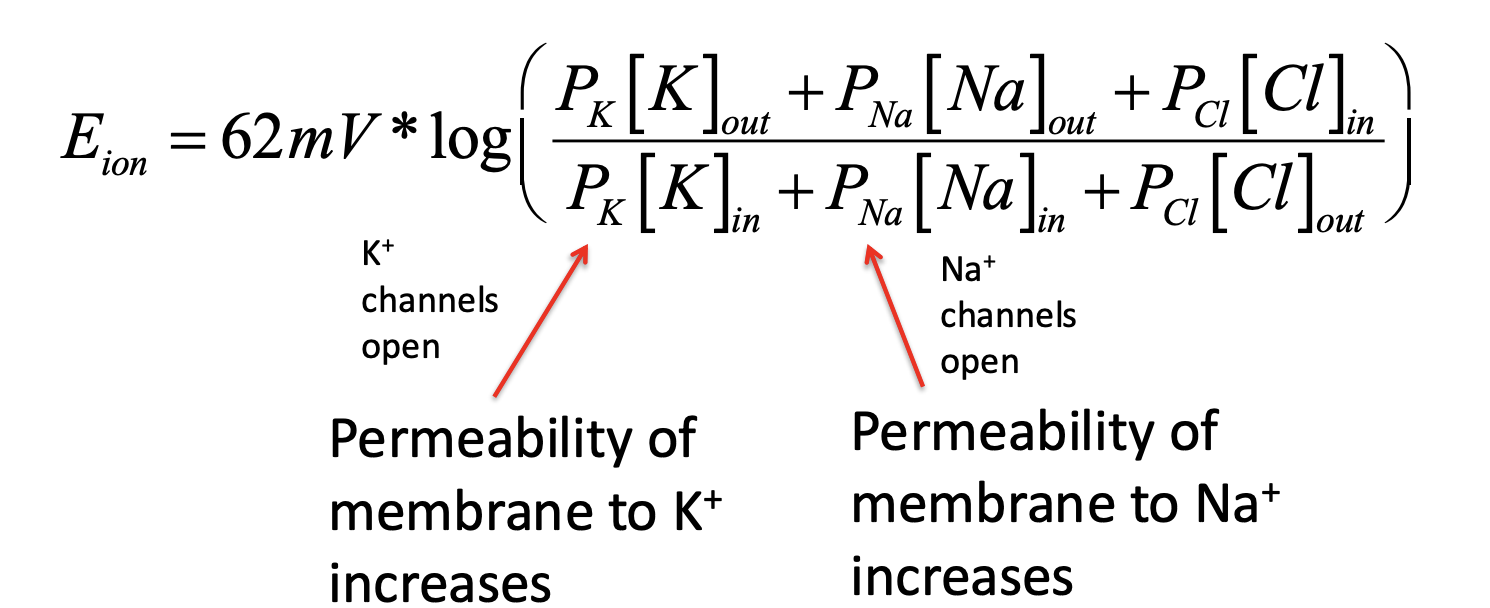
Na+ ion channels open
opening new Na+ channels decreases membrane potential. inside of the cell becomes more positive and depolarized
K+ ion channels open?
opening more K+ channels makes the membrane potential more negative and hyperpolarizes the cells
Changing membrane potential
what happens if new ion channels open?
action potentials
an organized dance of gated ion channels and moving ions.
types of channels;
Leaky K_
signal dependent Na+
voltage gates Nav+
Voltage gated KV+
Membrane potential
in resting state, voltage gated sodium and potassium channels are closed. The “leaky” potassium channels are always open.
Cell receives a stimulus (dendritic signal to become positive) which opens ligand gate. Na+ channels in dendrites
once cell reaches threshold depolarization, lots of Nav+ channels open and E takes off toward ENa=+62 mV
gated potassium channels open. K+ flows out hyperpolarizing cell.
more Kv+ channels are open so membrane potential close to Ek
two limits to membrane potential

Action potential
spreads as a wave of depolarization
only goes one way: sodium channgels are inactivated during falling phase and membrane potential undershoots.
can’t fire again for 1-2 ms. refractory period. cell can fire 500-1000 AP/Sec
Chemical synapse
when wave of depolarization gets to synapse, voltage gated Cav2+ channels open
causes synaptic vesicle to fuse with cell membrane and neurotransmitter to be releaesd
Neurons electrical activities
entire neuron: resting membrane potential
dendrites: graded post synaptic potentials in response to signals
axons: all or non action potentials
Neurons chemical signals
synapses: neurotransmitters diffuse between pre-synaptic axon and post-synaptic dendrites
key ideas 1
1. Membrane potential results from diffusion of some ions (K+ ) but not others (Cl- ) across cell membrane
2. Electrical attraction of membrane potential balances diffusion resulting from the concentration differences
3. This balanced tension is released when gated ion channels open causing a rapid change to the membrane potential = action potential
4. When the action potential reaches the synapse, Ca channels open and neurotransmitter is released.
Two types of neurotransmitter receptors
ligand gated ion channel: neurotransmitter binds to channel, channel opens, ions flow changing membrane potential
neurotransmitter binds to GCPR: Ligand binds to G protein coupled receptor. cascade ends up opening ion channel, ions flow changing membrane potential
What are neurotransmitters doing
on channels in post synaptic neuron
changes that neuron’s permeability, which changes its membrane potential
the downstream neuron’s response depends on:
how concentration gradients are set up
the type of channel the neurotransmitter opens
Protypical neuron concentrations

What is the result if Na+ ion channels open when Na+ is high outside cell?
if neurotransmitter opens Na+ channel, Na + goes into the cell
depolarization=excitation
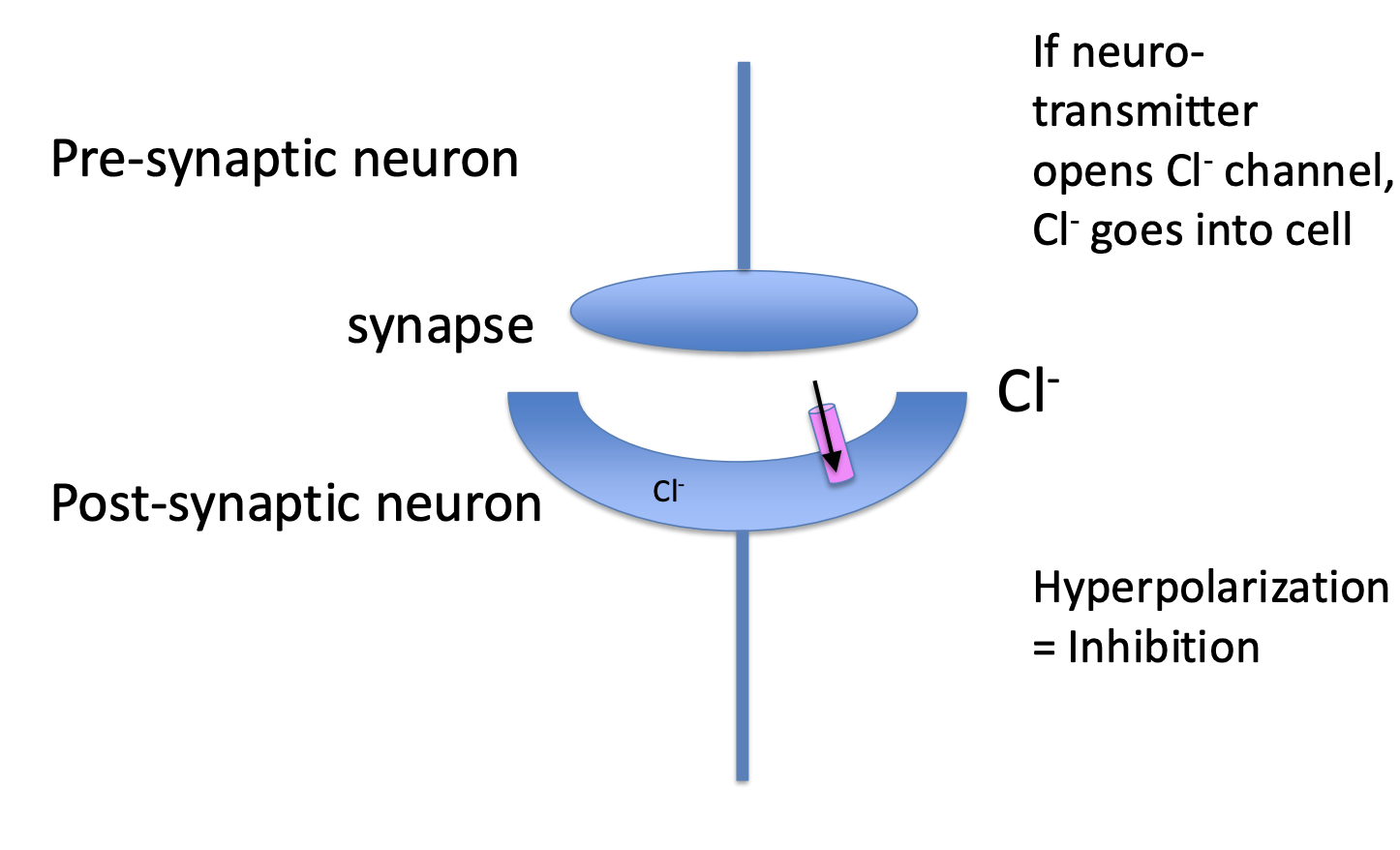
What is the result if Cl- ion channel opens when Cl- is high outside cell
if neurotransmtter opens Cl- channel, Cl- goes into cell
hyperpolarization=inhibition
What happens to neurotransmittersi n the synaptic cleft?
diffuse out synapse
recycled: reuptake and repackage
degraded by enzymes
Postsynaptic cell response depends on types and arrival time of signals
E→ excitatory signal (depolarizing)
I→ inhibitory signal (hyperpolarizing)
response is summation of all presynaptic inputs

Possible neuron origins (Moroz et al)
Implications: neurons. and synapses evolved more than once
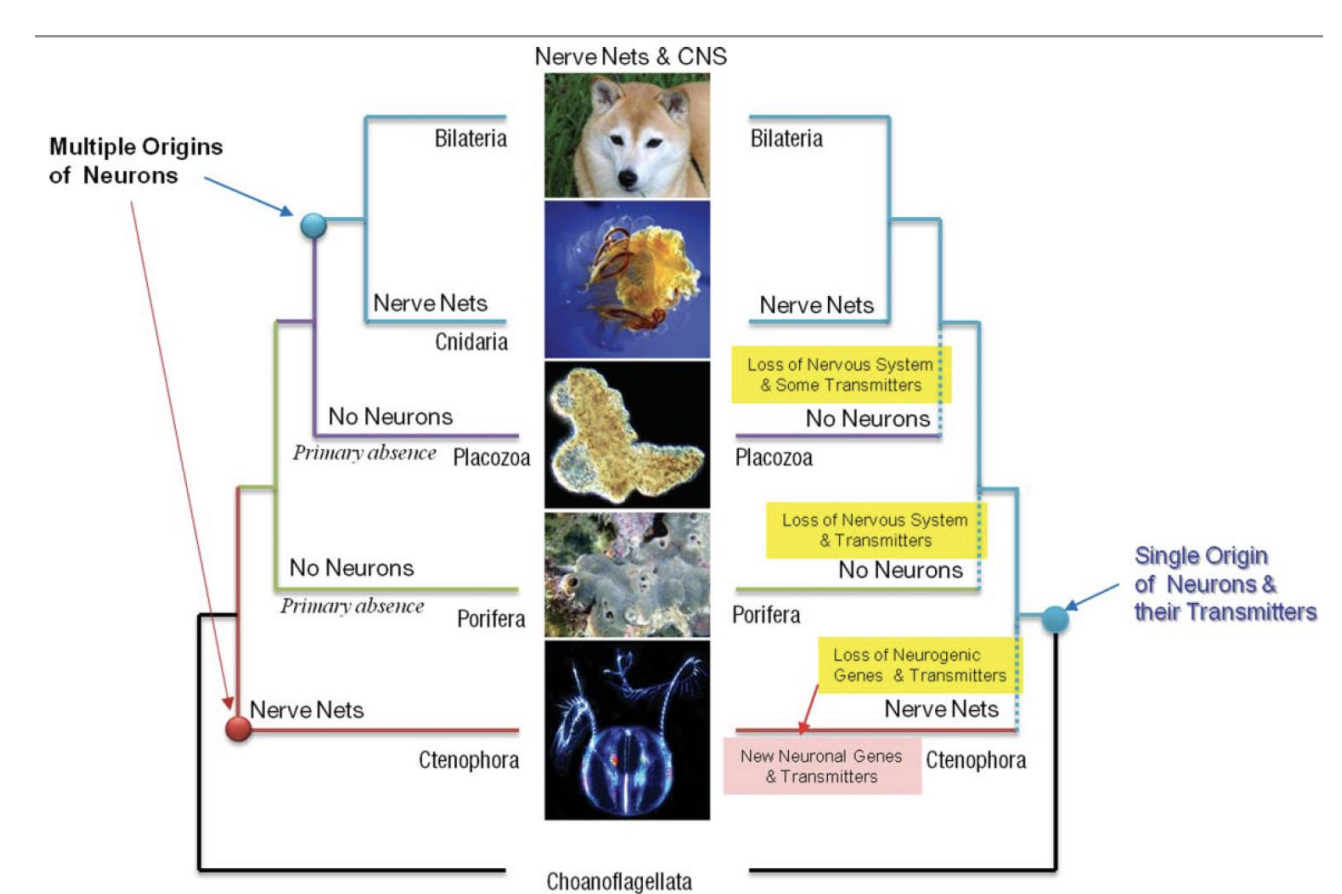
Ctenophores
have continuous nerve net similar to Golgi’s syncytial network
- cteophores do have chemical synapses to connect to sensory cells and ciliary comb plates
have special colloblasts (secretory cells that secrete glue), helps tentacles grab food
Placozoans
have peptide secreting cells with many genes that are similar to those in cnidarians and bilaterian neurons
Why are animals the only group with neurons?
As animals evolved, many became increasingly complex and multicellular. This created a challenge: different cells and tissues needed to communicate and coordinate their activities.
For example:
- An animal needs to detect a predator.
- It needs to transmit that information quickly throughout its body.
- It needs to coordinate muscles to move away.
Neurons solve this problem by transmitting electrical and chemical signals rapidly between cells.
Plant signaling
plants have membrane potentials: H+ pumps, K+ channels
plants also have glutamate, GABA, and acetylcholine receptors=ligand gated ion channels. All important for gathering and sharing information for growth and development, gravimetric detection, and wound detection
Mechanosensation and response
vennus fly traps respond to mechanical stimulation of hair cells
get same response if trigger hair cells or apply voltage to motor cells which close trap
can measure action potential applied to motor cells
Plant sensore vs animal neurons producing “action potential”
Plant sensors:
voltage sensitive. depolarize when Cl- flows out
Inactivate and return to resting potential by K+ flow out
Animal neurons:
voltage sensitive. depolarize when Na+ flows in
Inactivate and return to resting potential by K+ flow out
How common are the components needed to make a neuron?

Evolution of ion channels
Leaky K+ channels evolved 3 BBYBYA 4 subunits each w/ two alpha helices and pore region
to gain voltage sensitivity, K+ Channels added more helices
S4 is sensitive to the voltage across the membrane. in response to membrane charge, it move. this enables channel to open and close
how do voltage gated channels work?
change shape in response to membrane charge
original gene encoded one subunit channel is made of 4 identical subunits
duplicated and fused gene encoded 4 subunits, each with unique sequence. gene duplicated and then merged to create a longer gene, transcribing and making a protein with all 4 channel subunits
neurons take advantage of voltage gated ion channels-ancience proteins that enable electrical signaling
Summary 2
• Neural connections vary based on how the synapse is set up Concentration gradients Ion channel type
• Neurons evolved using existing components that were combined in new ways It occurred more than once Animal have more Nav channels and sodium pumps which may have led to the diversity of animal neurons
what kind of things do animals sense and detect
vision: light
hearing: sound/pressure
touch: pressure, stretch
olfaction: chemicals (gas)
taste: Chemicals (liquid and solid)
sensory receptor neurons
receive signal (input)
convert signal to neural output=transduction
generate output that is proportional to input
How does a sensory cell respond?
They work like a typical neuron:
concentration gradient generated by ion pumps
membrane potential resulting from leaky channels
Respond to signal:
ion channels open
ions flow
membrane potential changes
neurotransmitter output changes
environmental signal → neural signal
sensory neurones don’t always have long axons
ear hair cells and eye’s photoreceptors don’t generate action potentials
olfactory neurons response

ways sensory neurons couple the receptor and ion channel #1
in some sensory neurons, the ion channel IS the receptor
a. channel is opened by some mechanical stretching force → pressure, stretch, sound
b. channel is gated by binding to a ligand:
Taste: sour (H+), Salty (Na+), Umami (glutamate)
ways sensory neurons couple the receptor and ion channel #2
in some sensory neurons, the stimulus binds to a receptor molecuule: this modified receptor activates G protein (GPCR)
this indirectly causes ion channels to open or close
ligand binds to GPCR
activates G protein which eventually opens or closes ion channel
ions flow changing membrane potential
Ex. Olfaction, vision, taste: sweet, bitter, umami
Does having ion channels that directly or indirectly respond to signals sound familiar?
Ligand gated receptors and G protein coupled receptors for neurotransmitters!!!
Similar pathways used by neurons to detect similar stimuli
Which came first, detecting environmental signals or neurotransmitters?
detecting environmental signals
mollusc eye designs
can be simple or increasingly complex
most sophisticated is the octopus eye
different eye designs

vertebrate eye
cornea and lens collect and focus the light onto the retina
retina detects and processes light
Aquatic eyes in octopus and fish
Convergence: spherical lens → camera style eye
Octopus eye is more “ideal” than vertebrate eye
Photoreceptors
Dark responses:
ion channels are open
photoreceptor is depolarized
neurotransmitter is released (even though there is NO signal!)
Light responses:
ion channels close
photoreceptor hyperpolarizes
neurotransmitter decreases (when signal is present)

humans and apes are trichromats
many animals have more visual pigments and see more colors

Conclusions 3
• Vertebrates have a variety of sensory systems where each organism specializes in one or several senses
• Sensory stimuli cause ion channels to open or close, altering membrane potentials and neurotransmitter signals
• Humans are missing or have limitations in some senses and so our sensory intuition may not be the same as other animals.