Kaplan Gen Chem Chapter 1: Atomic Structure
 Call Kai
 Learn
 Practice Test
 Spaced Repetition
 Match
 Flashcards
 Knowt Play
1/37

There's no tags or description
Looks like no tags are added yet.
38 Terms
Protons and neutrons are found in the nucleus of an
atom
protons have a mass of 1 amu
in neutral atom, num of protons=num of electrons
What is the atomic number?
number of protons found in an atom of that element
all atoms of a given element have the same atomic number, but don’t nec have the same mass
What is the mass number?
sum of protons and neutrons in the atom’s nucleus
neutron’s mass slightly larger than proton’s mass
given element can have variable amt of neutrons, so atoms of same element can have same atomic num, but not nec same mass num
What are isotopes?
atoms of the same element with varying mass numbers
differ in num of neutrons
name of element followed by mass number like for ex carbon-12
What are electrons?
move through the space surrounding the nucleus
mass smaller than proton
What are valence electrons?
these are electrons farther from nuc with strongest interactions to surrounding environment and weakest with nuc
they are more likely to bond with other atoms bc they have the least electrostatic pull from their own nuc
determine reactivity of an atom
electrons move around nuc at varying distances→closer to nuc means lower energy levels→lower electron shells
Give the protons, neutrons, and electrons for nickel 58 atom and nickel 60 +2 cation.
nickel 58: protons→28, neutrons→30, electrons→28
nickel 60 +2 : protons→28, neutrons→32, electrons→26
What is the difference between atomic mass and atomic weight?
atomic mass/mass num varies from one isotope to another
atomic weight is constant for a given element; weight displayed on periodic table(avg of diff isotopes)
The atomic mass of an atom in amu is nearly equal to its
mass number
What are the 3 isotopes of hydrogen called?
protrium: 1 proton, 1 amu
deuterium: 1 proton, 1 neutron, 2 amu
tritrium: 1 proton, 2 neutrons, 3 amu
Half life is a marker of
stability; longer lasting isotopes are more abundant
What is a mole?
number of things equal to Avogadro’s number NA= 6.02 × 10 ^ 23
the atomic weight of C is 12 amu→avg C atom has a mass of 12 amu and 6.02 × 10 ^ 23 C atoms have a combined mass of 12 g
What is the Planck relation equation?
energy as electromagnetic radiation from matter comes in bundles called quanta
energy of a quantum or E= hf
h is Planck’s constant, 6.626 × 10 ^-34 J x S
f is frequency of radiation
In the Bohr model, what is the angular momentum of an electron orbiting a H nucleus ?
L= nh/ 2pi
n→principal quantum num
h→planck’s constant
What is the energy of an electron?
E= - R H/ n²
RH→Rydberg unit of energy, 2.18 × 10^-18 J/electron
neg sign means electron in any of its quantized states in the atom will have an attractive force toward the proton
equation is saying energy of an electron inc/becomes less neg the farther out from the nuc it is(increases n)
What is ground state of an atom? excited state?
state of lowest energy, in which all electrons in lowest possible orbitals
state where at least 1 electron has moved to a subshell of higher than normal energy
What happens when electrons in ground state transition?
excited to higher energy levels by heat or other energy forms
lifetime of excited state is temporary, so will return to ground state→results in emission of energy in photons E=hf
as electrons go from lower to higher energy level, they absorb light, have higher potential, get excited, and become distant from nuc
the electromagnetic energy of these photons are calculated using E=hc/wavelength
h→Planck’s constant
c→speed of light, 3.00 × 10^8 m/s
What is a line spectrum?
each line on an emission spectrum corresponds to a specific electron transition
bc each element can have its electrons excited to a diff set of energy levels, each have a unique atomic emission spectrum
What is the Lyman, Balmer, and Paschen series?
Lyman: ground of H emission lines corresponding to transitions from energy levels n greater than or equal to 2 to n=1; includes larger energy transitions from Balmer; shorter photon wavelengths in the UV region of the EM spectrum
Balmer: n greater than or equal to 3 to n=2; includes 4 wavelengths in the visible region
Paschen: n greater than or equal to 4 to n=3
What is the energy of electron transition formula?
E=hc/wavelength=Rh(1/ni² - 1/nf²)
formula tells us the energy of the emitted photon corresponds to the diff in energy btwn higher energy initial state and lower energy final state
What is an absorption spectrum?
exciting the electrons of a particular element results in energy absorption at specific wavelengths
the wavelengths of absorption correspond to the wavelengths of emission bc the diff in energy btwn levels remains unchanged
What is the Heisenberg uncertainty principle?
impossible to determine the momentum and position of an electron at the same time
What is the Pauli exclusion principle?
no 2 electrons in a given atom can have the same set of 4 quantum numbers
energy state: position and energy of an electron described by its quantum numbers
What is the principal quantum number n?
can be any positive number; the larger the number→the higher the energy level and radius of the electron’s shell
in each shell, it can hold up to 2n² electrons
diff in energy btwn 2 shells dec as distance from nuc inc based on energy of electron transition formula
What is the azimuthal quantum number l?
refers to shape and number of subshells within a given principal energy level n
for any given value of n, the range of values for l is 0 to (n-1)
in each subshell, it can hold up to 4l + 2 electrons
the energies of the subshells inc with inc l value
What is spectroscopic notation?
n is a number, and l is designated a letter
l=0 subshell is s
l=1 subshell is p
l=2 is d
l=3 is f
What is the magnetic quantum number ml?
specifies the particular orbital within a subshell where electron most likely to be found
each orbital can hold up to 2 electrons
possible values for ml are btwn -l and +l including 0
the shape of orbitals dependent on the subshell they are found
s: spherical
p: dumbbell
What is the spin quantum number ms?
electron has 2 spin orientations +1/2 and -1/2
whenever 2 electrons are in the same orbital, they must have opposite spins and are referred to as being paired
electrons in diff orbitals with the same ms values are said to have parallel spins
What is electron configuration?
first number denotes principal energy level, letter designates the subshell, and superscript gives the number of electrons in that subshell
ex: 2p^4 means 2nd principal energy level in p subshell with 4 electrons
can be shortened by placing the noble gas that precedes the element of interest in brackets
What is Aufbau principle?
electrons fill from lower to higher energy subshells and each subshell will fill before electrons begin to enter the next one
Which will fill first, 5d or 6s subshell?
use n+l rule
5d: n=5, l=2 → 7
6s: n=6, l=o → 6
6s has lower energy and will fill first
What is the shorthand notation for osmium?
[Xe]6s² 4f^14 5d^6
How do you determine the electron configuration for cations?
you start with the neutral atom, and remove electrons from the subshells with the highest value for n first
if multiple subshells are tied for the highest n value, then electrons are removed from the subshell with the highest l value among these
What is the electron configuration for F? F-? Fe 3+
F: [He]2s²2p^5
F- : [He]2s²2p^6
Fe3+ : [Ar]3d^5
What is Hund’s rule?
within a given subshell, orbitals are filled such that there are a max number of half filled orbitals with parallel spins
basis for this is electron repulsion: electrons in the same orbital tend to be closer to each other and thus repel each other more than electrons placed in diff orbitals
half filled and fully filled orbitals have lower energies(higher stability) than other states
What are the exceptions to electron configuration?
chromium should be [Ar]4s²3d^4 but is actually [Ar]4s^1 3d^5 due to extra stability from making 3d subshell half-filled
copper is actually [Ar]4s^1 3d^10 bc a full d subshell outweighs the cost of moving an electron out of 4s subshell
What does paramagnetic and diamagnetic mean?
paramagnetic: materials that have unpaired electrons that align with magnetic fields, attracting the material to a magnet; ex: metallic spheres closed enough to be induced by a magnet→are attracted to it→move toward it
diamagnetic: materials that have all paired electrons, which can’t easily be realigned; they are repelled by magnets
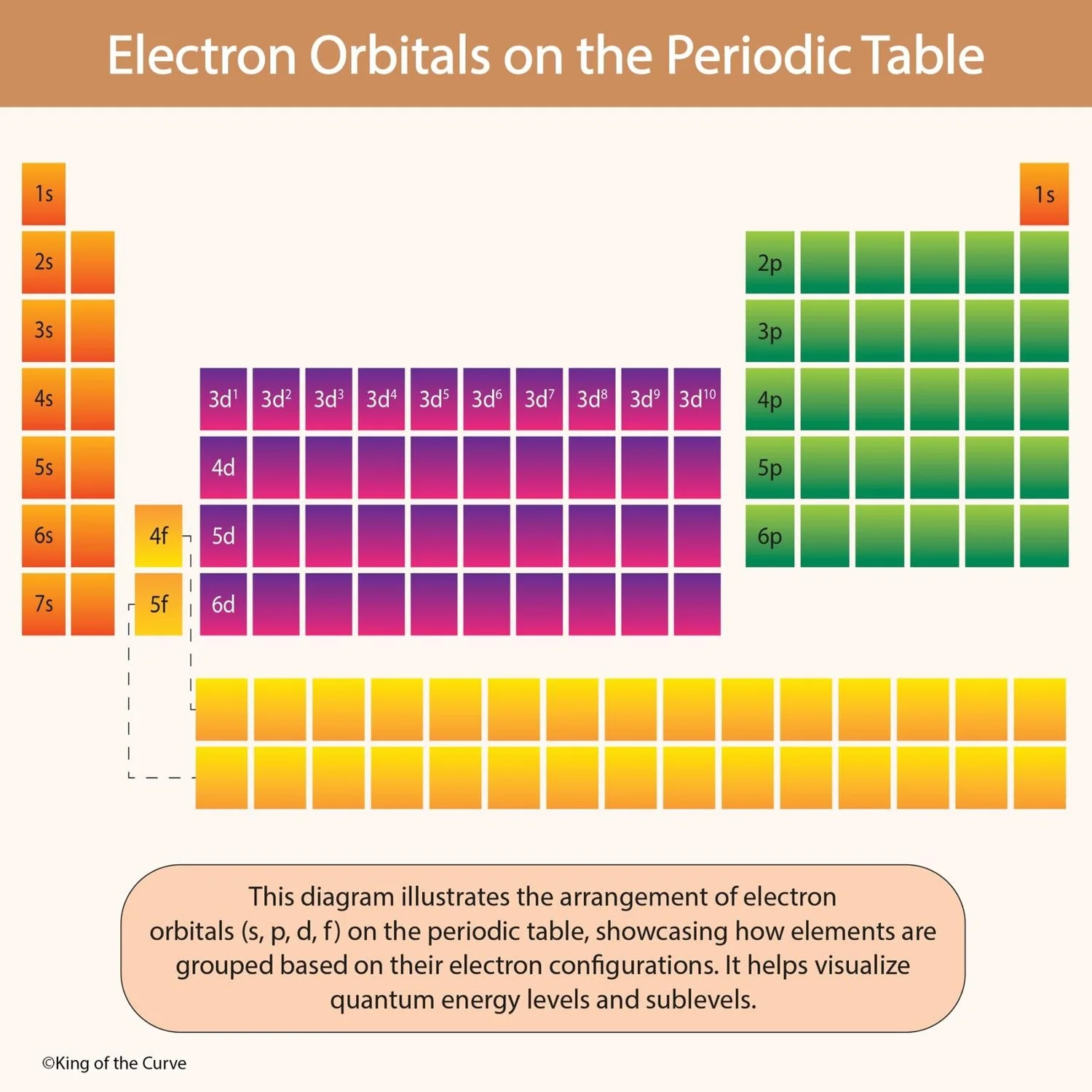
For groups 1 and 2 in PT, which subshell electrons are valence?
1 and 2: only the highest s subshell electrons
groups 13-18: highest s and p subshell electrons
transition elements: those in the highest s and d subshells
lanthanide and actinide: those in the highest s and f subshells
all elements in period 3 starting with sodium and below may accept electrons into their d subshell, which allows them to hold more than 8e in their valence shell