genetics exam 2
 Call Kai
 Learn
Learn Practice Test
 Spaced Repetition
 Match
Match Flashcards
 Knowt Play
1/132

There's no tags or description
Looks like no tags are added yet.
Name | Mastery | Learn | Test | Matching | Spaced | Call with Kai | Chat |
|---|
No analytics yet
Send a link to your students to track their progress
133 Terms
barr body
inactive X chromosomes
highly condensed
can be observed in stained interphase cells
arise from random inactivation of either maternal or paternal chromosome
occur early in embryonic development
all cellular descendants have same inactivated chromosome
hermaphrodites
2 phenotypes in C. elegans
have both testes and ovaries (bisexual)
have 2 X chromosomes and no Y
eggs fertilized by stored sperm
self fertilization
majority of offspring are x
or males w testes from only 1 X and no Y
less than 1%
primary sexual differentiation
involves only gonads where gametes are produced
secondary sexual differentiation
involves overall appearance of the organism
clear differentiation in organs like mammary glands and external genitalia
unisexual
plants and animals that contain only male or female reproductive organs
only 1
bisexual
plants and animals that contain both male and female reproductive organs
can produce both male and female gametes
differentiation in different tissues
in maize, diploid sporophyte stage predominates
both male and female structures are present on adult plant
indicates sex determination must occur differently in different tissues of the same plant
xy system
mammals and some insects
Xo system
some insects
zw system
reptiles
birds
some amphibians and insects
no special sex chromosomes
plants
fungi
genetic control of sex determination
in some organisms it is genetically determined and regulated
mutant genes can cause sex reversal
homozygous, mutations in tassel seed interfere w production and induce production of female structures instead
recessive mutations in silkless and barren stalk interfere w development of pistil
plants w only male-functioning repro organs
XX/XY mode
sex determination in lygaeus
female gam all have an X chromosome
male gam have either X or Y
zygotes w 2 X’s result in female
w/ 1 X and 1 Y result in male
6A + X vs 6A + Y from male
1:1 sex ratio
XX/XO mode
sex determination in protenor
depends on random distribution of X chromosome into half of male gam
presence of 2 X in zygote results in female
presence of only 1 X results in male
6A vs 6A + X from male
1:1 sex ratio
Z/W system
males not always heterogametic sex
in some organisms females are
ex: chickens
females are ZW and males are ZZ
mode in drosophilia
Y chromosome doesn’t determine sex
Y needed for fertility
determined by ratio of X chromosomes to haploid sets of autosomes (A)
normal female: XX and AA (1:1 or 1.0)
normal male: XY and AA (1:2 or 0.5)
X in male is upregulated so transcription lvls = that of XX female
genic balance theory
w/ respect to primary sex determination
threshold of maleness is reached when X:A ratio is 1:2 (X:2A)
presence of additional X (XX:2A) alters balance and results in female differentiation
temperature-dependent
environment, specifically temp, has profound influence on sex determination
achieved according to incubation temp of eggs during critical period of embryonic development
for all crocodiles, most turtles, and some lizards
case 1: low temp = 100% female, high temp = 100% male
case 2: opposite
case 3: low and high = 100% female, intermediate = various proportions of males
mechanism underlying TSD
temp affects expression/activity of enzyme, aromatase
converts T into estradiol
mode in humans
females have 2 X
males have X and Y
during early embryonic develop, embryo is hermaphroditic
gonadal phenotype is sexually indifferent (look same and have potential to form ovaries or testes)
triggered by presence of absence of Y
human Y
SRY: sex-determining region
MSY: male-specific region
has at least 75 genes
PARS on both ends
pseudoautosomal regions
present on both ends of Y chromosome
share homology w regions on X
synapse and recombing w X during mitosis
presence is critical to segregation of X and Y during male gametogenesis
male-specific region of the Y
MSY
nonrecombining region of Y chromosome
some portions of it share homology w X chromosome
has euchromatic (functional gene) and heterochromatic (nonfunctioning) regions
sex-determining region Y
SRY
located adjacent to the PAR of short arm of Y chromosome
genes on it become active in XY embryos at 6-8 wks
SRY/TDF either expressed or not to form testis/ovaries
testis-determining factor
TDF
determines maleness; master switch controlling genes involved in differentiation
males w 2 X and no Y, SRY on X
translocation from Y to X
females w 1 X and Y missing SRY
deletion of part of Y
ptn encoded by a gene in SRY that triggers testes formation
located within SRY
present in all mammals
gonads develop into testis if SRY/TDF expressed
klinefelter syndrome
male w extra Xs; phenotypically male
XXY; 47,XXY; 48,XXXY; 49,XXXXY karyotypes
tall stature w long arms & legs
underdeveloped testes and prostate gland
infertile
slight breast enlargement, hips rounded, no facial hair
normal intelligence but may be slow learner
turner syndrome
XO
1/2000 females
45, XO karyotype
female external genitalia and internal ducts
ovaries are rudimentary
short stature, underdeveloped breasts, skin flaps on back of neck
normal intelligence, may have learning disabilities
XXX syndrome
abnormal presence of 3 X’s
normal set of autosomes (47,XXX)
results in female differentiation
typically normal and unaware
or underdeveloped secondary sex characteristics, sterility, and mental retardation
extra X can disrupt normal female development
supermales
47, XYY
lyon hypothesis
explains dosage compensation
inactivation of X; random choice in each cell of which X is
occurs in somatic cells at early embryonic stage
then passed on to progeny cells by mitosis
ex: calico cats
x-linked; alleles in diff areas of body
genetic mosaics
ex: lack of sweat glands in human females
dosage compensation
prevents excessive expression of X-linked genes in humans & other mammals
X-inactivation
N - 1 rule; N = total # of X
all but one are inactivated
regardless of how many a somatic cell posseses
none in Turner (XO)
1 barr body in Klinefelter’s (XXY)
2 barr bodies in 47,XXX
syndromes not normal possibly bc:
inactivation does not take place in early stages of development of gonadal tissue
not all X inactivated
imprinting
expression of genes on one homolog but not the other
chemically modified DNA that gets inactivated, silencing genes
creates memory that keeps same homolog inactivated following chromosome replications and cell division
androgen insensitivity
XY karyotype
mutation in gene on X that codes for testosterone receptor
bodies can’t respond to male hormones (androgens)
phenotype
externally normal female w sparse or absent body hair
internally: blind vagina, no uterus, testis present in abdominal cavity
aneuploidy
variations in chromosome #
mistakes in mitosis or meiosis
when organism gains or loses 1 or more chromosomes and has other than an exact multiple of haploid set
2n +- x chromosomes
euploidy
complete haploid sets of chromosomes are present
multiples of n
polyploidy
occurs when more than 2 sets of chromosomes are
3n, 4n, 5n, …
v rare in humans
occurs in amphibians and lower animals
common in plants and important for speciation
monosomy
zygote w only 1 copy of a chromosome
2n - 1
result of nondisjunction
for X chromosome occurs in humans
for any autosome is usually not tolerated in humans & other animals but
trisomy
zygotes w 3 copies of 1 chromosome
2n + 1
result of nondisjunction
more viable than loss
in autosomes, have severe effects and usually lethal during development
plants are viable but phenotype altered
haploinsufficiency
single recessive gene is insufficient to provide life-sustaining function for the organism
Result of monosomy in autosome (2N - 1)
autopolyploidy
addition of one or more sets of chromosomes identical to haploid complement of same species
multiples of the same genome
2 sperms fertilize 1 egg
haploid gamete x diploid gamete; triploid
3 sperms fertilize 1 egg
diploid x diploid; tetraploid
allopolyploidy/amphidiploidy
combination of chromosome sets from diff species as consequence of interspecific matings
hybridization of 2 closely related species
contains 4 haploid genomes derived from separate species
diploid x diploid; tetraploid
chromosomal mutation/abberation
change in total # of chromosomes
deletion or duplication of genes or segments of a chromosome
rearrangements of genetic material w/in or among chromosomes
can result in form of phenotypic variation or be lethal
nondisjunction
chromosomes or chromatids fail to disjoin and move to opp poles during meiosis 1 or 2
usually occur to 1 chromosome
disrupts normal distrib of chromosomes into gametes
results in trisomy or monosomy
XYY condition
duplication of Y and nondisjunction originates in male
X + YY
occurs in meiosis 2 in Y-bearing cell
get sperm w 2 Y (from 2 sister chromatids) and sperm w/o any sex chromosome
at fertilization get: XYY or XO
nondisjunction in males in meiosis 1
sperm w X and Y chromosome
sperm w no sex chromosome
at fertilization
XXY or XO
down syndrome
trisomy 21 caused by random error
not expected to be inherited
affected express 6-8 characteristics:
prominent epicanthic fold in each eye
flat face, round head, short stature w protruding tongue
short, broad hands
mental retardation
avg life span 50 yrs
75% occur during meiosis 1
can come from maternal or paternal but inc w mate
down syndrome critical region
critical region of chromosome 21 contains genes that are dosage sensitive in this trisomy
responsible for many of the phenotypes
familial down syndrome
runs in families
translocation of bottom part of chromosome 21 onto another chromosome
one parent contains 14/21, D/G translocation
phenotypically normal but has only 45 chromosomes
normal chromosome 21 and other translocated to 14
fertilization results in embryo w 46 but 3 of 21
restore fertility of sterile hybrids
natural or induced chromosomal doubling
produces fertile amphidiploids
colchicine
disaggregates microtubules, causing nondisjunction of whole set of chromosomes
cell fails to divide and instead enters interphase; chromosome # is duplicated
applied to somatic cells undergoing mitosis
polyploidy cell size
often larger than cells of diploid relatives
ex: flowers and fruits
as polyploidy inc, gene expression either inc or dec tenfold
2 genes that encode G1 cyclins are repressed when ploidy inc
cell stays in G1 phase longer and grows to a larger size
reciprocal translocation
2 non-homologous chromosomes trade or swap segments w each other in 2 way exchange
structural chromosome abnormality
has unsual synapsis config during meiosis
results in rearrangement of genetic material
non-reciprocal translocation
single chromosomal segment breaks off and transfers to a non-homologous chromsome in one-way shift
no corresponding piece returned
structural chromosome abnormality
cri du chat syndrome
deletion of part of chromosome 5
developmental disorder
duplication
arise thru unequal crossing over between synapsed chromosomes during meiosis
or arise thru replication error prior to meiosis
can change dosage and gene expression, phenotype
rRNA genes
multiple copies of as it is needed to support ptn synth
some cells have more copies than others in same individual
normal amplification is insufficient
nucleolar organizer region
single area of chromosome in amphibian where 400 copies of rDNA are present per haploid
selectively replicated to further inc rDNA copies
ex of gene amplification
gene duplication
provide extra copies of gene
dup can acquire mutational changes over extended periods w/o hindering fitness of organism
can evolve into new genes
new function can impart adaptive advantage to organisms
inversions
change linear order of information on chromosome
crossing over in x heterozygotes can change # of centromeres chromosome has
x heterzygotes exhibit crossing over less freq in region w x
translocation
movement of a chromosomal segment to a new location in the genome
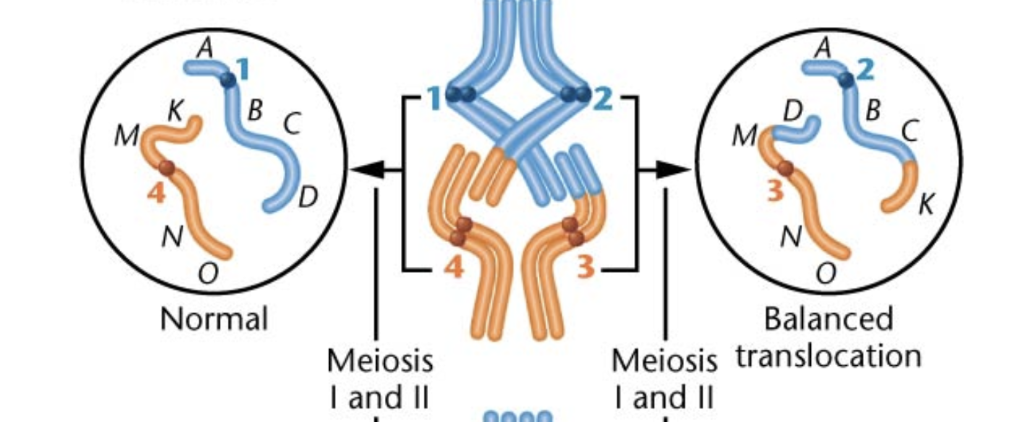
alternate segregation
regarding chromosome organization during meiosis for individuals hetero for reciprocal translocations
leads to normal and balanced gamete

adjacent segregation
regarding chromosome organization during meiosis for individuals hetero for reciprocal translocations
leads to gametes containing duplications and deficiencies
results in semisterility
partial trisomy or monosomy leading to birth defects
big impact on repro fitness/evolution

robertsonian translocation
breaks at extreme ends of short arms of 2 nonhomologous acrocentric chromosomes
small segments lost, larger fuse at acrocentric
ex: familial down syndrome
fragile sites
more susceptible to chromosome breakage when cells are cultured in absence of certain chems
ex: folic acid
could be regions along chromosome where chromatin is not tightly coiled
strong association btwn x and mental retardation
link btwn autosomal x and lung cancer
FHIT gene on x found altered or missing
linkage
2 genes on a single pair of homologs
no exchange/recombination occurs
2 types of gametes
exchange occurs between 2 nonsister chromatids
get 4 types of gametes
parental/nonrecombinant gamete
chromatids that don’t cross over
recombinant gamete
chromatids that cross over
linkage ratio
affected by genetic distance
no linkage
4 gametes; 1:1:1:1
AB, Ab, aB, ab
linkage w/o recombination
2:0:2:0
AB and ab
linkage w recombination
ratio btwn 1:1:1:1 to 2:0:2:0
single crossover
recombination is reciprocal
equal proportion of genetically different gametes w recombinant chromosomes
0-25% each
altogether recombinant gametes can’t be more than 50% of total
4 types of gametes
genetic map
likelihood that 2 genetically linked traits will be separated by a crossover is dependent upon how far apart they are
if close together on chromosome, less likely to have a chiasma and be separated
if far apart, more likely for alleles to be recombined
linked genes exist in linear order along chromosome, basis for x
restriction fragment length polymorphism
RFLP
example of DNA markers
several million help give geneticists ability to identify and locate related genes
mendel
experiments would not have been as informative if he picked traits controlled by genes close together on same chromosomes
complete linkage
4 gametes still made
only 2 types of gametes
each makes up 50% of total
test cross for linkage
F1: double heterozygous x double homozygous
chi square analysis
test cross for linkage on sex chromosomes
F1: heterozygous female x hemizygous male
Female: yw y+w+ x Male: y w
map unit
defined as 1% recombination between 2 genes on a chromosome
also called centiMorgan (cM)
1 cM = 1% recombination
supports chromosomal theory that chromosomes contain genes in linear order and are equivalent of mendel’s unit factors
double crossover
occur less frequently
2 single crossovers
use product law
three point cross
genetic method to determine gene order
parent producing crossover gametes must be heterozygous at all loci
y w ec
y+w+ec+
other parent should be homozygous (recessive)
y w ec
genetic cross only estimation of distance
as distance btwn 2 genes increases, mapping estimates become less accurate
recombination underestimates the distance
farther apart, greater underestimate
some areas on chromosomes are hot or cold spots for recombination
farther apart 2 genes, greater prob of undetected crossovers
degree of inaccuracy increases
most accurate maps from closely linked genes
interference
numerical indication of observed rate of DCO compared to expected
reduces expected # of multiple crossovers when crossover event in one region of chromosome inhibits a second event nearby
can be quantified using observed DCOs
I = 1 - C
complete when no DCOs occur
positive if fewer DCOs than expected
when 2 genes close together
negative if more DCOs than expected
coefficient of coincidence
observed # of DCOs divided by expected # of DCOs
dna markers
short segments of DNA whose sequence and location are known
useful landmarks for mapping purposes
conjugation
transfer of DNA between 2 bacterial cells
requires physical contact
U-tube experiment (no exchange bc cells can’t pass)
unidirectional and only some strains can be donor, F+
receiving cells, F-
occurs in 1×10⁻⁷ cells
double dna nicked, complement synthesized on both single strands, moves across tube to F-, ligase closes circles
transformation
introduction of free-form DNA into bacterial cells
done in labs to get transgenic animals
genes close enough to each other to be cotransformed are linked
extracellular dna binds to cell at receptor site
dna enters cell adn strands separate
1 strand degraded,1 pairs homologously w host dna
after, dna recombines w chromosome
creates heteroduplex
1 round of cell division produces transformed and nontransformed
transduction
introduction of viral DNA into bacterial cells
ex: genetic recomb in bacteria via bacteriophages
no cell to cell contact (U-tube experiment)
minimal medium
salts
NH4+
glucose
complete medium
minimal medium
yeast extract/ amino acids
prototrophs
wild type
strains that will grow on minimal medium
auxotrophs
mutant strains that can only grow on minimal medium if it is supplemented w some biochemical
complete medium
F+ factor
donor
not lost in x strain
copied into recipient cells
plasmid
composed of double stranded closed circle of DNA
exist in multiple copies in cytoplasm
may contain one or more genes
use same rep enzymes as host
distributed to daughter cells
rep independently of bacterial chromosome
bacterial genome
haploid DNA
no homologous chromosome
no masking of phenotype
no mitosis or meiosis
chromosome dna is circular
plasmids—extrachromosomal DNA
genetic exchanges occur
resistance mutants
will grow on media containing an antibiotic
ex: strR resistant to streptomycin
genetic exchange in prokaryotes
involves DNA molecule from external source
replacement of chromosomal info by recombination
how closely linked 2 genes influences likelihood:
both will be transferred to host simultaneously
one recombination even will include both genes
F factor plasmids
confer fertility and contain genes for sex pilus formation on which genetic recombination depends
Hfr strain
high freq recombination (1×10⁻⁴)
special types of DNA donors
F+ plasmid integrated into chromosome
becomes part of chromosomal DNA
genes transferred to F- cells
conjugation btwn x and F-
leads to transfer of genes on the chromosome by recomb
rarely complete
F+ DNA not transferred
F- cells don’t become F+
interrupted mating technique
used to map genes in E. coli
conjugation interrupted
recipients w various number of bacterial genes
number of transferred genes inc w amt of time of conjugation
transferred replace genes in chromosome by homologous recomb
genes close to F+ first
F’ DNA
can shuttle in and out of bacterial chromosome thru recomb
piece of chromosome may be transferred along w F plasmid
deleted from one strain and inserted into another
Rec proteins
essential to bacterial recomb
mutants deficient in x don’t undergo recomb