Distillation Post Lab Quiz
 Call Kai
 Learn
 Practice Test
 Spaced Repetition
 Match
 Flashcards
 Knowt Play
1/53

There's no tags or description
Looks like no tags are added yet.
54 Terms
Distillation Apparatus Parts
Aluminum heating block

Distillation Apparatus Parts
Lab jack

Distillation Apparatus Parts
Distillation Flask

Distillation Apparatus Parts
Distillation Head
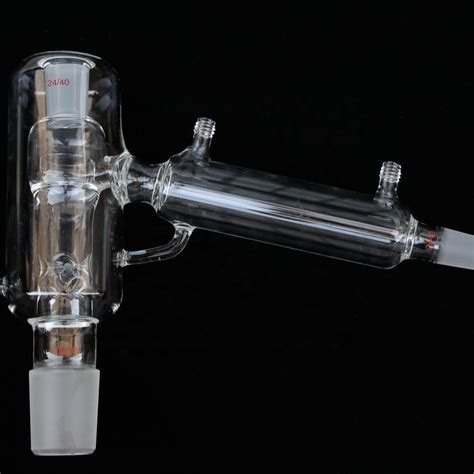
Distillation Apparatus Parts
Straight adapter

Distillation Apparatus Parts
Rubber Adapter
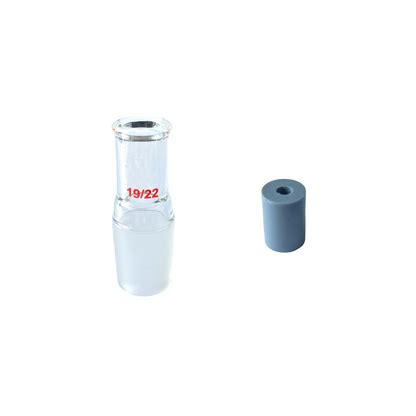
Distillation Apparatus Parts
Thermometer

Distillation Apparatus Parts
Condenser

Distillation Apparatus Parts
Vacuum Adapter

Distillation Apparatus Parts
Receiving flask

Distillation Apparatus Parts
Hose clamp

Distillation Apparatus Parts
Keck clamp

Simple Distillation
useful method for isolating a pure liquid from other substances that are not volatile
large boiling point difference
Fractional Distillation
useful method for isolating the individual pure liquid components from a mixture containing two or more volatile substances.
when boiling point difference is small
(extra) What is the difference between a simple and fractional distillation?
presence of a fractional distillation column between the stillpot and the stillhead
Fractional Distillation Column
(on the right) similar to a condenser, the major difference being that a fractionating column has a large outside jacket and some indentations at the male end to hold the packing in place.

Vacuum Distillation
a compound with very high boiling points, lowers system pressure to reduce boiling point
Boling Point
the temperature at which the total vapor pressure of the liquid is equal to the external pressure
(extra) How do you obtain an accurate temperature reading
the thermometer must be carefully positioned so that the top of the mercury bulb is approximately even with the bottom of the sidearm outlet
Head Temperature
the temperature read on the thermometer will be identical to the temperature of the boiling liquid & it corresponds to the boiling point of the liquid and will remain constant throughout the distillation
Pot Temperature
will be identical to the temperature of the boiling liquid, although the bath temperature will be higher.
Chromatography
used to separate components of a mixture based on their differential partitioning between a mobile phase (liquid or gas) and a stationary phase (solid or liquid)
Gas Chromatography
technique that may be used to separate mixtures of volatile compounds whose boiling points may differ by as little as 0.5 °C.
mobile phase and liquid phase, interchanges between both until solution is all seperated
mobile phase also contains gas carriers
When can gas chromatography also be used
can also be applied as an analytical tool to identify the components of a mixture or in preparative applications when quantities of the pure components are desired.
Definition of Mobile Phase
generally a liquid or a gas that flows continuously over the fixed stationary phase
Function of Mobile Phase
Helps to separate and carry the analyte through the system
Definition of Stationary Phase
The solid or liquid phase that remains fixed during the chromatographic process
Function of Stationary Phase
Interacts with the analyte to facilitate separation based on different affinities
Carrier Gas
a flowing inert gas such as helium or nitrogen that transports vaporized sample molecules through the system without reacting with them, enabling separation and analysis in the column and detector
Retention Time
the elapsed time required for the com-pound to pass from the point of injection to the detector, and it may be used for purposes of identification.
(extra) Is the retention time independent or dependent
it is independent of the presence or absence of other components in the sample mixture.
(extra) What are four factors that influence retention time?
(1) the nature of the stationary phase
(2) the length of the column
(3) the temperature of the column
(4) the flowrate of the inert carrier gas
Thus, for a particular column, temperature, and flowrate, the retention time will be the same for a specific compound.
When can you perform a distillation
Separating Volatile Liquids from Nonvolatile Impurities
Separating Two or More Volatile Liquids
Purifying Reaction Products or Solvents
Distilling Heat-Sensitive Compounds (Vacuum Distillation)
Separating Immiscible Liquids (Steam Distillation)
When do you do a simple distillation
Separating a liquid from nonvolatile impurities or solutes
Separating two volatile liquids with a large difference in boiling points < 30-40C apart
Removing a low-boiling organic solvent from a high-boiling product after extraction or synthesis
When do you do a fractional distillation
Separating volatile liquids with close boiling points—typically < 30-40C apart.
Purifying complex liquid mixtures containing multiple volatile components with similar boiling points
Use of a fractionating column
When do you do a vacuum distillation
Distilling heat-sensitive or thermally labile compounds that decompose, oxidize, or polymerize before reaching their atmospheric boiling point.
Distilling compounds with extremely high boiling points > 150-200C that are difficult or unsafe to heat to atmospheric boiling temperatures.
Mechanism: By lowering the pressure inside the distillation apparatus using a vacuum pump, the vapor pressure required for boiling is reduced, allowing the substance to boil at a significantly lower temperature.
Purpose of each component of the distillation apparatus
Stillpot (Distillation Flask / Round-Bottom Flask)
Holds the liquid mixture to be distilled along with boiling chips or a stir bar.
Purpose of each component of the distillation apparatus
Heat Source (Heating Mantle, Oil Bath, or Hot Plate)
Provides controlled thermal energy to the distillation flask.
Purpose of each component of the distillation apparatus
Magnetic Stir Bar
Prevents bumping (uncontrolled, violent boiling).
Purpose of each component of the distillation apparatus
Distillation Head (Three-Way Adapter)
Connects the distillation flask, the thermometer, and the condenser.
Purpose of each component of the distillation apparatus
Thermometer & Thermometer Adapter
Measures the temperature of the vapor before it condenses (head temperature).
Purpose of each component of the distillation apparatus
Fractionating Column (Required for Fractional Distillation Only)
Provides high surface area for continuous evaporation and condensation cycles
Purpose of each component of the distillation apparatus
Liebig Condenser (Water-Cooled Condenser)
Converts the vapor back into a liquid (distillate).
Purpose of each component of the distillation apparatus
Vacuum Adapter (Take-Off Adapter)
Connects the condenser to the receiving vessel and vents the system.
Purpose of each component of the distillation apparatus
Receiving Flask
Collects the condensed purified liquid (distillate).
Purpose of each component of the distillation apparatus
Clamps and Support Stands
Secures the glassware in place.
Placement of thermometer
Why is it important
Measures true vapor temperature (boiling point of the condensing distillate), not liquid/pot temperature.
Placement of thermometer
What if too high or too low
High: Reads artificially low (bulb is in cooler air above the vapor path).
Too Low: Reads artificially high (bulb is exposed to superheated vapor or liquid splashes near the pot).
Why are we wrapping with aluminum foil
To heat it up faster and maintain the heat inside, allowing vaporization to happen quicker
Why centrifuge tubes as receiving flasks
Microscale Efficiency: Ideal for small-volume distillations < 1- 2 mL
Easy storage:
Easier to track volume
Requirement to switch from fraction A to B to C
Fraction A (Pure First Component)
Collect while head temperature is stable at the boiling point of the lower-boiling liquid.
Fraction B (Intermediate / Transition Mixture)
Switch when temperature begins to rise as the first component depletes (collects mixed distillate).
Fraction C (Pure Second Component)
Switch when temperature plateaus again at the higher boiling point.
GC : qualitative results
Parameter: Retention Time
How It Works: Compares the retention time of an unknown compound's peak to that of known pure standards under identical column and flow conditions.
Result: Identifies component identity (what compounds are in the mixture).
GC : quantitative results
Parameter: Peak Area (Integration).
How It Works: Calculates the area under each peak, which is directly proportional to the amount of that compound present.
Result: Determines relative abundance or concentration (percent composition of each component in the mixture).
Distillation graph analysis
