Lecture 3: Actors in digital platform ecosystems
 Call Kai
 Learn
 Practice Test
 Spaced Repetition
 Match
 Flashcards
 Knowt Play
1/24

There's no tags or description
Looks like no tags are added yet.
25 Terms
What are actors in a digital platform ecosystem and what is their relationship?
platform owner : Value co-creation and value-capture (goal)
desines the platform (the core interaction)
capturing value
offering boundary resources (e.g. SDK, API) for complementors to co-create value-adding complements
provides value-creating services (e.g. payment functionalities, recommender systems) on the platform
can use customers´ data to improve the platform
establish governance mechanism that define rules for orchestrating interactions/ faciliating transactions between autonomous complementors and consumers in the ecosystem
defining openness
(platform = modular architecture comprising a core and a flexible periphery)
provided by the platform owner
acts as an intermediary between users and complementors
no actor
complementors (e.g. Developer)
co-creating complementary products or services
autonomously decide to join an ecosystem
users
use the products/services, (pay for it)
creating value by providing data and feedback

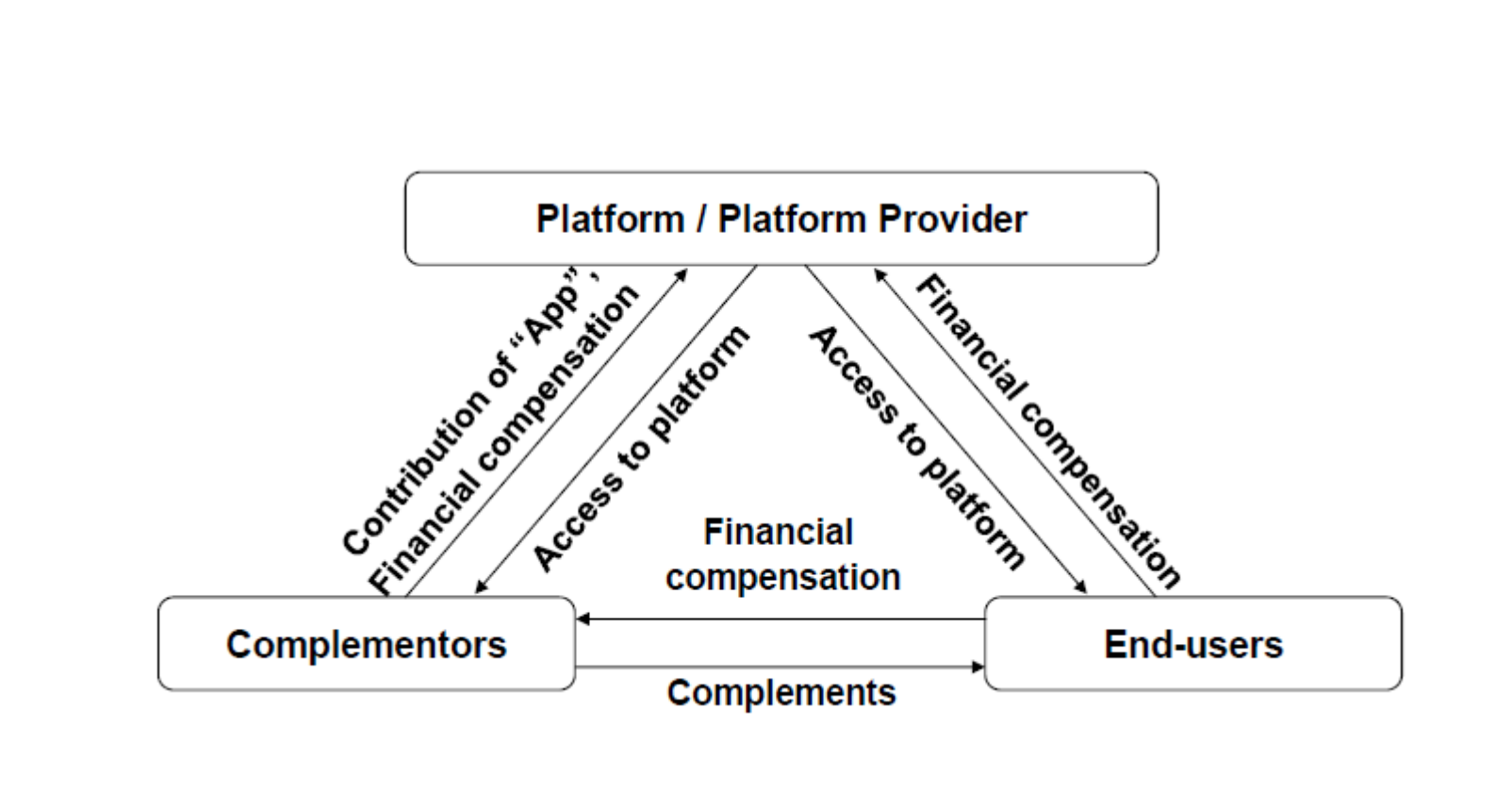
How actors in digital platform ecosystem interact?
Platform/Platform Provider: enable access to platform for complementors and end-users
End Users: gives financial compensation (Entschädigung) to platform provider and complementors
Complementors:
gives financial compensation to platform provider and/or contribution (Beitrag) of “App”
gives complements to end-users
What strategies in the platform markets firms have to approach (annähern) platforms?
Build your own platform ecosystem
buy the platform ecosystem
Belong to the platform ecosystem as a partner
How platform owners managing partners in platform ecosystem during structural core change (e.g. from PS4 to PS5)?
Platform owner
faciliate governance for partners on the old core (e.g. Apple continues software-updates)
reason: otherwise partners may leave the ecosystem before the new platform is ready
reinforce (verstärken) governance between the partner dynamics of partners on the old and the new core
e.g. Apple works on old and new devices
instead of making partners directly switch, owner helps them work across both platforms
reason: smooth transition
Options of Partners on the old core:
wait & See → only changed when new core is successfull
embrace partners on the new core → stay on the old platform but start collaborating with the new ecosystem
jump to the new core → partners completely switch to the new platform
criteria for partners to jump:
Revenue, size, focus, resources & capabilities, Embeddedness in network

Discribue the three platform ownership models.
centralized platform ecosystems controlled by a single owner (e.g. Facebook, Apple iOs, SAP Cloud Platform)
Consortia: Group of actors owns the platform (e.g. Cloud Foundry Foundation actors are Cisco, SAP, Dell,IBM…)
jointly define, establish, maintain governance mechanisms for the ecosystem
distribution of power over multiple stakeholders
decentralized platform ecosystems controlled by peer-to-peer communities (e.g. Ethereum)
Governance mechanism through Community
users can directly influence the future direction of the ecosystem
What is the autonomy of complementors and what differences exist?
complementor = developer of a complementary product/Service that make the platform more valuable to users
describes the degree of freedom complementors have when co-creating value with the digital platform
High autonomy:
complementors are loosely coupled, flexible, independent to the platfrom
complementors contribute (beitragen) to the variety and number of complements
e.g. Android´s app developers
Low autonomy:
complementors are tightly coupled to the platform
complementors form strategic partnerships
e.g. Android´s Open Handset Alliance
→ platforms often combine high and low autonomy complementors
→ degree of autonomy affects control, scalability and flexibility
→ complementors are heterogenous across various dimension
What different types of platform users could be in different platform domains?
Software (apps, operating system) → User
E-Commerce → Buyer, institutional purchaser
Gig/Crowdwork → Client, Sourcer
Crowdsourcing → Sourcer
Sharing economy: User, Guest
Social Media → Content consumer
Social shopping → Buyer, consumer, institutional purchaser
Healthcare → Patient
Crowdfunding → Funder, Sponsor, Backer
→ End-Users are critical to platform success
Define Platform Complementor and show that platform complementors differ.
Platform Complementor = The developer of a complementary product/Service
complement = product/service make the platform more valuable to users
heterogenous across various dimensions
Types of complementors:
Organizational form: Individual vs. institutional complementors
Incentive of complementor: Hobby developer vs. Entrepreneur vs. employed developer
Scope of renumeration (Entlohnung): unpaid vs. Part-time-paid vs. Full-time paid
Complementor Size: large vs. small
Contribution to platform ecosystem:
Developer with small user base vs. Developer with large user base
→ complementors are heterogenous across various dimension
What are barriers for complementors? Why should they be reduce?
Barriers for complementors:
Time/Effort Barrier → How much time and effort does it take to join the platform?
Skill Barrier → Does participants require special kowledge?
Resources Barrier → Does the complementor need many resources (money, employees, equipment?
Investment Barrier → How much money must be invested before earning anything?
Access Barrier → Can complementors actually get access to the platform?
Reasons for reducing them:
helps to archieve greater participation from complementors → ensures that the platform´s core interaction is highly repeatable
platform owners must actively reduce complementor barriers
→ complementors should be able to participate in it with minimum effort
Explain boundary resources as the concept that helps reduce barriers for complementors.
= software tools and regulations that serve as the interface for the arm´s length relationship between the platform owner and the application developer
= tools, rules and support provided by the platform owner through the platform that help complementors build products/services for the platform
boundary resources ensure that complementors can co-create value-adding complements more easily
Give examples for technical and social boundary resources.
Technical Boundary Resources: enable complementors to develop and integrate complements
SDKs
APIs
Documentation
Software libraries
Seller/creator tools
Social Boundary Resources: help complementors to understand the platform and participate effectively
Forum/FAQ provided by platform
developer guidline

Which six forms of interaction between platform participants exists/ Which Interaction Driver for interaction of platfrom participants exists?
Interaction Driver = explain why people interact on a digital platform
content: consumption of content as motivation (Content Interaction Driver)
connection: participants need to have pre-existing relationships (Connection Interaction Driver)
coordination: instructions (Anweisungen) to direct participants toword outcome (Coordination Interaction Driver)
clout: dominant attractants (Clout Interaction Driver)
competition: competitive mechanism that select one winning participant out of many (Competition Interaction Driver)
culture & code: exchange based on shared culture (Culture & Code Interaction Driver)
What is Content Interaction Driver?
Participants interact through the creation and consumption of content, without any prior (vorherige) relationship requirements
Shared interests drive interactions (rather than participant relationships)
Consumers primarily explore content
Producers focus entirely on creating and promoting content
Even when consumers and producers connect, such connections revolve (drehen sich) around prior content discovery
AI recommendation systems make conent interaction much better
e.g. TikTik, Spotify, YouTube
What is Connection Interaction Driver?
Participants interact through unilateral or multilateral connections
e.g. Instagram
What is Coordination Interaction Driver?
Interaction arise from a set of instructed actions (eine Reihe vorgegebener Handlungen) that coordianate participants toward an outcome rather than deriving from existing relationships, influence, or shared interests
Interaction spaces may also be structured around the coordination of tasks and workflows
e.g. Wikipedia
structured around the coordination of different types of producers toward a common goal
Every user´s individual action in a coordinated workflow affects the experience and subsequent actions of every other user
What is Clout Interaction Driver?
the interaction space is structured such that certain participants
typically producers - drive interactions across multiple other participants because of their greater influence
Few producers with a high degree of influence determine the experience for a large number of consumers
the role of producers is critical for such platform
e.g. Donald Trumps´Twitter content
What is Competition Interaction Driver?
Competitive mechanisms choose one winning interaction out of several potential interactions with participants
Competitive mechanisms work best in scenarios where participants can compete with minimal investment or high upside (hohem Gewinnpotenzial) potential to cap the losses incurred by those who do not win (Verluste für diejenigen, die nicht gewinnen halten sich in Grenzen)
e.g. Amazon Marketplace, Fiverr.
e.g. Amazon Mechanical Turk
platform that makes it easier for individuals or businesses to outsource their processes and jobs to a distributed worforce who can perform these tasks virtually
What is Culture & Code Interaction Driver?
Certain interaction spaces may be structured entirely around a shared culture and code
The exchange of content, development of influence, coordination of work, and the creation of relationships are all subservient to the shared culture and code
Most interaction spaces start centered by content and shared interests, eventually giving rise to a shared culture
e.g. GitHub, Discord
e.g. Reddit is functionally organized around content and clout but is well known for their strong, insular culture
Explain how the relations between platform participants are multifaceted and why there can be conflicts.
Multifaceted = platform participants can have different kinds of relationships at the same time
e.g. cooperate with platform owners, competing with other complementors, compete with the platform owner itself
users can have changing roles
conflicts:
complementors may want lower platform fees
complementors compete for users
users may demand lower prices or more privacy
platform owner wants platform growth and profit
→ platform owners must govern the ecosystem and balance the interests of all participants

Why roles of platform actors can be “Instable”?
Dual roles: Multiple roles at the same time
Dynamic: Possible constant change of roles (Consume & contribute on social media platforms)
Change role: Abandon old role (Leave one role and take on another)
What are the difference between technology-oriented and market-oriented perspectives on platform ecosystem?
Technology-oriented Perspective:
Software vs. Hardware
Purpose: Co-creation of value, innovation
Innovation-Platform
Market-oriented Perspective:
Marketplace vs. Community
Purpose: Matching of supply and demand, exchange of information
Transaction Platform
What are Transaction Platforms? Give examples.
Intermediaries or online marketplaces
facilitate Exchanges of goods and services or information or interactions between different user groups
Creating value by enabling exchanges that would not otherwise occure without the platform as an intermediary
capturing value by collecting transaction fees (Transaktionsgebühren) or charging for advertising (Werbekosten)
market-oriented
Examples:
Facebook Social Network: Connects users, advertisers, businesses, creators to exchange information and attention
LinkedIn: Connects professionals, recruiters, companies for networking and job opportunities
WhatsApp: connects users for communication (exchange of information)
TripAdvisor: connects travelers with hotels, restaurants, attractions while facilitating information exchange through reviews
The more participants and functions available on a transaction platform, the more useful it becomes
What are Innovation Platforms? Give examples.
Facilitate the development of new, complementary products and services (PC, smartphone apps)
serve as a technological foundation upon which other firms develop complementary products or services
Built mostly by third-party companies
adding functionality or assets to the platform
Capturing value by directly selling or renting a product
technology-oriented
Examples:
Microsoft (Windows, Azure, .NET)
Nintendo: Switch platform enables game developers to create games
Apple iOS
Sony Playstation
The more complements there are or the higher quality they are, the more attractive the platform becomes
Explain why some Platform could be both: transaction platform and innovation Platform. Give examples.
Apple:
primarily innovation
iOS enables developers to built apps (innovation)
AppStore connects developer and users (transaction)
Tencent:
WeChat is a transaction platform
WeChat APIs is a innovation platform
Facebook:
Facebook Social Network (Transaction platform) + Facebook for Developers (Innovation Platform)
Microsoft:
Microsoft (Windows, Azure, .NET) (Innvation Platform)
Windows Store (Transaction Platform)

What differs in the ecosystem structure for transaction and innovation platforms?
biggest different: who interacts with whome and for what purpose
Transaction platforms:
organize interaction between different user groups to facilitate transaction and match supply with demand
focus on matching and exchange
Innovation platforms:
organize interaction between the platform owner and complementors
platform owner provides a technological foundation, while complementors devlope complemtary products/services that increase the platform´s value
focus on innovation and co-creation