Shapes and IMFs
 Call Kai
 Learn
 Practice Test
 Spaced Repetition
 Match
 Flashcards
 Knowt Play
1/47

There's no tags or description
Looks like no tags are added yet.
48 Terms
What is the valance shell of an atom?
the outer shall of an atom
What does electron pair repulsion theory (EPRT) explain?
negative charges repelling explains and predicts shapes of molecules and polyatomic ions
What is electron pair repulsion theory ?
electron pairs surrounding a central atom repel
so are arranged as far apart as possible
arrangement of electron pairs minimises repulsion holding bonded atoms in a definite shape
different numbers of electron pairs -> different shapes
How are wedges used to represent 3D molecules?
wedges = bonds
solid line = bond in the plane of the paper
solid wedge comes out of the plane of paper
dotted wedge goes into the plane of paper
How does lone pair electrons affect the shape of a molecule?
lone pair electrons are slightly closer to central atom
and occupies more space than a bonded pair
so repels more strongly than a bonded pair
so bond angle is reduced by around 2.5° for each lone pair
What are the names, bond angles and shapes of molecules with: three bonded pairs and one lone pair?
pyramidal

What are the names, bond angles and shapes of molecules with: 2 bonded pairs and 2 lone pairs?
non linear

What changes in molecules containing multiple bonds?
each multiple bond (double or triple bonds etc) is treated as one bonding region
What are three principles of electron power repulsion theory?
Electron pairs around central atom repel each other as far apart as possible
The greater the number of electron pairs the smaller the bond angle
Lone pairs of electrons propel more strongly than bonded pairs of electrons
What are the names, bond angles and shapes of molecules with two electron pairs/regions?
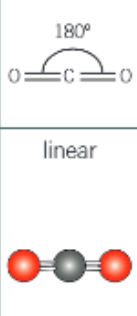
What are the names, bond angles and shapes of molecules with three electron pairs/regions?

What are the names, bond angles and shapes of molecules with four electron pairs/regions?

What are the names, bond angles and shapes of molecules with six electron pairs/regions?

Define the term dipole
a separation in electrical charge so that one atom of a polar covalent bond, or one end of a polar molecule, has a small +ve charge δ+ and the other has a small -ve charge δ-
Define the term electronegativity
a measure of the attraction of a bonded atom for the pair of electrons in a covalent bond
Define the term polar covalent bond
a bond with a permanent dipole, having small δ+ and δ-partial charges on the bonded atoms
Define the term polar molecule
a molecule with an overall dipole, having taken into account any dipoles across bonds and the shape of the molecule
What are non-polar bonds?
the bonded electron pair is shared evenly.
i.e.
bonded atoms same element eg H2 or O2 (pure covalent bond)
or bonded atoms same/similar electronegativity
or hydrocarbon liquids (solvents, do not mix with water)
What are polar bonds?
bonded electron pair shared unequally between bonded atoms
- has different electronegativity values
- when bonded atoms are of different elements:
Nuclear charges are different
Atoms may be different sizes
Shared pair of electrons may be closer to 1 nucleus (experiencing more attraction from 1 of the atoms)
What is the Pauling scale?
compares electronegativity of atoms of different elements depending on position in periodic table
How does electronegativity change across the periodic table?
electronegativity increases up and across periodic table
across the table nuclear charge increases, atomic radius decreases
F = most electronegative atom (noble gases not included, tend not to form compounds) – Pauline value 4.0
What does a large electronegativity difference mean?
1 bonded atom has much larger attraction for shared pair than other atom.
more electronegative atom will gain control of electrons and the bond will be ionic rather than covalent
How can electronegativity help estimate type of bonding?
covalent: 0
polar covalent: 0-1.8
ionic: >1.8
Can symmetrical molecules make dipoles?
no - partial charges will cancel out
How can dipoles act in a molecule?
depending on shape of molecule:
Dipoles may reinforce each other to produce larger overall dipole eg H2O
Or cancel out if acting in opposite directions eg CO2
What happens when a polar solvent is dissolved in water
Water molecules attract anions and cations
Ionic lattice breaks down as it dissolves
in the resulting solution water molecules surround anions and cations
cations are attrached towards O (δ-)
anions are attrached towards H (δ+)
Are IMFs and covalent bonds relatively strong?
Covalent bonds are strong but intermolecular forces (IMFs) are week
What are IMFs?
IMFs = interactions between dipoles of different molecules (responsible for melting and boiling points)
What do covalent bonds determine?
Identity and chemical reaction of molecules
What are the three IMFs?
Induced dipole-dipole interactions (London forces)
Permanent dipole-dipole interactions
Hydrogen bonding
What is the bond enthalpy of each IMF?
Bond enthalpy / kJ mol-1
London forces – 1-10
Permanent dipole-dipole interactions – 3-25
H bonding – 10-40
Single covalent bonds – 150-500
What molecules do London forces exist between?
all molecules (polar/non polar)
Act between induced dipoles across molecules
What forms London forces?
movement of electron pair produces a changing dipole in a molecule
at any instant a different instantaneous dipole exists
the instantaneous dipole produces a dipole on a neighbouring molecule
the induced dipole induces further dipoles on neighbouring molecules which then attract another (ripple effect) (temporary but repeatedly occurring)

What is the effect of the number of electrons in a molecule?
More electrons per molecule:
- larger instantaneous and induced dipoles,
- > London Forces,
- stronger IMFs (more energy to overcome)
- so higher melting point
What do permanent dipole-dipole interactions exist between?
Act between the permanent dipoles in polar molecules
containing:
- an electronegative atom with a lone pair of electrons
And
- a H atom attached to O, N or F
What type of line represents an IMF?
a dash line
What is hydrogen bonding's affect on water?
- Open lattice
- Boiling Point
- Relatively high surface Tension
Explain water's open lattice
when frozen, O has 2 lone pairs and is bonded to 2 H atoms
so H2O can form 4 H bonds
which extend outwards holding water molecules slightly apart (further apart in ice than water)
forming open tetrahedral lattice full of holes, decreasing density
solid ice less dense than liquid water (floats)
when ice melts lattice collapse and molecules move closer together (liquid water denser than ice)
Explain waters boiling point
water has London forces as well as H bonds between molecules
so has much higher melting and boiling points than would be expected from just London forces.
H bonds are broken completely when water boils
Why are water's properties advantageous?
Ice floats on ponds and lakes = insulating layer so water doesn’t freeze and fish survive
Without H bonds water would exist as a gas at room temperature (no life as we know it)
What are simple molecular substances made up of?
simple molecules – small units containing definite number - of atoms with a definite molecular formula
All simple molecular substances are covalently bonded
What is a simple molecular lattice made up of?
molecules held in place by weak IMFs
atoms within molecules strongly bonded by covalent bonds
What happens when a simple molecular substance becomes molten?
- intermolecular forces break
- covalent bonds don’t
How are non-polar substances soluble/insoluble?
(easier to predict)
soluble in non-polar solvents
IMFs form between molecules and solvent
interactions weaken the IMFs in lattice -> compound dissolves
insoluble in polar solvants because:
little interaction between molecules in lattice and solvent molecules
IM bonding within polar solvent = too strong to be broken
How are polar substances soluble or insoluble?
- polar substances may dissolve in polar solvents
- because solvent molecules and solute molecules attract
- solubility can extend to liquids and gases
-solubility depends on strength of dipole
- hard to predict
How is solubility affected with compounds that contain both polar and non-polar parts
Can dissolves in both polar and non-polar solvents (eg ethanol)
Explain the difference between hydrophilic and hydrophobic parts of a molecule
Some biological molecules have hydrophobic and hydrophilic parts
- hydrophilic part = polar (electronegative atoms that can interact with water)
- hydrophobic part = non-polar (comprised of carbon chain)