Genetics 3000 DNA Replication and Recombination
 Call Kai
 Learn
 Practice Test
 Spaced Repetition
 Match
 Flashcards
 Knowt Play
1/52

There's no tags or description
Looks like no tags are added yet.
53 Terms
Complimentary base pairing suggests that …
the cell has everything it needs to easily make a copy of a DNA molecule
Replication is …
rapid, (E. coli have 4.6 million base pairs and can make 1000 nucleotides per second
Homo sapiens have …
3 billion base pairs and can make 50 molecules per second
Replication is incredibly …
accurate (E. coli make 1 mistake per 100 million-1 billion base pairs while homo sapiens make a mistake every 100-1000 base pairs)
Semiconservative replication is when …
one new strand is made using the existing strand as a template, results in two new DNA molecules and half of each was the original molecule
What two models for DNA replication were proposed but proved wrong?
Conservative and dispersive
Conservative model =
parent helix used to make a copy is left intact, the two strands don’t separate
Dispersive model =
Daughter helices are mixes of original parent strands and new strands instead of one linear DNA piece being entirely old or new DNA
Who ran the experiment to determine which replication model was correct?
Meselson and Stahl (1958)
Meselson and Stahl labeled DNA 14N (light) and 15N(heavy) …
then the DNA is spun in a centrifuge to separate the heavy from the light, DNA labeled with only 14N will lay above DNA labeled with 15N, and DNA containing both will lie in the middle
The replication experiment started with …
labeling DNA 15N, these cells were isolated then transferred to grow with 14N, now when new nucleotides are added they will be light
When you allow the replication experiment allows enough time to replicate once what should you expect?
A dispersive and semiconservative will make DNA molecules that combine light and heavy, while conservative would make 1 DNA molecule of only light and one only heavy, therefore conservative is ruled out after only one round
After more than one round of replication, what would you expect to see in the experiment?
dispersive would continue to show blended bands for several rounds and they would gradually grow lighter, semiconservative would show two mixed bands permanently, and every other DNA molecule would be light
Where does replicatio n
Replication is bi- …
directional, meaning replication will take place in both directions away from the origin
First during replication the DNA must …
unwind at the replication point, producing single stranded templates, the the ends unravel creating a replication bubble, each end has a replication fork which is where the DNA is unwinding
Eukaryotes have multiple points of replication because …
it decreases the amount of time needed for replication to take place which decreases the amount of time needed to reproduce
What are the requirements for replication?
nucleotide pool, template DNA, and enzymes
The nucleotide pool must be …
balanced between the 4 nucleotides otherwise the oversupply of one may result in that nucleotide being incorporated when it shouldn’t be resulting in mutations
Enzymes needed for replication are …
proteins that allow chemical reactions to be compatible with life like DNA polymerases, there are multiple types
DNA polymerase III can only add nucleotides in the …
5’ to 3’ direction, so its adding nucleotides onto the 3’ end because the polymerase needs a free 3’ OH
DNA polymerase III carries out …
in vivo replication which adds new nucleotides and can remove them as part of the proofreading activity
Exonuclease refers to the ability of polymerases to …
remove newly added nucleotides
DNA pol III Holoenzyme is made up of what pieces?
alpha subunit (adds the nucleotides), beta subunit (exonuclease proofreading), sliding clamp (encircles un-replicated DNA and tethers it to DNA polymerase), y complex (loads enzymes onto the template - is the clamp loader)
The core enzyme of DNA pol III holoenzyme contains the …
alpha and beta subunits, which are connected to the sliding clamp by the sliding clamp loader, the core enzyme contains the catalytic activity
The single origin of replication in bacteria is called …
oriC, its identifiable to initiator proteins, they wrap the oriC around themselves and then right outside the circle the DNA unwinds and replication begins, so it doesn’t start replication and adding nucleotides directly at the origin
After the DNA is separated, helicase binds to …
ssDNA and begins breaking H-bonds to continue separating the DNA
DNA gyrase / topoisomerase releases …
excess twisting which is created by helicase as it unravels the DNA, binds onto the double stranded DNA (ahead of the replication fork which is where helicase sits)
The cell cannot take too long before DNA polymerase starts adding nucleotides because …
the cell recognizes when ssDNA is present and degrades it because viruses are often in the form of ssDNA
Single-strand-binding proteins protect …
ssDNA from being degraded, they bind onto the ssDNA and keep it from reconnecting to the other strand and it prevents the cell from degrading the DNA
In order to start replication DNA polymerase III needs a starting 3’ end so …
Primase synthesizes an RNA primer that DNA pol III can bind to and start
DNA is double stranded and antiparallel so when replication begins going in BOTH directions we get a …
leading strand and a lagging strand, so the newly synthesized strands are built in two different ways
For one replication bubble, there are …
two leading strands and two lagging strands
A leading strand is called this because …
the process doesn’t have to be interrupted, DNA pol III simply goes straight along the template adding nucleotides in the 3’ → 5’ direction
The lagging strand is called that because …
DNA pol III has to move ahead of the fork and replicate going backwards so that its adding in the 3’ → 5’ direction, then it meets the previously made nucleotides and picks up and moves ahead again, this makes fragments that must be connected later called Okazaki fragments
Because DNA pol III starts somewhere new after finishing a fragment on the lagging strand, the Primer must add …
RNA primer for DNA pol III to start on between every okazaki fragment
The primers are removed from the okazaki fragments and filled in by …
DNA pol I , after they are removed and filled in DNA ligase connects the Okazaki fragments by forming phosphodiester bonds
DNA pol III can recognize a mistake when …
a nucleotide is added that doesn’t match the typical radius of a purine and a pyrimidine, G-G would be too thick and it would poke out signaling to DNA pol III that the wrong nucleotide was added
What are the key differences between replication in prokaryotes vs eukaryotes?
Eukaryotes have more DNA and more types of DNA polymerases, multiple origins of replication, and they have linear chromosomes
Linear chromosomes create what problem?
end replication on the lagging strand, on the end of the chromosome there is no space to add an RNA primer for DNA pol III to bind to, this leavers ssDNA hanging off the end = target for degradtion
Telomerase …
holds an RNA template that can be added to the end of a linear chromosome, this extends it and allows RNA primer to fit on the end without covering the nucleotides that still need to be copied, then the telomerase along with the RNA template are removed
It’s called telomerase because …
the telomeres of the linear chromosome have a G-rich repeated sequence which is where the RNA template is added

Homologous recombination (HR) gives the cell an opportunity to …
repair damaged or incorrect areas of DNA during replication
When homologous chromosomes are present …
complimentary regions can align
HR requires the physical …
breaks in both strands of DNA on the two separate chromosomes, either the break in a single strand of non sister-chromatids of a double break in DNA strands of one chromatid
Heteroduplex molecules of DNA form when …
two single-stranded DNA molecules (or strands) from different or non-identical sources pair with each other
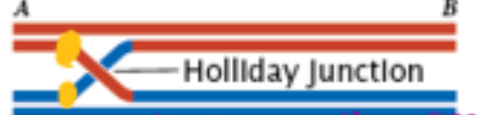
The Holliday disjunction is …
the structure where strands pass each other
HR is a super important process because …
there are enzymes whose jobs are to break phosphodiester bonds so that exchange can occur but many other things that aren’t intentional can cut DNA too like radiation
For exchanging to occur between chromosomes, which bonds must be broken?
the backbone of the molecule, the phosphodiester bond
Cleavage of the Holliday disjunction is required to …
restore the double stranded molecules, they cannot stay connected otherwise meiosis will not occur properly, cleavage can occur in the horizontal or vertical plane
Overall recombination process:
