1- The central problem of statistical mechanics
 Call Kai
 Learn
Learn Practice Test
 Spaced Repetition
 Match
Match Flashcards
 Knowt Play
1/26

There's no tags or description
Looks like no tags are added yet.
Name | Mastery | Learn | Test | Matching | Spaced | Call with Kai | Chat |
|---|
No analytics yet
Send a link to your students to track their progress
27 Terms
What does statistical mechanics aim to describe?
The average properties of many‑body systems.
Give examples of many‑body systems relevant to statistical mechanics.
Populations, particles, financial markets, atoms, molecules.
What type of systems does this course focus on?
Systems in equilibrium with constant volume V and constant number of particles N.
What kinds of particles can N represent?
Atoms, molecules, electrons.
What is the central task of statistical mechanics?
To link microscopic mechanics with macroscopic thermodynamic variables and functions.
What are examples of macroscopic thermodynamic quantities?
p= pressure
E=energy
S= entropy
F= Helmoltz free energy
G= Gibbs energy

What determines the microscopic behaviour of particles?
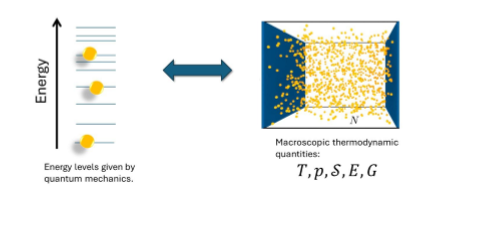
What macroscopic parameters describe a system like a glass of water?
V, ρ, T.

Why is statistical mechanics challenging?
Many microscopic configurations correspond to the same macroscopic parameters.
What is the Schrödinger equation for stationary states?

What are the 1D infinite square well energy levels?

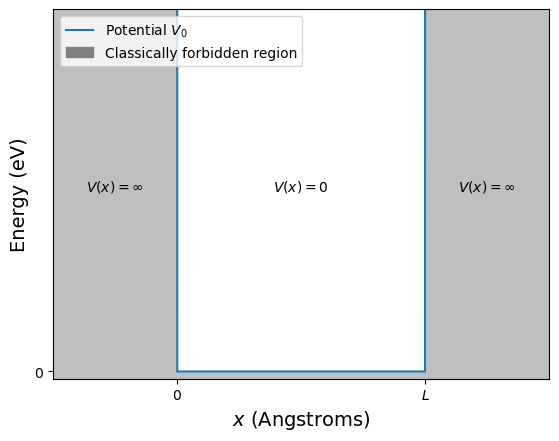
How is the model extended to 3D?
A cube of side a with infinite potential walls.
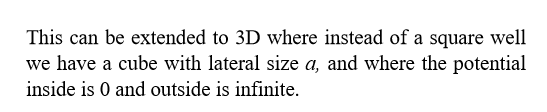
What is the 3D energy level formula?

What are the allowed quantum numbers?

What is degeneracy?
Different quantum number combinations giving the same energy.

What happens to the degeneracy of each energy level as the energy goes up?
The degeneracy of each energy level increases as the energy goes up
What geometric method is used to estimate degeneracy of a particle in a 3D box macroscopic box?
Count the number of lattice points (nx,ny,nz) lying within a thin spherical shell in quantum‑number space.

What radius corresponds to an energy level?

How is energy related to radius?

How does degeneracy behave as energy increases for a particle in a 3D box?
Degeneracy increases with energy — higher energy levels correspond to more quantum states.
Why can R be treated as continuous for macroscopic boxes?
Because the box is large and energies are high, making the spacing between allowed quantum states extremely small.
What does degeneracy correspond to geometrically?
The number of states in a thin spherical shell between radii corresponding to ε and ε+Δε.
What is the number of states with radius ≤ R?


Why is there a factor of 1/8 in Φ(ε)?
Because only positive quantum numbers nx,ny,nz are allowed, corresponding to one octant of the sphere.
How do you estimate the number of states between ε and ε+Δε?
Differentiate Φ(ε) with respect to ε and multiply by Δε.
What is the expression for the number of states in a small energy interval (ε and ε+Δε)?


What does ω(ε,Δε) physically represent?
The density of states at energy ε multiplied by the width of the energy interval.