5.2 Molecular markers, genotyping, and mapping traits through linkage
 Call Kai
 Learn
Learn Practice Test
 Spaced Repetition
 Match
Match Flashcards
 Knowt Play
1/29

Earn XP
Description and Tags
Exam 2
Name | Mastery | Learn | Test | Matching | Spaced | Call with Kai | Chat |
|---|
No analytics yet
Send a link to your students to track their progress
30 Terms
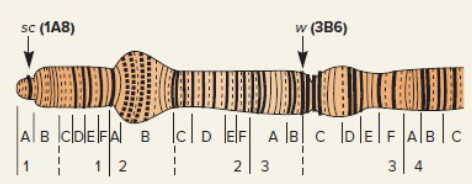
Cytogenetic Map
Shows positions on chromosomes based on cytological features

Genetic Map
shows relative positions of genes (or SNPs) based on how frequently recombination between them occurs

Physical Map
based on DNA sequences
Recombination does not always…
occur at random locations across a genome
Hot spots
areas of frequent recombination
Cold spots
areas of infrequent recombination
Hotspots may be the result of
regions that experience high levels of DNA damage
higher order chromosome structures that make the region more accessible to recombination enzymes
Repetitive sequences (like satellites)
Genetic (Molecular) Markers
is a fragment of DNA that is associated with a specific location within the genome that is variable
Most current genetic mapping projects follow inheritance of SNPs or minisatellites (because sequence and genotyping are relatively inexpensive now)
Genetic markers can be
phenotypic markers - Genes
long DNA fragments (microsatellites)
short DNA fragments (SNP/minisatellites)
Single Nucleotide Polymorphisms (SNPs)
Individual nucleotide differences between different people
Most commonly used genetic marker
can cause Restriction Fragment Length Polymorphisms (RFLPs) at enzyme cut sites
Restriction enzymes
are proteins that cut DNA at specific sequences
Gel Electrophoresis
uses electricity to separate DNA molecules by size (number of nucleotides)
When DNA from a restriction digest is run on a gel, the resulting sizes of the DNA fragments can be seen
mixture of DNA fragments of different sizes
band of longest (slowest) fragments at the top
band of shortest (fastest) fragments at the bottom
Simple sequence repeats (SSRs)
are another type of DNA polymorphism
are tandemly repeated short DNA sequences common in the human genome
Exact length of each —- varies from person to person
are a LOT in the human genome

Restriction fragment length polymorphisms (RFLPs)
Depending on the number of repeats in an SSR, length of a DNA fragment between two restriction sites can be different
are central to forensic analysis since it is a cheap way to genotype an individual
Linkage mapping
Can help find:
rare disease alleles in families
Undiscovered genes that contribute to complex traits (major and minor effect genes)
Important trait loci in crops and livestock
Creating scaffolds for genome assembly (of species that lack annotated genomes)

Mapping genes through linkage - pedigree
can ask how each co-segregates with a disease in a family to identify areas of the genome that cause the disease
If the D/d locus is unlinked to the C/T locus, each gametic genotype should appear in equal frequencies
If the D/d locus is completely linked to the A/G locus, the expected genotypes of the gametes are: DA and dG
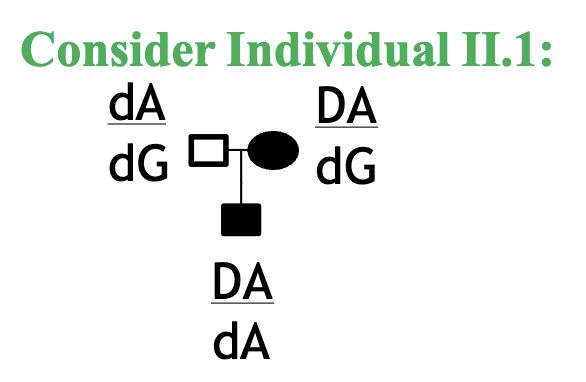
Are the maternally inherited alleles parental or non-parental? a. Parental (nonrecombinant)
b. Non- parental (recombinant)
c. Not possible to determine
a. Parental (nonrecombinant)

Are the paternally inherited alleles parental or non-parental? a. Parental (nonrecombinant)
b. Non- parental (recombinant)
c. Not possible to determine
c. Not possible to determine

How would you describe the paternal gametic contribution of III-1?
a. recombinant
b. parental
c. Cannot determine
a. recombinant

How would you describe the paternal gametic contribution of III-2?
a. recombinant
b. parental
c. Cannot determine
b. parental
Logarithm of ODDs score (LOD)
helps with Pedigrees that have low sample size, which leads to inaccurate
distancesrepresents the likelihood of linkage
Data from multiple pedigrees can be combined (increase of statistical power)
Score>3 is considered evidence for linkage (This means the SNP is 1000x more likely to be linked than unlinked)
Formula: log10 x P (rec events)# rec events * P (non-rec events)#non-rec events /
(0.25)# informative events aka total
You are a physician helping 3 different families with Autosome Dominant Tubulointerstitial Kidney Disease (ADCTKD). These families share symptom similarities. Sequencing of candidate genes did not provide any helpful information. Each family member provides a blood sample for genotyping. You analyze each pedigree for co- segregation of each of the 100,000 SNPs with the disease- causing allele. For 1 SNP, you observe:
1 recombinant genotype
7 non-recombinant genotypes
If this SNP were 20cM away from the disease allele, how often would you expect to
observe a recombinant genotype?
a. P = 0.1 (10%)
b. P = 0.2 (20%)
c. P = 0.25 (25%)
d. P = 0.5 (50%)
e. P = 1 (100%)
b. P = 0.2 (20%)
Pedigree Linkage Mapping Pros:
useful for identifying genetic basis for (human) diseases
doesn’t require huge sample sizes (though multiple pedigrees are best)
can map genes even if there are multiple alleles that lead to the trait
Pedigree Linkage Mapping Cons:
Few recombination events in a single meiosis means that regions mapped may contain 100s of genes (low resolution)
samples can be difficult to obtain
need new set of pedigrees for each trait
Recombinant Inbred Lines (RILs)
A population of highly inbred (ie homozygous) progeny from a cross where parents have distinctly different phenotypes
To map loci: genotype and phenotype the —- and identify loci that co-segregate with the trait of interest

Which region is linked to the gene variant leading to obesity?
A) 1
B) 2
C) 3
B) 2
Quantitative Trait Loci mapping (QTL mapping)
Studying how quantitative traits like weight and height are controlled by different areas of the genome
Linkage/QTL Mapping using RILs Advantages:
Highly accurate (easy to obtain lots of samples and phenotype measurements)
Relatively easy and inexpensive
Can maintain RILs indefinitely in the lab
Linkage/QTL Mapping using RILs disadvantages:
Limited to model and domesticated organisms
Need a different panel of RILs for different traits (or create a collaborative cross)
Low resolution; Recombination is infrequent enough that large regions of chromosomes are linked
Genome Wide Association Studies (GWAS)
Mapping traits in a population
relies on ancestral linkage of SNPs (haplogroups that stay together over generations)
do not formally test for linkage