Physiology of the menstrual cycle & fertilisation
 Call Kai
 Learn
 Practice Test
 Spaced Repetition
 Match
 Flashcards
 Knowt Play
1/46

There's no tags or description
Looks like no tags are added yet.
47 Terms
What is the 1st stage of the menstrual cycle?
Follicular phase
What happens to FSH levels during the follicular phase?
They rise steadily, stimulating a few ovarian follicles
The first follicle to mature produces large amounts of oestrogen, what effect does this have on the development of other follicles?
Inhibits their growth
What impact does the increasing levels of oestrogen (produced by Graafian follicles) result in?
Endometrial thickening (proliferation)
Thinning of cervical mucus (easier passage for sperm)
Inhibition of LH production by anterior pituitary gland
What happens when oestrogen reaches/exceeds the threshold level?
Stops acting as a negative feedback mechanism - conversely stimulating the production of LH (which peaks on day 12)
What is the result of the spike in LH on day 12?
Thinning of the membrane of the Graafian follicle - within 24/48hrs it ruptures and releases the secondary oocyte (OVULATION)
Where is the secondary oocyte released into during ovulation?
Mature ovum is released into the peritoneal space - taken up by the uterine tubes via fimbriae
Start vs end of follicular phase?
START = day 1 of menstruation
END = ovulation (day 14)
What phase of the menstrual cycle begins following ovulation?
luteal phase
Following ovulation, what do increased levels of FSH and LH stimulate?
Stimulates the graafian follicle to become the corpus luteum = secretes progesterone
What is the result of rising levels of progesterone during the luteal phase?
Endometrium becomes receptive to implantation
LH and FSH levels fall
Increased basal body temp
What does the fall of FSH and LH during luteal phase result in?
Degeneration of the corpus luteum - progesterone falls and menstruation begins (cycle repeats)
What occurs if fertilisation happens?
Ovum produces hCG = preventing degeneration of corpus luteum
Progesterone production continues = prevents menstruation
Placenta eventually takes over corpus luteum
What layer of the endometrium sheds during uterine cycle?
functional layer
What are the 3 phases of the uterine cycle?
proliferative phase
secretory phase
menstrual phase
What drives the proliferative phase of the uterine cycle?
oestrogen production increases (as a result of rising levels of FSH and LH)
What effect does oestrogen have on the endometrium layer?
repair and growth of the functional endometrium following recent menstruation
increases the thickness, vascularity and number of secretory glands
When does the secretory phase begin?
following ovulation
What hormone drives the secretory phase of uterine cycle?
Progesterone = released by the corpus luteum
What effects does progesterone have on the endometrium?
Promotes the secretion of various substances to make the uterus more receptive/welcoming for the embryo implantation
When does the menstrual phase of the uterine cycle begin?
At the end of the luteal phase (beginning of the follicular phase), when the corpus luteum degenerates
What impact does falling progesterone have on the endometrium?
Spiral arteries in functional endometrium contract
Blood supply decreases as a result = functional endometrium becomes ischemic and necrotic
Shedding of endometrium = menstruation
What are the distinct follicle phases?
primordial follicle
primary follicle
preantral follicle
antral follicle
mature/graafian follice

What makes up the primordial follicle?
primary oocyte
surrounding flat epithelial cells (pre-granulosa cells)
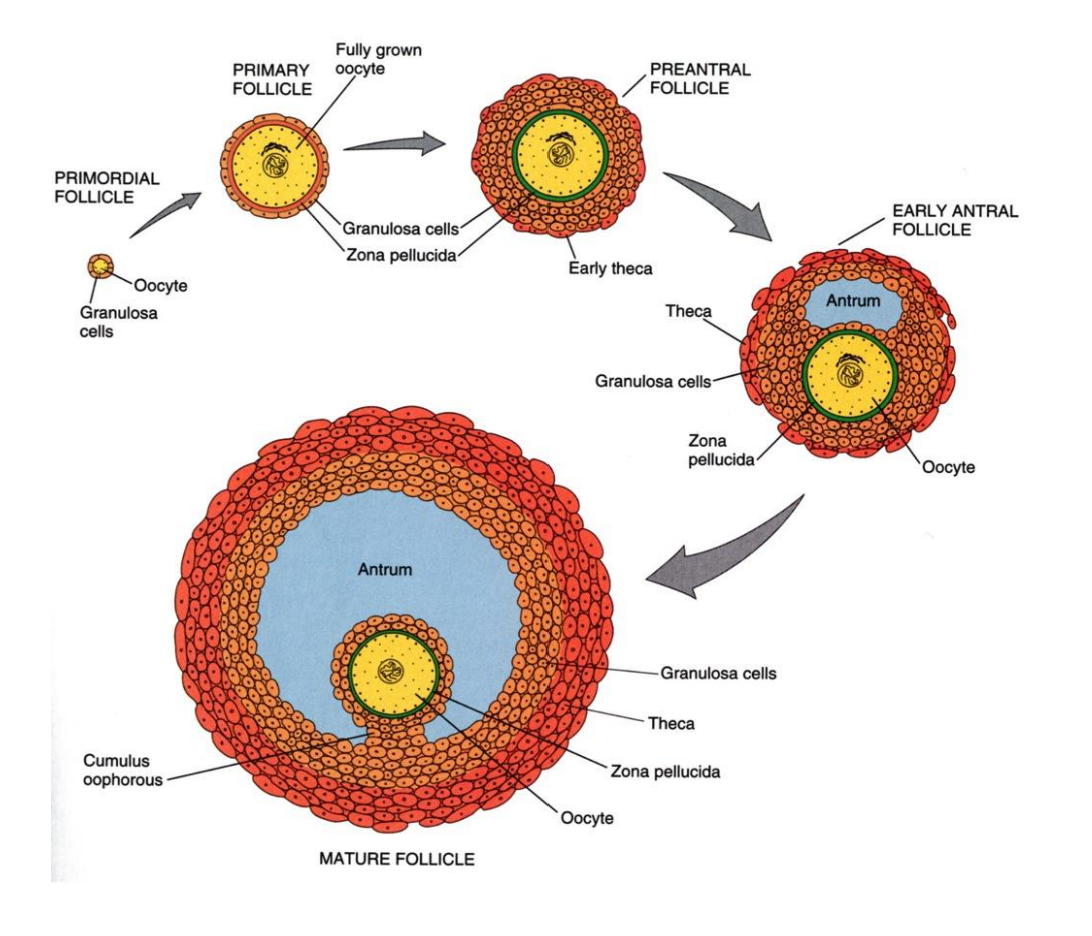
How does the primordial follicle become the primary follicle?
primordial follicles begin to grow, and the surrounding follicular cells change from flat to cuboidal
These cuboidal cells proliferate to produce stratified epithelium = granulosa cells
This unit is called the primary follicle
What forms the zona pellucida?
glycoproteins secreted by granulosa cells and the oocyte onto the oocyte surface
secondary follicle stage
What makes up theca cells?
Ovarian connective tissue (stromal cells)
What two layers form in the theca cells in the preantral follicle?
Theca interna and externa
What is the most characteristic feature of the preantral follicle?
However, the most characteristic feature of this preantral stage is that the granulosa cells will acquire receptors for FSH (follicle-stimulating hormone).
Thus, follicular development from the early antral stage onwards becomes gonadotropin-dependent.
What characterises the antral follicle?
The antral (or tertiary) follicle is characterized by the presence of a cavity filled with follicular fluid, known as the antrum.
As mentioned, the development of these follicles is now dependent on gonadotropins (FSH and LH).
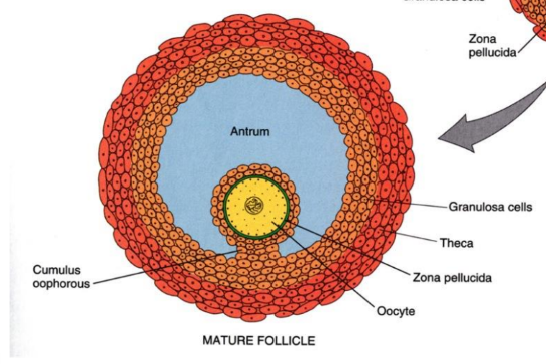
Describe the mature/graafian follicle
Due to the growth of the antrum, the oocyte is located in one of the sides of the follicle.
The oocyte, however, remains surrounded by granulosa cells, forming the cumulus oophorus or cumulus.
Where does fertilisation usually occur in the uterine tubes?
In the first 1/3 - ampullary region of uterine tubes
How does sperm movement from the cervix to the uterine tube occur?
Mainly by muscular contractions of the uterus and uterine tubes - very little by self propulsion
Why do sperm become hyperactive and highly motile around ovulation?
They are attracted to the egg by warmer temperatures (thermotaxis) and in the ampulla vs isthmus region of the uterine tube via chemotaxis
Sperm chemoattractant?
progesterone made by corona radiata cells
What processes must sperm undergo to be able to swim into the ampulla?
capacitation
acrosome raction
Capacitation
period of conditioning in the FRT lasting aprox 7hrs
glycoprotein coat and seminal plasma proteins are removed from the plasma membrane overlying the acrosomal region of the spermatozoa
Acrosome reaction
Occurs after binding to the zona pellucida (induced by zona proteins)
enzymes released needed to penetrate the zona pellucida
What are the 3 stages of fertilisation?
Penetration of corona radiata
penetration of zona pellucida
fusion of oocyte and sperm cell membranes
Penetration of corona radiata
It is thought that other sperm aid in penetration the barriers protecting the oocyte
capacitated sperm can pass freely through the corona radiata
Penetration of the zona pellucida
facilitated by acrosomal enzymes
permeability of ZP changes when sperm contact it
soluble factor from sperm enters = changes ionic composition
Ca2+ released from the ER of egg = cortical granules lining the egg fuse with egg cell membrane = release of lysosonal enzymes
What zona pellucida proteins mediate the sperm binding and acrosome reactions?
ZP1, ZP3 and ZP4
What facilitates the initial adhesion of sperm and oocyte membranes?
interaction of integrins on oocyte and their ligands, disintegrins on sperm
after adhesion plasma membranes fuse
What 3 ways does the egg respond to the entrance of the spematozoon?
Cortical and zona pellucida reactions
Resumption of 2nd meiotic division
Metabolic activation of the egg
Cortical and zona pellucida reactions
Release of cortical oocyte granules =
oocyte membrane becomes impermeable to other sperm
and zona pellucida alters its structure and composition to prevent sperm binding and penetration
Resumption of 2nd meiotic division
Oocyte finishes meiotic division immediately after entry of spermatozoon,
one of daughter cells hardly receives any cytoplasm (2nd polar body)
other cell = definitive oocyte. Its chromosomes (22 plus X) arrange themselves as the female pronucleus
Describe the fusion of male and female pronuclei
Come into close contact and fuse
during growth of pronuclei, each pronucleus must replicate its DNA