Medicine through time c1500-1700
 Call Kai
 Learn
 Practice Test
 Spaced Repetition
 Match
 Flashcards
 Knowt Play
1/7

Earn XP
8 Terms
renaissance
a french term meaning “rebirth”. A period in time where people were beginning to think different about the world, via art, science, and medicine,
Change Vs Continuity in the Renaissance Period.

The Printing Press
In c1440, The printing Press was invented.
This meant that the church no longer controlled what went into books, as books were printed, rather than written by hand.
It also meant that it was easier to access books, and could be new ideas spread quickly.
Andreas Vesalius
• With the ban of dissection lifted, Vesalius conducted dissection on executed criminals to improve the understanding of human anatomy.
• Vesalius disproved Galen’s previous work, such as the jaw bone was one bone not two. Galen’s work was incorrect because he dissected animals.
• In 1543, Vesalius published his findings in a book called On the fabric of the human body. This bok was used to train doctors, and encouraged them to make their own dissections.
Thomas Sydenham
Encouraged the idea of scientific observation.
This was the idea that to diagnose a patient’s illness, you must observe their symptoms and treat the disease causing them.
He published his book Medical Observations, and influenced changing ideas about how disease should be diagnosed.
The Royal Society
In 1660, the royal society was founded in London to help scientists share new discoveries and carry out experiments
This had the support of king Charles II, which massively increased the credibility of the organisation.
In 1665, they issued their first medical journal
William Harvey
Famously discovered that blood was pumped around the body by the heart, and that the same blood was used.
This disproved Galen’s theory that blood was made in the liver and then pumped around.
1628, he published his book where other doctors could learn about his discoveries.
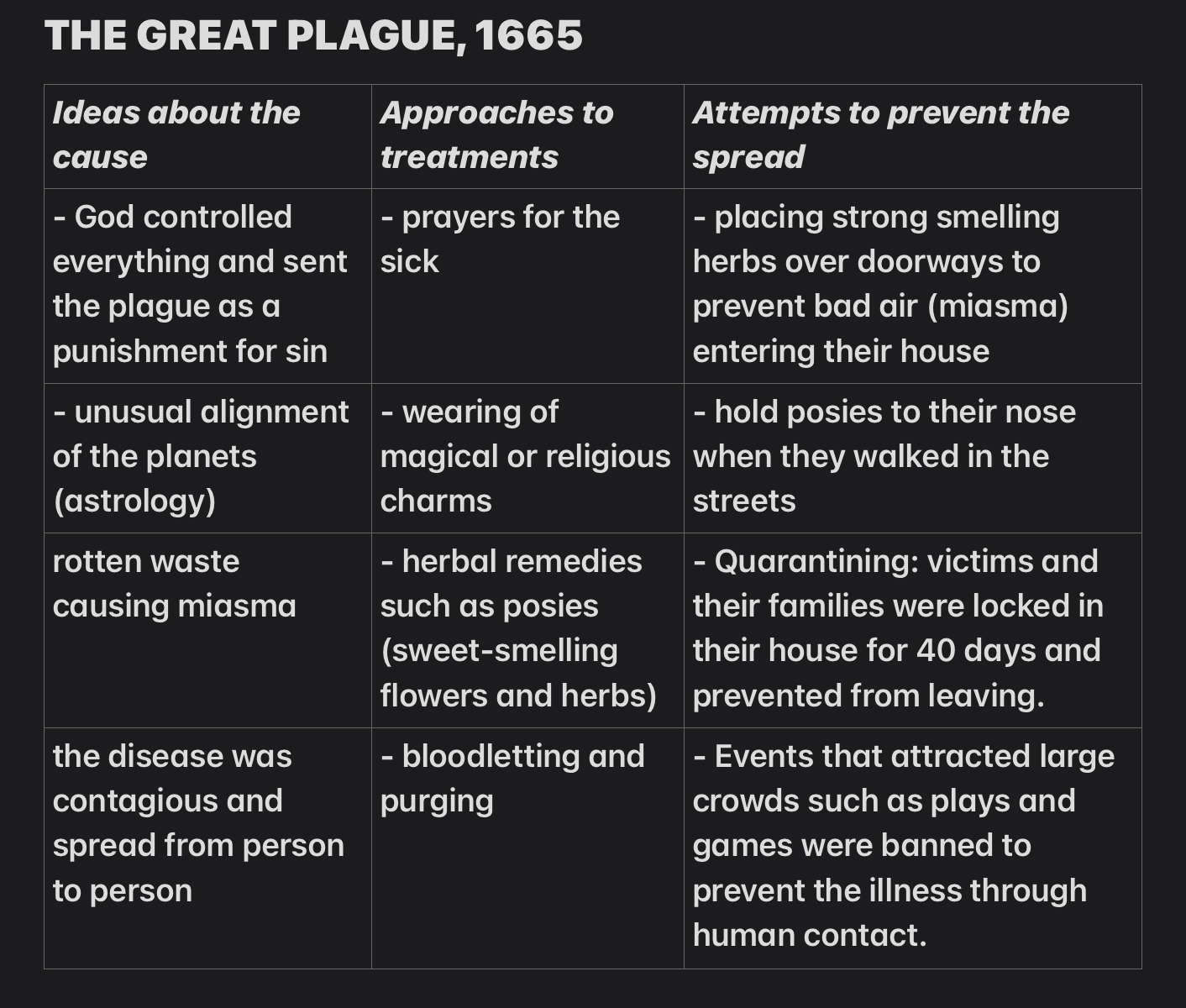
The Great Plague, 1665