Art History Midterm 1
 Call Kai
 Learn
 Practice Test
 Spaced Repetition
 Match
 Flashcards
 Knowt Play
1/86

There's no tags or description
Looks like no tags are added yet.
87 Terms
Prehistory art details
90% are animals, rest male-animal hybrids or females with exaggerated characteristics
rare to find scenes, small pieces left, deep in caves, ritualistic, mainly cave paintings, practiced art, many artistic over time, no horizon line, always side profile
Ancient Mesopotamia Art details
No use of rock contours but more relief carvings
scenes, hierarchy of scale
feared death- epic of Gilgamesh
language- cuneiform
Sumerian art (3500-2332 BC)
Akkadian art (2332-2150 BC)
Neo-Sumerian and Babylonian art (2150-1600 BC)
Assyrian and Neo-Babylonian art (900-539 BC)
Sumer details
3500-2332 BC
independent city states with different politics but same culture
ziggurat, libation, votive offerings, sky gods
peaceful, start of civilization
language was for religious purposes
ziggurat
bottom steps up to the temple
circumambulation- walk around the whole building in order to enter

libation
pouring for ritual purposes
votive offerings
statues that were used in temples to stand in place of a worshipper (proxy)
Standard of Ur Royal Cemetery 2600 BCE Sumerian

Statues of worshipers (watchers) Square Temple at Eshnunna (2700 BCE) sumerian

The White Temple Ziggurat Uruk 3200-3000 BCE Sumerian

Akkadians details
1st empire-kingship (2332-2150 BC)
different language but same religious beliefs as Sumerians
lost wax method
war
language was for legal purposes
Civilization
agriculture, permanent architecture, social stratification, specialization of labor, written language
Head of Akkadian Ruler Nineveh (2250-2200 BC) lost wax method Akkadia

Cylinder Seal of Hunting Scene with Modern Impression 2250-2150 BCE Akkadian

Decorated Ochre, Blombos Cave, South Africa (75,000 BC)

Bradshaw Rock Paintings, Australia, (ca 20,000 BC)

Lion-headed Figurine, Hoblenstein Stadel Cave, Germany (40,000-35,000 BC)

Venus of Willendorf, Austria (28,000-25,000 BC) (4.4”)

Wall of Bison, Altamira Caves, Spain (13,000-11,000 BC)

The Hunting Scene, Lascaux Cave (17,000-13,000 BC)

Predynastic Egypt
love multiplicity of meaning
rigid
mastabas
wealthy used eye makeup
hierarchy of scale
leaders showed themselves powerful and idealistically
ka-afterlife positive
consistent
Old Kingdom
height of civilization
pyramids
Middle Kingdom
trying to go back to the old kingdom
New Kingdom
trying to go back to old, lil Amarna period
Amarna Period
different art style and religious revolution (Akhenaten)- more androgenous and nonideality
once he died they reverted back to the old ways and completely erased him
Venus
female statue with a exaggerated parts
Neo Sumerian detail
same religious beliefs as Sumerian
peace- works show stability and wisdom
Seated Statue of Gudea (c. 2100 BCE) (Neo-Sumerian) 17”

Ziggurat at UR (c. 2100BCE) (Neo-Sumerian)

Babylonia
one of biggest civ of ancient times over 2,000 peeps
worldly power corruption, pride, materialism (opposite of zion)
after fall the civilization was completely erased
Stele of Hammurabi (c. 1780 BCE) (Babylonian) 7’4”

The Ishtar Gate (569 BCE) (Babylonian)

Assyrian Details
walled- Merciless to opposition but forgiving to those who submitted
Fortified citadels
Lots of reliefs depicting stories
hunting had religious purposes
Reconstruction of Citadel of Sargon II (c. 722-705 BCE) (Assyrian)

Ashurnasirpal II Hunting Lions (c. 883-559 BCE) (Assyrian)

Lamassu from Citadel of Sargon II, Dur-Sharrukin (720-700 BCE) (Assyrian)

Palette of King Narmer (c. 3000-2900 BCE) ( predynastic Egyptian)

Mastaba (predynastic)

Imhotep, Pyramid of Djoser at Saqqara (2630-2575 BCE) (predynastic Egyptian)

Great Pyramids at Giza (2520-2494 BCE) (Old Egyptian)

The Great Sphinx (Khafre?) (2520-2494 BCE) (Old Egyptian)

Menkaure with Two Goddesses (2490-2472 BCE) (Old Egyptian)

Wooden Statue of the Scribe Kaaper, Saqqqara, (2500 BCE) (Old Egyptian)

Black Pyramid of Amenenhat III, (1850 BCE) ( Middle Egyptian)

Gold Mask of Tutankhamun, Valley of the Kings, Thebes, (1323 BCE) (New Egyptian)

Kneeling Statue of Hatshepsut, (1473-1458 BCE) (New Egyptian)

Judgment of Hunefer, from an illustrated Book of the Dead (c. 1290-1275 BCE) (New Kingdom Egyptian)

Colossal Statues of Ramses, Temple of Ramses, Abu Simbel, (1290-1224 BCE) (Egyptian)

Thutmose, Bust of Nefertiti, (1353-1335 BCE) (Egyptian-Amarna Style)

Akhenaten with Nefertiti and their children Amarna Style (1353-1335 BCE) (Egyptian-Amarna Style)

Akhenaton from temple of Aton, Amarna Style, (1353-1335 BCE) (Egyptian-Amarna Style)

Cycladic Details
Traders, island, metal tools, ships, lots of marble, economically diverse, no written document or cities, all works of art/info found in graves
love figures with arms crossed, females but if male playing instruments, no distinct faces, geometric
Frying Pan, (Cycladic)

Male Harp Player, (2600-2300 BCE) (Cycladic)

Female Figure, (4500-400 BCE) (Cycladic)

Minoan Details
Palace of Knossos- labyrinth, bulls
Two types of writting- linear A and linear B (we can read B) so we can’t read their records
lots of fish motifs, light is female and dark is male
fresco- bright colors bonds to wall
Bull Leaping Fresco at Knossos, Crete (1400 BCE) (Minoan)

Palace of Knossos, Crete (1400-1100 BCE) (Minoan) (abandoned)

Kamares-Ware Jar with Fish, Crete (1800-1700 BCE) (Minoan)

Snake Goddesses or Priestesses, Crete (1500 BCE) (Minoan)

Landscape with Swallows (Spring Fresco), Thera (1650 BCE) (Minoan)

The Harvester’s Vase, (1500-1400 BCE) (Minoan)

Mycenean Details
built for war, maybe troy, cyclopean
Lion Gate of Mycenae, (13th C BCE) (Mycenaean)

Dendra Panoply, (1450 BCE) (Mycenaean)

Gold Death Mask (Mask of Agamemnon), (16th C BCE) (Mycenaean)

Geometric Greece
abstract triangular, experimenting with how to depict mythology, start of civ after dark age/systemic collapse, Orientalizing so some of their stuff looks Egyptian
Corinthian Black-figure amphora with animal friezes, Rhodes, 625-600 BC (Geometric/Orientalising)

Hero and Centaur form Olympia (750-730 BCE) (Geometric)

Archaic Greece
no emotion in the facial, women are fully clothed, men naked, prehumanism, arachic smile
Calf Bearer from Acropolis, Athens, 560 BCE (Archaic)

Kore from the Acropolis, Athens, 530 BC (Archaic)

Temple of Hera I, Paestum, 550 BCE

Classical Details
stoic- not a ton of emotion but more motion, temple is not straight, perfectly mathematical order, wealthy, start of wet fabric for women, black and red vase
Dying Warrior from East Pediment, Temple of Aphaia, 480 BCE

Hera II Temple, Paestum 470-456 BCE (Classical Greece)

Exekias, Ajax and Achilles Playing Dice, 540-530 BCE (Classical)

Euthymides, Three Revelers, (Red figure amphora), 510 BCE (Classical)

Hellenistic Details
other cultures are actually represented, what it means to be human, emotion and movement, women are naked, alexander the great
Warrior from Riace, 460-450 BCE (Classical)

Iktinos and Kalikrates, Parthenon (Temple of Athena Parthenos), 447-443 BC (Classical)


Epigonos, Dying Gaul, 240-200 BC (Hellenistic)
Winged Nike of Samothrace, 190 BCE (Hellenistic)

Seated Boxer, (Lysippos? Apollonius?) 100-50 BC (Hellenistic)

Etruscans
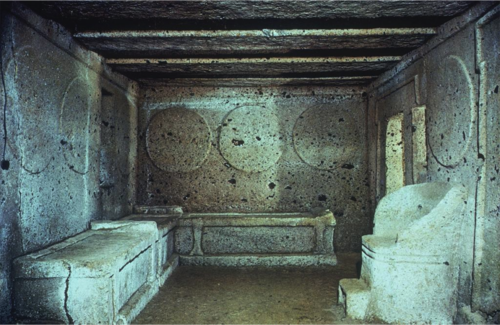
different language and society, men and women are more equal, lil fresco men are dark and women are lighter, better view of the afterlife, where Rome became, grave were carved out like houses
Tombs of the Leopards, Tarquinia, 480-470 BC (Etruscan)

Sarcophagus with Reclining Couple, Cerveteri, 520 BC (Etruscan)

Tomb of Shields and chairs, Cerveteri, 6th c. BC (Etruscan)