Guidelines to Improve Locomotor Function Post-Stroke
 Call Kai
 Learn
 Practice Test
 Spaced Repetition
 Match
 Flashcards
 Knowt Play
1/27

There's no tags or description
Looks like no tags are added yet.
28 Terms
what percentage of individuals who suffer a stroke report limitations in walking ability?
75%
what is the most often stated patient goal during rehab after stroke?
walking
what are gait outcome measures that can be used with stroke patients?
10 meter walk
6 minute walk test
DGI or FGA
dual task like “walking while talking” test
what would you used to perform the observational gait analysis?
rancho gait analysis form
how do we categorize gait?
in terms of
ADLs/IADLs (dependent vs independent)
likeliness to be hospitalized (more likely to be hospitalized, less likely)
fall risk (need intervention to reduce falls risk, less likely to have adverse events)
d/c destination (to SNF vs to home)
ambulation ability (household walker, limited community ambulator, community ambulator, cross stress and normal WS)
what are common gait deviations seen post-stroke?
walk 50% slower
increased double limb support time
shorter step length with less involved limb
decreased weight shift, weight acceptance, weight bearing, and stance time on paretic leg
lack of trailing limb position with paretic LE (lack of full hip extension in terminal stance)
asymmetry is a classic feature of gait in hemiplegia
what is motor learning and how can be determine if it has occured?
a permanent change in movement behavior measured after a retention period; repeated observation of performance allows us to determine if a motor skill is learned (ie gait analysis)
what does acquisition of skilled movement involve?
retention
generalizability
resistance to contextual change
what is motor adaptation?
precursor to motor learning, short term adjustment in behavior to a novel movement setting/environment/constraint. once the novel situation is removed, the motor performance adapts back to the regular situation
what are intervention choices limited by for improving walking ability?
functional abilities of the patient, therapeutic goals for patient
what is rehabilitation dose?
amount of rehab received over a set period of time (reps per set, sets per week, sessions over week, hours per day, total numbers of reps of a functional task in a day or IPR stat, or total reps of an exercise)
what dosage in mammalian models invoked plastic changes?
600 reps of retreivals to monkeys to invoke plastic changes in stroke models
2000 steps per day to restore hindlimb stepping animal models of SCI
what does evidence support for locomotor training post stroke?
locomotor training at higher cardiovascular intensities improves mobility impairments post stroke (HIGT) since it utilizes the key principles of neuroplasticity (FITT)
what evidence is included in the CPG for improving walking function in ambulatory chronic CVA, incomplete spinal cord injury, and TBI?
see image
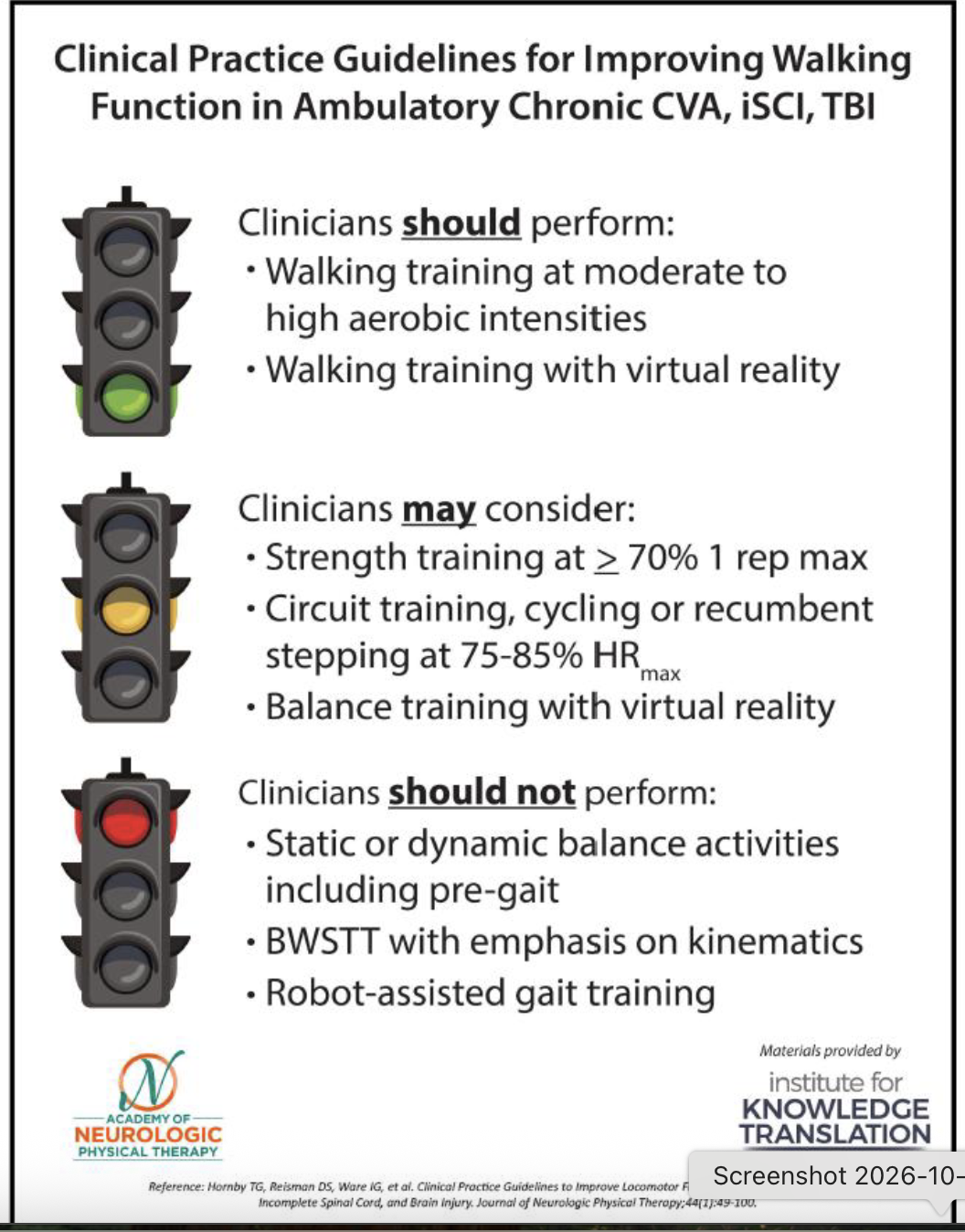
what are the goals of the CPG to improve locomotor function following chronic stroke, iSCI, and TBI?
details relative efficacy of specific intervention to improve walking speed and timed distance
delineates evidence for strategies that can be used clinically to improve walking function
is strength training recommended for stroke rehab?
mixed recommendation findings- effects of strength training were inconsistent across studies for gait speed and distance- may be more useful is we perform training at higher intensities (>70% 1 rep max)
is body weight supported treadmill training or robotics (exoskeletons) recommended?
It depends! may be indicated for non-ambulatory patients to engage in high intensity gait training- clinical expertise and judgement plays an important role in this decision making
what is moderate to high intensity gait training?
large amounts of structures and graded walking practice delivered at moderate to high cardiovascular intensities with targeted heart rate ranges of 60-80% of heart rate reserve or 70-98% of maximum heart rate
how can heart rate maximum be calculated?
208 - 0.7*age
what is needed for best carryover of HIGT?
take the pt off the treadmill and practice overground walking during therapy session
what are the key considerations for post-stroke rehab for locomotion trainnig?
critical to monitor cardiovascular function
always consult with MD prior to starting HIGT
precautions/contraindications: uncontrolled CV or metabolic disease, MSK disease or injury, severe neurological deficits
may require modifications to set up for safety
what are the vital sign parameter guidelines?
see image

does the evidence support use of AFOs and FES?
yes, strong evidence supports use of both for multiple outcomes for individuals with decreased LE motor control due to both acute and chronic post-stroke hemiplegia
what is the purpose of the CPG for use of AFOs and FES post-stroke?
provides evidence to guide clinical decision making for use of either AFO or FES to improve body function and structure, activity and participation for individuals with post-stroke hemiplegia and decreased LE motor control
what is the scope of the CPG for use of AFOs and FES post-stroke?
rehab of individuals with acute and chronic stroke
goals based on compensation and recovery approach
outcomes across ICF levels of function
target populations of CPG included adults (greater than 18 y/o) of all races and ethnicities

what CPG is shown in the image?
The Clinical Practice Guidelines (CPG) for use of Ankle-Foot Orthoses (AFOs) and Functional Electrical Stimulation (FES) to improve locomotor function in individuals post-stroke.
when is it most effective to initiate locomotor training?
repetition matters!- at least 1000 steps of treadmill training needed to create synaptic changes in motor cortex
key takeaways about locomotive training?
all locomotor training devices can improve overground walking, no device is superior
these devices supplement but do not replace other rehab interventions
treadmill training provides high intensity, task specific walking practice
include locomotor training post-stroke is critical; use BWSTT or robotic assistance if necessary
weight the benefits and limitations of each approach when selecting interventions and making treatment decisions