11.8 Molecular Orbital Theory: Electron Delocalization pt. 1
 Call Kai
 Learn
 Practice Test
 Spaced Repetition
 Match
 Flashcards
 Knowt Play
1/34

Earn XP
Description and Tags
Tested: Linear Combination of Atomic Orbitals (LCAOs), Period Two Homonuclear Diatomic Molecules,
35 Terms
molecular orbital theory
an advanced model of chemical bonding in which electrons reside in molecular orbitals delocalized over the entire molecule; in the simplest version, the molecular orbitals are simply linear equations of atomic orbitals
minimum
We can never do better than nature at minimizing the energy of the orbital; the best approximation for the actual molecular orbital is the one with __________ (minimum/maximum) energy.
linear combinations of atomic orbitals (LCAOs)
weighted linear sum analogous to a weighted average of the valence atomic orbitals of the atoms in the molecule
molecular
__________ (valence/molecular) orbital theory states that molecular orbitals are weighted linear sums of the valence atomic orbitals of all the atoms in a molecule, and that many of the molecular orbitals are delocalized over the entire molecule.
bonding orbital
a molecular orbital that is lower in energy than any of the atomic orbitals from which it was formed, results from constructive interference of orbitals that are in-phase

decreasing
The bonding orbital has increased electron density in the internuclear region, thereby ____________ (increasing/decreasing) energy compared to orbitals in nonbonded atoms.
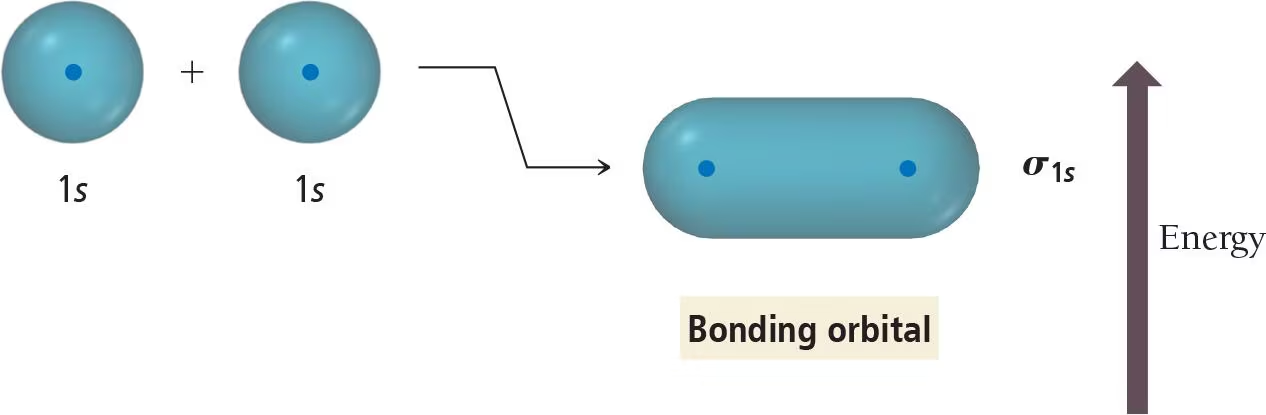
lowest
Electrons seek the _______ (highest/lowest) energy molecular orbital available. A molecule has more than one molecular orbital and some may be empty.
antibonding orbital
a molecular orbital that is higher in energy than any of the atomic orbitals from which it was formed, results from destructive interference of orbitals that are out of phase
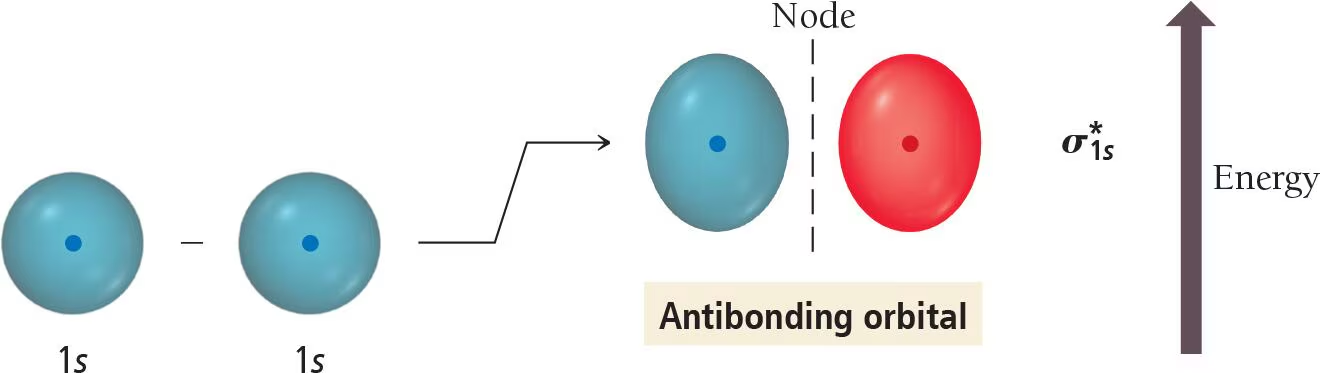
increasing
The antibonding orbital has a node in the internuclear region, thereby ____________ (increasing/decreasing) energy compared to orbitals in nonbonded atoms.

waves, constructive, destructive
Remember that electrons in orbitals behave like ____ (waves/particles): bonding molecular orbital arises out of _______________ (constructive/destructive) interference between overlapping atomic orbitals because both orbitals have the same phase, while antibonding molecular orbital arises out of ______________ (constructive/destructive) interference between overlapping atomic orbitals because subtracting one from the other means the two interacting orbitals have opposite phases.
decrease
2 Hydrogen atoms can __________ (increase/decrease) overall energy by forming H2 because electrons can move from higher-energy atomic orbitals into lower energy σ1s bonding molecular orbital.

(σ1s)2
molecular orbital electron configuration of H2
bond order
for a molecule, the number of electrons in bonding orbitals minus the number of electrons in nonbonding orbitals divided by 2

positive
____________ (positive/0/negative) bond order implies that the molecule is stable.
positive
Generally, the more _______________ (positive/close to 0/negative) the bond order, the stronger the bond as there are more electrons in bonding molecular orbitals and therefore electrons have lower energy than they did in the orbitals of the isolated atoms.
increases
As bond order __________ (increases/decreases), the bond gets stronger and shorter.
equal to
Summarizing LCAO-MO Theory
We can approximate molecular orbitals as a linear combination of atomic orbitals. The total number of molecular orbitals formed from a particular set of atomic orbitals is always _______ (greater than/equal to/less than) the number of atomic orbitals in the set.
bonding, antibonding
Summarizing LCAO-MO Theory
When 2 atomic orbitals combine to form 2 molecular orbitals, 1 molecular orbital is lower in energy, the __________ (bonding/antibonding) orbital, and the other is higher in energy, the __________ (bonding/antibonding) orbital.
lowest, 2
Summarizing LCAO-MO Theory
When assigning the electrons of a molecule to molecular orbitals, fill the _______ (lowest/highest) energy molecular orbitals first with a maximum of _ spin-paired electrons per orbital.
parallel
Summarizing LCAO-MO Theory
When assigning electrons to 2 molecular orbitals of the same energy, follow Hund’s rule - fill the orbitals singly first, with ___________ (opposite/parallel) spins, before pairing.
positive
Summarizing LCAO-MO Theory
The bond order in a diatomic molecule is the number of electrons in bonding molecular orbitals minus the number in antibonding molecular orbitals divided by two. Stable bonds are associated with a ____________ (positive/0/negative) bond order.
stabilizes, destabilizes
Every electron that enters a bonding molecular orbital ____________ (stabilizes/destabilizes) the molecule or polyatomic ion, and every electron that enters an antibonding molecular orbital ____________ (stabilizes/destabilizes) it.
homonuclear diatomic molecules
molecules made up of 2 atoms of the same kind
(σ2s)2
molecular orbital electron configuration of Li2

3
For homonuclear molecules with valence electrons in orbital 2p, approximate the next higher-energy molecular orbitals as linear combinations of the 2p orbitals taken pairwise, creating __ bonding orbitals and _ antibonding orbitals.
σ2p, σ*2p
Combining 2px orbitals (ones that lie along the internuclear axis) results in creation of bonding orbital ___ and antibonding orbital ___.

π2p, π*2p
Combining 2pz orbitals (ones that are added together in side-by-side orientation) results in creation of bonding orbital ___ and antibonding orbital ___.

π2p, π*2p
Combining 2pz orbitals (identical to 2pz orbitals save for 90 degree rotation about the internuclear axis) results in creation of bonding orbital ___ and antibonding orbital ___.
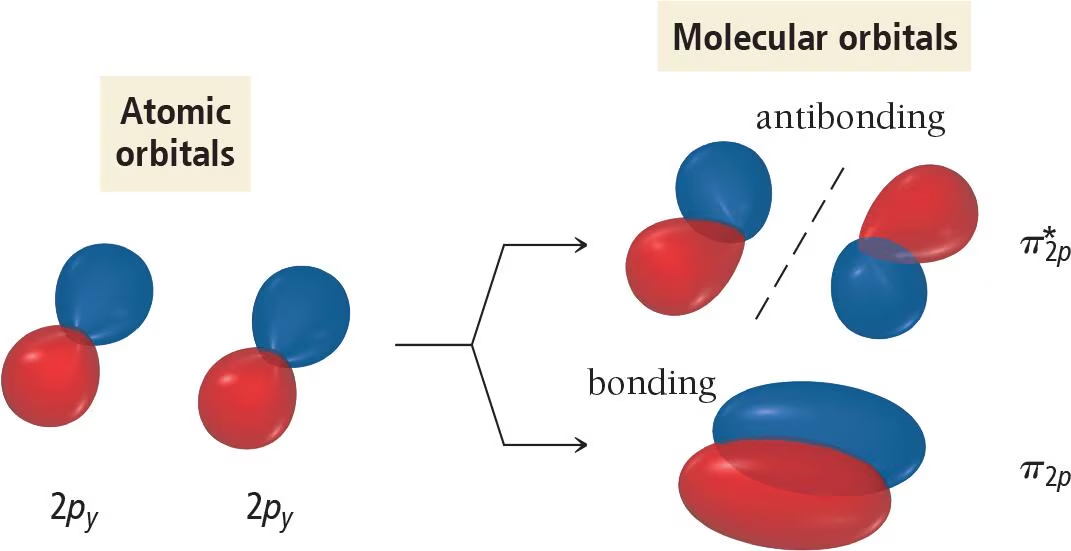
y, z
The energies and names of the bonding and antibonding molecular orbitals obtained from the combination of the 2p_ (x, y, z) atomic orbitals are identical to those obtained from the combination of the 2p_ (x, y, z) atomic orbitals.
B2, C2, N2
s-p mixing is significant in __, __, and __: these homonuclear diatomic molecules have molecular orbitals ordered (from lowest to highest energy): σ2s, σ*2s, π2p, σ2p, π*2p, σ*2p.

O2, F2, Ne2
s-p mixing is not significant in __, __, and __: these homonuclear diatomic molecules have molecular orbitals ordered (from lowest to highest energy): σ2s, σ*2s, σ2p, π2p, π*2p, σ*2p.
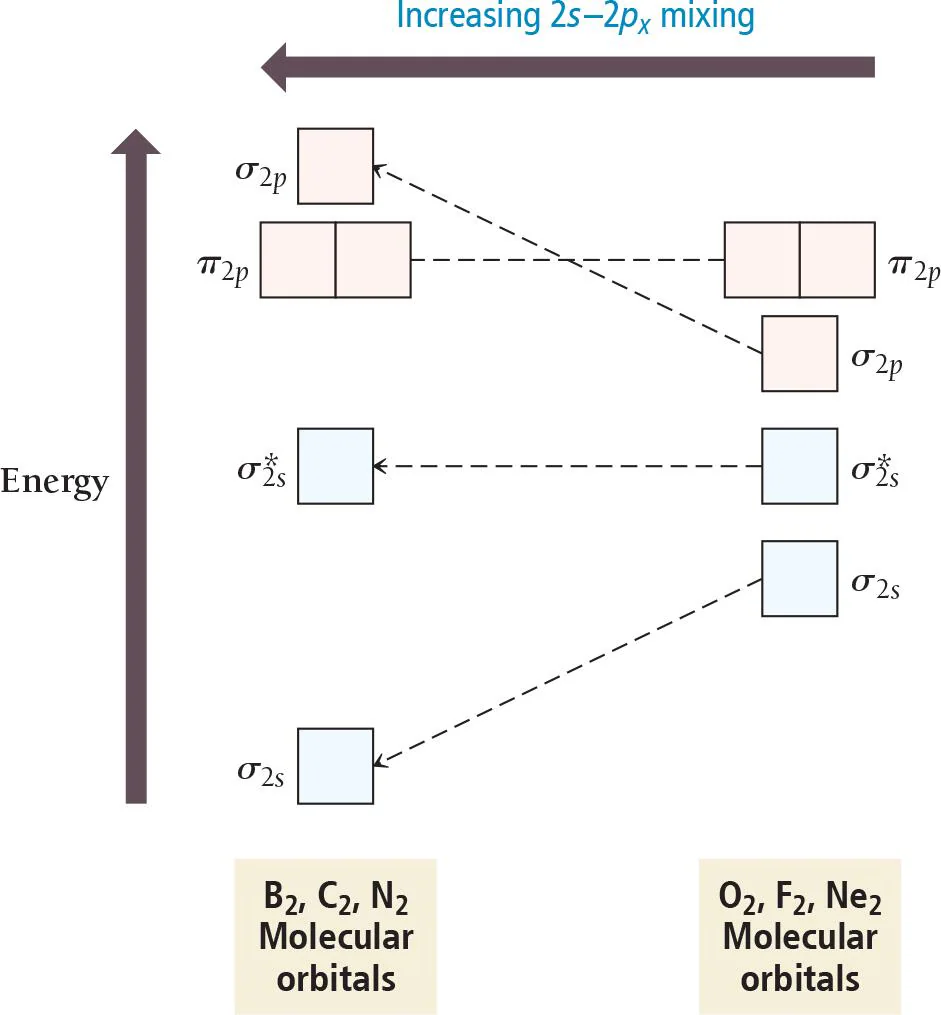
unpaired
___________ (paired/unpaired) electrons’ spin and movement around the nucleus (orbital angular momentum) generate tiny magnetic fields.
paramagnetic
When a _________________ (paramagnetic/diamagnetic) substance is placed in an external magnetic field, magnetic fields of each atom or molecule align with the external field, creating attraction.
diamagnetic
When a _________________ (paramagnetic/diamagnetic) substance is placed in an external magnetic field, atoms or molecules are slightly repelled from the magnetic field.
molecular orbital diagram
The ______________________ (Lewis structure/valence bond model/molecular orbital diagram) allows us to see unpaired electrons and determine whether the molecule is paramagnetic or diamagnetic (e.g. paramagnetism of O2).