Neonatal and Maternal Care: Prematurity, Emergencies, Sepsis & Cardiac Conditions
 Call Kai
 Learn
 Practice Test
 Spaced Repetition
 Match
 Flashcards
 Knowt Play
 Podcast
1/141

There's no tags or description
Looks like no tags are added yet.
142 Terms
What is Respiratory Distress Syndrome (RDS)?
A condition characterized by lack of surfactant production, leading to increased pressure in the alveoli, making breathing difficult.
What are common signs of Respiratory Distress?
Tachypnea, nasal flaring, grunting, retractions, and cyanosis.

What is Transient Tachypnea (TTN)?
A condition resulting from inhibited adaptation to extrauterine life, causing fluid retention in the lungs and impaired lung expansion.
What causes Meconium Aspiration Syndrome?
Exposure to meconium-stained amniotic fluid, leading to inflammation and epithelial injury in the airways.
What are the symptoms of Meconium Aspiration Syndrome?
Tachypnea, nasal flaring, grunting, retractions, and cyanosis immediately after birth.

What is Neonatal Pneumonia?
An infection in newborns that can be bacterial, viral, or fungal, commonly associated with E. Coli and Group B Streptococcus.
What are the signs of Neonatal Pneumonia?
Respiratory distress, poor feeding, apnea, tachycardia, and poor perfusion.

What is a disrupted esophagus?
A condition where a blind part of the esophagus is present but can also anastomose to the trachea, increasing the risk of aspiration.
What is the primary investigative tool for fetal cardiac abnormalities?
Prenatal ultrasound.
What are the signs and symptoms of a heart problem in neonates?
Cyanosis, tachypnea, tachycardia, murmurs, decreased peripheral pulses, and failure to thrive.
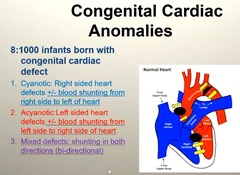
What is Tetralogy of Fallot (TOF)?
A cyanotic heart defect characterized by right ventricular hypertrophy, patent VSD, overriding aorta, and narrowing of the pulmonary artery.
What is Transposition of the Great Arteries (TGA)?
A heart anomaly where blood circulates from the right atrium to the right ventricle and goes to the aorta without being oxygenated.
What is Hypoplastic Left Heart Syndrome?
A condition where the left ventricle is underdeveloped, leading to severe illness and requiring urgent surgery.
What is Coarctation of the Aorta?
A narrowing of the aorta that can lead to heart failure and discrepancies in blood pressure between limbs.
What is a Ventricular Septal Defect (VSD)?
A defect characterized by a hole in the ventricular septum, leading to increased blood flow to the lungs and potential heart failure.
What is Patent Ductus Arteriosus?
A condition where the ductus arteriosus fails to close after birth, leading to increased pulmonary blood flow and potential heart failure.
What are common management strategies for Patent Ductus Arteriosus?
Medical management with duct inhibitors and fluid restriction, or surgical intervention if necessary.
What is the significance of antenatal screening?
It allows for early detection and management of potential congenital abnormalities, reducing neonatal mortality and morbidity.
What are the potential implications of fetal cardiac anomalies?
Concerns about ongoing morbidity, discussions about long-term implications, and possible termination of pregnancy.
What are some important considerations of birth in neonates with cardiac issues?
It should consider the needs for supportive care, surgery, or monitoring, ideally in a facility with a neonatal intensive care unit.
What are the signs of heart failure in neonates?
Decreased urine output, odema, mobility decreased, tachyponea, changes in HR, feeding issues
What is the role of serial ultrasounds in managing congenital heart defects?
To monitor the condition over time and assess for any changes or complications.
What is the significance of capillary refill time in assessing neonatal health?
It helps evaluate peripheral perfusion and circulatory status.
What does a heart murmur indicate in a neonate?
It may suggest an underlying heart defect or abnormal blood flow.
What is the typical management for a small Ventricular Septal Defect?
Expectant management with monitoring, as many small defects close spontaneously.
What are the common symptoms of heart defects that may not be immediately diagnosed?
Some heart defects may show no symptoms until the child is older, making early detection challenging.
What is the leading non-obstetric cause of maternal death?
Trauma
List three causes of trauma in pregnancy.
Attempted suicide, motor vehicle accidents, falls
What are potential outcomes of trauma during pregnancy?
Preterm birth, placental abruption, uterine rupture, fetal loss
What is the priority in managing trauma in pregnant women?
Maintaining cardiopulmonary function and oxygenation to vital organs
How should a woman presenting with trauma after 20 weeks gestation be positioned?
On her left lateral side to reduce inferior vena cava compression
What is anaphylaxis?
A life-threatening emergency that can occur within 10 minutes of exposure to an allergen
What are common signs and symptoms of anaphylaxis?
Swelling, runny nose, hives, lightheadedness, shortness of breath
What is the management protocol for anaphylaxis?
Remove trigger, administer oxygen, adrenaline, fluids, and consider bronchodilators and antihistamines
What are some causes of maternal collapse and cardiac arrest?
Cardiac issues, respiratory disorders, trauma, sepsis
What is disseminated intravascular coagulation (DIC)?
A blood clotting disorder that can cause organ damage and uncontrollable bleeding
What is the significance of amniotic fluid embolism?
It can lead to anaphylactic reaction and respiratory failure in pregnant women
What is the difference between dizygotic and monozygotic twins?
Dizygotic twins arise from two fertilized eggs; monozygotic twins arise from one zygote that splits
What complications are associated with multiple pregnancies?
Low birth weight, preterm birth, placenta previa, placental abruption
What is twin-to-twin transfusion syndrome?
A condition where blood from one twin is transfused to another via shared placenta blood vessels
What is the recommended management for preterm birth?
Tocolytics, antibiotics, steroids, magnesium sulfate
What is the role of ultrasound in multiple pregnancies?
To determine zygosity and chorionicity, assisting in planning care
What are the birth considerations for twins?
Elective birth by induction or cesarean section; CTG recommended
What factors should be considered in postnatal care of multiple births?
Mode of birth and care needed for the woman after experiencing labor and surgery
What is the significance of maintaining oxygenation during trauma management?
To ensure vital organs, tissues, and the baby receive adequate oxygen
What is the Glasgow Coma Scale (GCS) threshold for intubation?
GCS < 8
What is the first step in the DRSABCD approach?
Danger - ensure the environment is safe
What should be monitored in cases of anaphylaxis?
Maternal vital signs and fetal condition
how do you monitor fetal well-being after trauma?
Cardiotocography (CTG) after 24 weeks
What is the importance of positioning during CPR in pregnant women?
To prevent inferior vena cava compression, which can hinder CPR effectiveness
What are the implications of maternal collapse?
It can lead to shock, loss of consciousness, and potentially cardiac arrest
What is the definition of abortion in the context of pregnancy?
Abortion is the medical termination of pregnancy, which can be induced through medication or surgical procedures.
What are the sub-categories of preterm birth based on gestational age?
Extremely preterm (less than 28 weeks), Very preterm (28 to less than 32 weeks), Moderate preterm (32 to 33±3 weeks), Late preterm (34 to 36+6 weeks).
What is the threshold of viability for preterm infants?
The threshold of viability is the gestational age at which a preterm infant is at risk of deterioration and can survive outside the womb.
What are common complications faced by preterm infants?
Respiratory challenges, thermal instability, feeding difficulties, jaundice.
What is the significance of maintaining a neutral thermal environment (NTE) for preterm infants?
NTE allows the infant to maintain normal body temperature, minimizes metabolic rate and oxygen consumption, and prevents unnecessary energy expenditure.
What are the mechanisms of heat loss in preterm infants?
Evaporation, conduction, convection, and radiation.
What is Non-Shivering Thermogenesis (NST) and where does it occur?
NST occurs in brown adipose tissue (BAT) and is triggered by cold stress via the sympathetic nervous system.
What are the risk factors for hypothermia in preterm infants?
Prematurity, low birth weight, wet skin after birth, cold delivery or NICU environments, inadequate clothing or covering.
How can caregivers support thermoregulation in preterm infants immediately after birth?
By drying the infant thoroughly, using warm blankets, and promoting skin-to-skin contact (kangaroo care).
What is the role of glucose for neonates?
Glucose is the primary energy source for the neonatal brain, which consumes a large proportion of the total glucose supply.
What are the challenges faced by preterm infants regarding nutrition and growth?
They have an immature gastrointestinal system, which complicates feeding and growth.
What is the impact of temperature management on preterm infants?
Inadequate temperature management diverts energy from growth and healing to heat production.
What interventions can be used in the NICU to maintain temperature for preterm infants?
Radiant warmers, incubators (servo-controlled), and the use of plastic wraps for very preterm infants.
What is the significance of surfactant in neonatal care?
Surfactant helps reduce surface tension in the lungs, aiding in respiratory function, especially in preterm infants.

What are the long-term challenges faced by preterm infants after discharge?
They may struggle with developmental challenges, respiratory distress, and feeding difficulties.
What is the importance of good neonatal care for preterm infants?
Good neonatal care can speed up surfactant production and improve outcomes for preterm infants.
What are the signs of respiratory distress in preterm infants?
Signs include increased work of breathing, grunting, nasal flaring, and retractions.
What is necrotizing enterocolitis?
Necrotizing enterocolitis is a serious gastrointestinal condition that can occur in preterm infants, characterized by inflammation and bacterial invasion of the bowel wall.
What is the role of artificial surfactant in neonatal care?
Artificial surfactant is used to treat respiratory distress syndrome in preterm infants by improving lung function.
What are the benefits of kangaroo care for preterm infants?
Kangaroo care promotes bonding, helps regulate the infant's temperature, and supports breastfeeding.
What is the significance of maintaining adequate humidity for very preterm infants?
Maintaining adequate humidity helps prevent dehydration and supports skin integrity.
What is the primary source of glucose for the fetus in utero?
The placenta provides a continuous glucose supply.
What happens to maternal glucose supply after birth?
There is an abrupt cessation of maternal glucose supply.
What are the three key adaptations a neonate must make after birth?
Mobilising glycogen stores, initiating gluconeogenesis, and increasing lipolysis.
What typically happens to blood glucose levels in neonates within the first 1-2 hours after birth?
Blood glucose typically falls and stabilizes with feeding and endogenous production.
What is glycogenolysis?
The breakdown of glycogen stores, mainly in the liver, to maintain glucose levels.
What condition is characterized by hyperinsulinaemia in infants of diabetic mothers?
It increases the risk of hypoglycaemia after birth.
What are the risks associated with preterm infants regarding glucose levels?
They have limited glycogen stores and immature metabolic pathways, increasing the risk of hypo- and hyperglycaemia.
What does SGA stand for, and what is its implication for infants?
SGA stands for Small for Gestational Age, indicating reduced energy reserves and increased metabolic demand.
What is the operational threshold for hypoglycaemia in neonates?
Commonly defined as blood glucose less than 2.6 mmol/L
What are some risk factors for hypoglycaemia in neonates?
Prematurity, SGA, LGA, infants of diabetic mothers, perinatal stress, and delayed feeding.
What are common clinical signs of hypoglycaemia in neonates?
Jitteriness, lethargy, poor feeding, apnoea, and seizures (late sign).
What are potential consequences of untreated hypoglycaemia in neonates?
Neurological injury, developmental delay, and seizure disorders.
What is the immediate management for hypoglycaemia in neonates?
Early feeding, buccal glucose gel, and intravenous therapy with IV dextrose.
What defines hyperglycaemia in neonates?
Blood glucose levels >10 mmol/L.
What are some risk factors for hyperglycaemia in neonates?
Prematurity, sepsis, parenteral nutrition, steroid therapy, and immature insulin response.
What are common clinical signs of hyperglycaemia?
Often asymptomatic, but may include glycosuria, dehydration, and electrolyte imbalance.
What are the potential consequences of neonatal hyperglycaemia?
Increased risk of intraventricular haemorrhage, infection, mortality, and poor growth.
What is neonatal hyperbilirubinemia?
Elevated serum bilirubin levels presenting as jaundice.
At what bilirubin level does jaundice become visible in neonates?
When bilirubin exceeds approximately 85 µmol/L.
What is the most common form of hyperbilirubinemia in neonates?
Physiological jaundice: Unconjugated hyperbilirubinemia.
What are the common causes of unconjugated hyperbilirubinemia?
Physiological jaundice, breastfeeding-associated jaundice, and haemolysis.
What is conjugated hyperbilirubinemia indicative of?
It is always pathological and indicates liver disease or biliary obstruction.
What are the common causes of conjugated hyperbilirubinemia?
Haemolytic disorders, sepsis, cephalohaematoma, and metabolic disorders.
What is the gold standard for measuring total serum bilirubin?
Total serum bilirubin (TSB) measurement.
What is the mechanism of phototherapy in treating hyperbilirubinemia?
It converts unconjugated bilirubin into water-soluble forms for excretion.
What is the definition of sepsis?
Life-threatening organ dysfunction caused by a dysregulated host response to infection.