Basic Acoustics
 Call Kai
 Learn
 Practice Test
 Spaced Repetition
 Match
 Flashcards
 Knowt Play
1/46

There's no tags or description
Looks like no tags are added yet.
47 Terms

Acoustic signal
The intermediate between the speaker and the listener, it allows us to communicate, allows the speaker to convey what that speaker wants to say and for the listener to pick up on what they are saying

Intention
The starting point where the speaker conceives a desire, thought, or specific message that they want to communicate to someone else
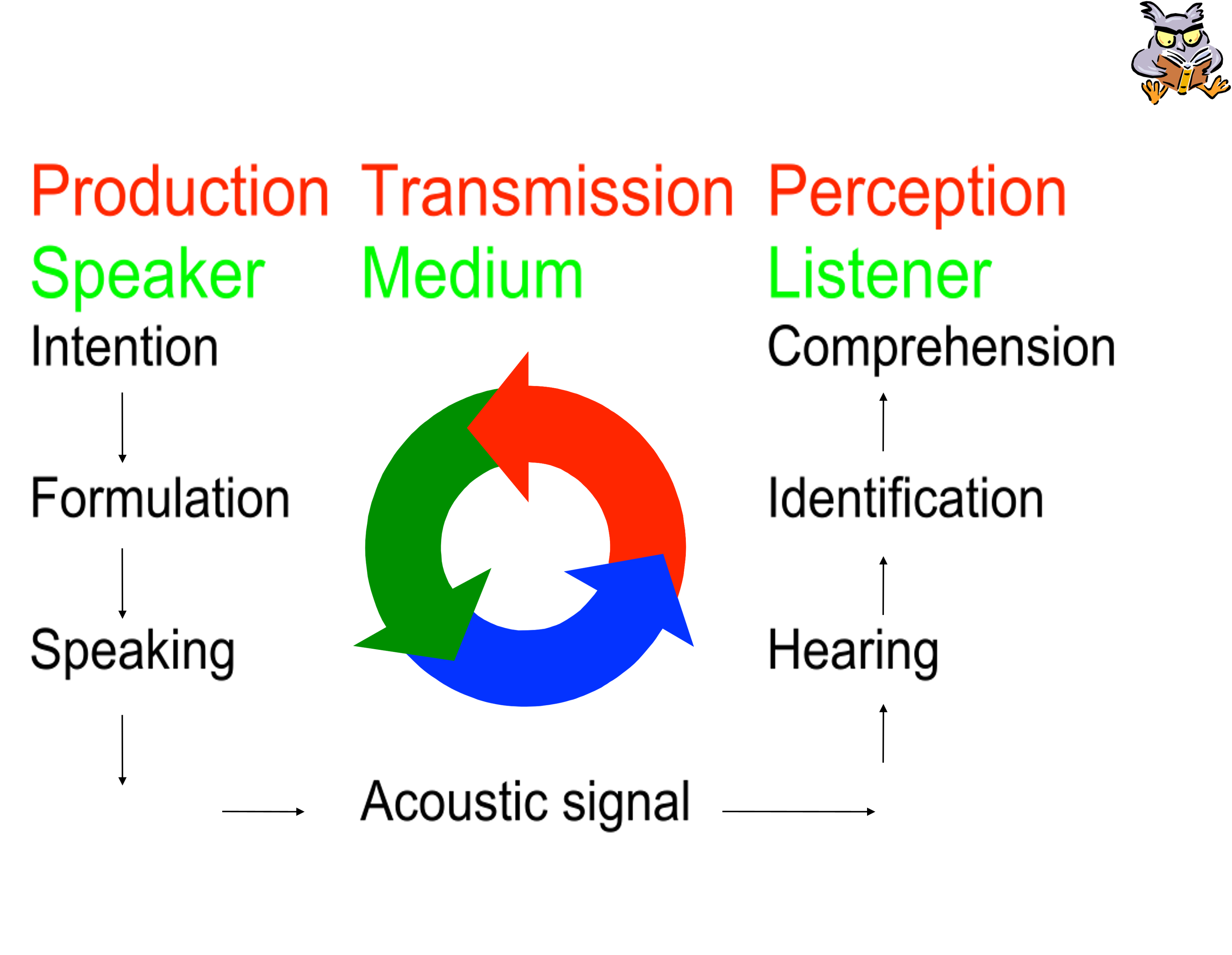
Formulation
The stage in the speaker’s brain where the abstract thought or intention is translated into a structured message using the rules of language (selecting grammar, syntax, and vocabulary)

Speaking (production)
The process where the brain sends motor commands to the vocal tract (lungs, larynx, tongue, lips, etc.) to convert the linguistic message into physical movements, producing spoken sounds

Hearing (reception)
The process where the listener's ear receives the sound waves, converting the physical acoustic vibrations into neural impulses transmitted via the auditory nerve to the brain.

Identification
The cognitive stage where the listener's brain analyzes the incoming auditory patterns, breaking them down into recognizable phonetic features, syllables, and words.

Comprehension
The listener decodes the identified words to reconstruct the original message, grasping the conceptual meaning and intention behind what the speaker said
Serial aspect
Sequence of successive outputs for a given stage
Parallel aspect
Processing at different stages at a given time
Sound
Vibration = repetitive to and fro motion of a body; for sound this normally involves air molecules (air = medium)
Kinetic energy
Energy generated by movement
Potential energy
Stored energy based on an object's position or state
Energy transfer
When the equilibrium in the medium is disturbed, displacement away from the resting position generates potential energy, whereas actual movement generates kinetic energy (ignoring friction). The total energy in the system is a combination of both through the transfer of one into the other and remains constant.
Transverse wave
Particles move perpendicular to direction of wave
Longitudinal wave
Particles move in same direction as wave (e.g. sound)
Period
Time to complete a cycle of events
Reciprocal of period
Frequency in Hz (number of cycles/second)
Wavelength
Distance in space covered by a complete cycle ( = c/f, where c = speed of sound ≈ 340 m/s in air)
Sound propagation
Transfer of energy through a medium (air in most cases) causing patterned vibrations of molecules
Area of compression
Where neighbouring air molecules collide (positive pressure => pressure > atmospheric pressure)
Area of rarefaction
Where neighbouring air molecules move apart (negative pressure => pressure < atmospheric pressure)
High frequency sounds
Short wavelengths are more directional than low frequency sounds
Complex waveforms
Consist of multiple individual waves (e.g. sine waves or sinusoids), each with a specified frequency, amplitude, and phase
Area of equilibrium
Where molecules move through their “preferred” non-perturbed state (pressure = atmospheric pressure)
Frequency
The number of complete oscillations (cycles) of a sound wave that pass a point each second, expressed in Herz (objective)
Pitch
The perceived highness or lowness of a sound; also referring to perceived quality of voice characteristic reflecting fundamental frequency, expressed in octaves and semitones (subjective)
Intensity
The power carried by a sound wave per unit area, often expressed in Watts per square meters (W/m2) (objective)
Sound pressure (acoustic pressure)
The local deviation from the ambient (static) atmospheric pressure caused by a sound wave, usually expressed in Pascal (objective); usually expressed relative to lowest sound pressure humans can detect as Sound Pressure Level (in decibels or dB)
Loudness
The perceived strength or volume of a sound (subjective), expressed in phons (subjective)
Harmonic
An individual sinewave
Phase
A specific point or part of a cycle (where you are in terms of the cyclic events)

Circular map
A timeless representation of cyclic events that maps position-velocity coordinates, which are associated with a specific angular displacement (degrees/radian)

Constructive interference (constructive addition)
Happens when two waves overlap to create a larger wave
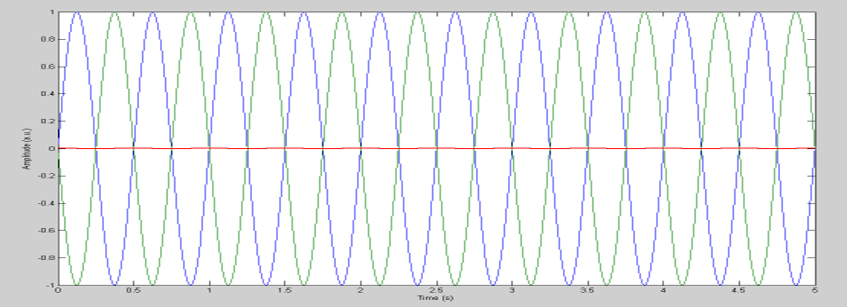
Destructive interference (destructive addition)
Happens when two waves cancel each other out
Saw-tooth signal
A non-sinusoidal periodic waveform that ramps up or down linearly before sharply resetting
Waveform parameters
Phase, frequency, amplitude
Periodic signal
Line spectra = clear harmonic structure
Non-periodic signals
No simple harmonic structure, can be transient or continuous signal
Transient signal
Non-periodic signals with a short duration
Continuous signal
Non-periodic signals with a longer / continuous duration
White noise
Every single frequency is in principle represented; the largest common frequency is infinitely low in value, therefore the repeat time is infinitely large, which would make it difficult (if not impossible) to perceive a clear pitch, simply because you need too much time to discover the pattern
Linear (proportional) scaling
Difference is absolute; 50 is to 100 as 500 is to 550 or 1 is to 2 as 100 is to 101
Logarithmic scaling
Difference is relative or proportional; 50 is to 100 as 500 is to 1000 or 1 is to 2 as 100 is to 200
Fourier analysis
A mathematical method used to break down complex signals, functions, or data into simple building blocks made of sine and cosine waves
Harmonic structure
The different harmonic components all together
Logarithmic
Human speech and sound are perceived on an approximately ________ scale for both pitch and loudness
Diffraction
The bending of a sound wave around obstacles