Surgical Nursing Final
 Call Kai
 Learn
Learn Practice Test
 Spaced Repetition
 Match
Match Flashcards
 Knowt Play
1/114

There's no tags or description
Looks like no tags are added yet.
Name | Mastery | Learn | Test | Matching | Spaced | Call with Kai | Chat |
|---|
No analytics yet
Send a link to your students to track their progress
115 Terms
OR attire
Surgical scrubs, surgeon’s cap or bouffant, surgical mask
What is a surgical hand scrub?
Process of removing as many microorganisms as possible.
How many brush strokes should each surface get?
10 each, two times.
What is the traditional scrub?
Chlorhexidine or Provodine
How should a sterile hand towel be picked up?
Pick it up by a folded corner, step back, and unfold it
How should a sterile gown be put on?
1.Pick up gown and step back
2. Hold gown by shoulder and insert hands into armholes
3. Let it unfold (do NOT shake)
4.Advance both arms simultaneously (do NOT reach for the ceiling)
5.Keep fingers inside the cuffs
6.Have an assistant secure the closure

What is this called?
Closed gloving
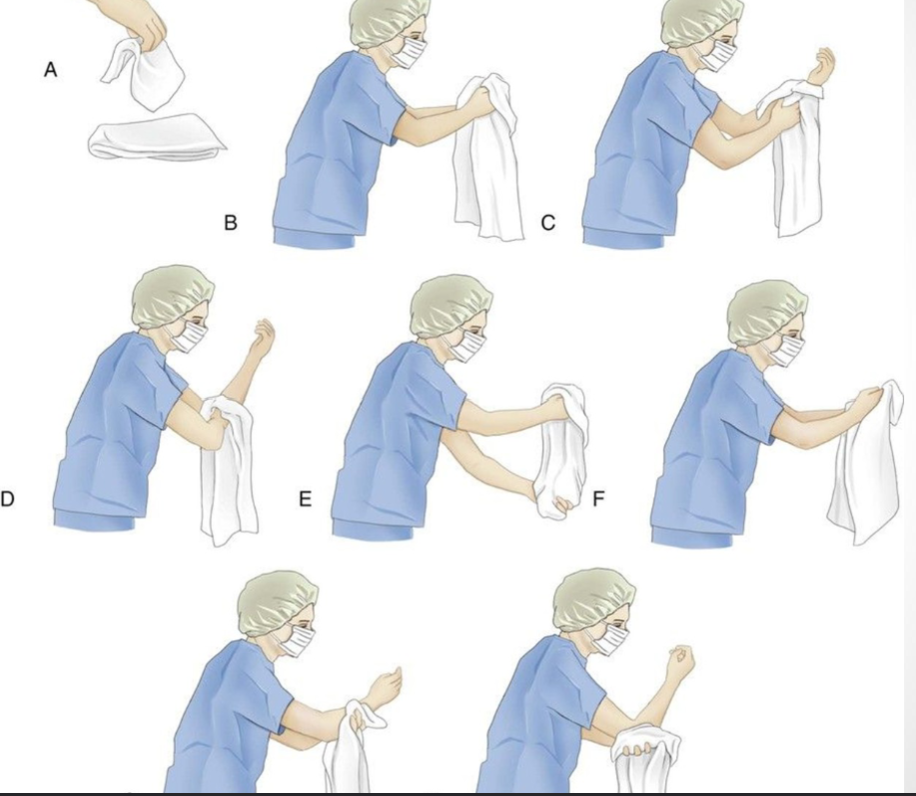
What is this process?
Hand drying
What can you do after scrubbing to make it easier to glove?
Alcohol or Sterillium hand rub
What are the responsibilities of a surgical nurse?
Maintaining sterility, instrument/sharps count, sponge count, and passing of instruments
How should instruments be handed over?
“Snap”/place firmly into hand of surgeon
What are the 7 ways to accomplish hemostatis?
Sponge - blotting
Suture - ligate
Hemostatic agents (gelfoam)
Vascular clips - clamp
Forceps - crush
Electrosurgery - burn
Chemical cauterization - silver nitrate
What is the ideal surgical patient?
Clean, dry, and recently groomed
What are the 3 types of surgical clips?
Soft tissue, neurology, and orthopedic
What are examples of soft tissue procedures?
Ovariohysterectomy (spay - pyometra or c-section), Orchiectomy (castration - testicular or prostate cancer), onychectomy (declaw), Caudectomy (tail amputation)
Abdominal surgery shaving landmarks
Cranial: mid-sternum
Caudal: pubis
Lateral: last rib or flank

Spay shaving landmarks
Cranial: Xiphoid
Caudal: Pubis
Lateral: last rib or flank

Castration shaving landmarks
Cranial: mid prepuce
Caudal: cranial edge of scrotum
Lateral: 3 cm past nipple line
Soft tissue surgery examples
Anal sacculectomy, perianal fistula/hernia, inguinal mass, perineal urethrostomy, scrotal urethrostomy, urethral prolapse repair
Soft tissue limb procedures
Amputation of forelimb
Soft tissue head/neck procedures
Total ear canal ablation (TECA), ventral bulla osteotomy (VBO), salivary mucocele, pinnectomy, thyroidectomy, parathyroidectomy
Soft tissue thoracic procedures
Intercostal thoracotomy, median sternotomy, lung lobectomy, heart procedures

Dorsal hemilaminectomy shaving landmarks
Cranial: 2 vertebral spaces cranial to site
Caudal: 2 vertebral spaces caudal to site
Lateral: 2 clipper widths (9 cm) lateral to dorsal midline

Ventral slot (ventral hemilaminectomy) shaving landmarks
Cranial: ventral bola
Caudal: 2 cm caudal to manubriums
Lateral: lateral midline

Craniotomy shaving margins
Cranial: nose
Caudal: base of skull
Lateral: lateral to globe of eye & pinna
Orthopedic general landmarks
Joint above to joint below intended surgical site
Orthopedic forelimb procedures
Arthrodesis, arthroscopy, ORIF (fracture open reduction & internal fixation), Ex-fix (fracture external repair), Incongruity (elbow malalignment)
Orthopedic hindlimb procedures
TPLO (Tibial Plateau Leveling Osteotomy), MPLR (medial patella luxation repair), THR (total hip replacement), TKR (total knee replacement), CCLR (caudal cruciate ligament repair)

What is this technique for orthopedic cases called?
Hanging leg technique
What is used to scrub the patient?
Chlorhexidine (2% or 4% solution)

What is this scrubbing technique and what is it used for?
Target, used for soft tissue and neuro procedures

What is this scrubbing technique and what is it used for?
“Barber pole”, used for orthopedic procedures
Initial/preliminary scrub
Scrub clipped area to remove majority of debris, alternate scrub then rinse at least 3 times
Traditional sterile patient scrub
Sterile open gloving, sterile scrub (sterile sponges, saline/chlorohex), scrub in chosen pattern (scrub & rinse x3)
One-step prep
Chloraprep or duraprep, clean exam cloves, paint in chosen pattern (overlap each pass by 50%), allow to dry prior to draping
What is the inflammation process also called?
Vasodilation
How many growth factors do platelets release?
10
Tissue trauma/cellular death
-Injury that inflicts damage, which compromises the cutaneous, mucous barriers and compromises circulation
-Potential for bacterial growth or infection
The healing process is supported by what?
WBC’s, neutrophils, monocytes - macrophages, epithelial cells, endothelial cells, fibroblasts
Pathology of wounds
Laceration
Puncture
Incision
Contusion/bruise
Abrasion
Burn
Avulsion
Surgical wounds
Damage to tissues occurring during pre, intra, or post-operatively, compromises cutaneous and mucosa barriers which compromises circulation, potential for bacterial growth/infection
Primary closure/first intention
Skin is closed immediately after wound, heals without complications (no infection, good blood supply), reserved for surgical incisions
Second intention
Wound edges are not approximated, left open to heal from “inside out”, similar to first intention but takes longer to heal - generally weeks
Healing takes place by formation of:
Epithelialization (rebuilding of epidermal layers), granulation tissue (growth of new connective tissue & blood vessels), contraction of wound edges
What are the 3 phases of wound healing?
Lag phase, repair phase, maturation phase
Lag phase
-Begins immediately after trauma (inflammatory process & vasodilation), clot contraction (scab formation)
-Debridement - begins 6 hours after injury (lysis, necrosis, exudation), white blood cells leaked into wound, “clean up”
Repair phase
-Begins around day 4
-Three major components: Epithelialization (divide & migrate), Fibroplasia (produce collagen, wound strength), Capillary budding (revascularization of tissue)
Maturation phase
-Collagen rebuilds over 18-24 month period
-Tissue never regains full strength
Delayed primary closure
-wound is managed open for several days
-closed before granulation tissue appears
-direct apposition of skin, or reconstructive procedure (skin graft)
Secondary closure
-wound is managed open until granulation tissue is established
-closed by direct apposition of skin edges or reconstructive procedure
What are the 4 surgical wound classifications?
Clean, clean contaminated, contaminated, dirty
Clean wound
no entrance into bacterial flora
Clean-contaminated wound
Starts clean, enter bacterial flora, close clean
Contaminated wound
Traumatic injuty, intra-op gross spillage
Dirty wound
Pus present
Contamination vs. Infection
-all traumatic wounds are contaminated
-only considered infected if bacterial numbers are at least 10^5 bacteria per gram of tissue/fluid
Second intention healing
-wound edges left open
-cellularly identical to primary
-develops granulation tissue, epithelialization, contraction of wound edges/scar
-takes weeks to close
Triage
Assignment of degrees of urgency to wounds or illness to decide the order of treatment
Coaptation
-Pulling together separated tissue, as in a fracture
-Application of external appliance, such as a splint or cast
Dressing
Material used to cover and protect open wounds
Bandage
Material used to bind a wound or body part
Splint
Rigid material used to hold body part in fixed position
Cast
Rigid material encasing body part to hold in fixed position
Sling
Soft material suspending body part
What are the benefits of bandaging?
-Prevent further contamination
-Stabilize hard and soft tissue structures
-Absorb exudate/debris
-Limit/reduce hemorrhage
-Minimize edema
-Prevent self-mutilation
-Provide better healing environment
Exudate
A mass of cells and fluid that has seeped out of blood vessels or tissue
Debris
Foreign material, dead tissue/cells or fluid
Edema
Swelling caused by fluid trapped in tissue
Lavage
Flushing out wound with warm sterile fluids
Types of dressings
-Adherent
-Non-adherent
-Occlusive (impermeable to air = moist environment)
-Semi occlusive (used to debride wounds mechanically)
-Non-occlusive (ex. Xeroform, impregnated mesh)
Primary layer of bandaging
Has direct contact with the wound, ex. Telfa pad, adaptic dressing, stockinet, or nothing
Secondary layer of bandaging
-Protective padding and stabilization, limits movement, holds contact layer in place, aids in absorption
-Cast padding or roll cotton, 2-3 layers
-May also include fortification (ex. fiberglass, plaster, prefabricated splint)
Tertiary layer of bandaging
-Protection and stabilization of second layer
-Cotton stabilized with conforming gauze - Kling
-VetWrap or Elasticon

Anatomy of a bandage

Robert Jones bandaging technique
-Immobilizes injury distal to elbow or stifle
-Must include joint above and joint below injury
-Copious amounts of roll cotton
-Thumps like a watermelon
-Only for short term stability

Modified Robert Jones bandaging technique
-Temporary compression after surgery
-Reduces swelling
-Most common
-Less cotton than Robert Jones
-Less stability
Fortified Robert Jones bandaging technique
-Modified Robert Jones + splinting material (ex. spoon splint, fiberglass, popsicle stick)
-Stabilizes both hard and soft tissue
-Reduces swelling
-Must include joint above and joint below injury

Cast bandaging technique
-Most rigid stabilization
-Encompasses limb
-Needs oscillating saw to remove

Spica Splint bandaging technique
-Similar technique as Modified Robert Jones, extends to top of forelimb and encompasses thorax
-Immobilizes shoulder, humerus, and elbow
Sling bandaging technique
-Relieve stress on joints
-Often lack 3-layer technique
-Can be homemade or purchased

Ehmer Sling bandaging technique
-Partially immobilizes & stabilizes hip joint
-Prevents weight bearing on hind limb
-Limb held in flexion
-Most prone to tissue trauma

Velpeau Sling bandaging technique
-Partially immobilizes scapular joint
-Prevents weight bearing on forelimb
-Limb held in flexion
-Can cause respiratory distress if too tight
“Other” bandages
-Tail (wagging injury, bite wound, VERY hard to do)
-Belly wrap (abdominal pressure after surgery)
-Head/ear (aural hematoma, TECA, ear cropping, need to be careful with tightness around neck)
Bandage complications
-Too tight (cuts off circulation which can lead to necrosis, pressure sores, skin irritation)
-Too loose (stability is compromised, can exacerbate injuries)
-Left on too long (pressure sores, tissue necrosis, muscle atrophy from disuse)
-Wet +/- Dirty (skin irritation, infection, poor healing environment)
Ideal suture
-Sterile
-Swaged needle
-creates as little tissue trauma as possible
-high tensile strength retention
-knot security
Suture classifications
-Absorbable vs Non-absorbable
-Natural vs. Synthetic
-Monofilament vs Multifilament (braided)
Antibacterial suture
-”Plus” sutures, coated with Triclosan
Suture size
-size of suture denotes is diameter
-measured in metric units
-USP scale runs from 11-0 (smallest) to #7 (largest)
Absorbability
-ability to be degraded and eliminated by the body
-natural material: proteolytic degradation & inflammation
-synthetic material: hydrolysis & inflammation
-non-absorbable: encapsulation & inflammation
Tissue healing times
-Skin: 5-7 days
-Subcutaneous: 7-14 days
-Peritoneum: 7-14 days
-Fascia: 14-28 days

Needle types
-Taper point
-Taper cut tip
-Traditional cutting
-Reverse cutting

Suture packet information
What are the 3 types of information given when asked for suture?
-Size
-Type
-Needle type or code
How should you select a suture type and size?
-Patient size
-Area (tissue) of placement (skin vs. hollow organ)
-Strength required
-Healing potential of tissue
-Importance of cosmetic appearance
-Cost
Knot security
-Multifilament have better knot security
-Minimum of 4 throws
-Knot is weakest point of suture line
-Depends on tying technique and physical characteristics of the suture material
Throw
Motion of wrapping the strands of the suture around each other and pulling on the ends to tighten them
Simple knot
Consists of 2 throws, can untie under tension
Surgeon’s throw
Suture is wrapped around needle holders twice before pulling tight

Continuous Sutures
-Simple continuous, Purse string
-Advantages: rapidly placed, less foreign material, better air/watertight seal
-Disadvantages: over tensioning could lead to tissue strangulation, breakdown of one are disrupts entire line (dehiscence), can transmit infection along entire suture line

Interrupted Sutures
-Simple interrupted, Cruciate, Horizontal mattress
-Advantages: more secure closure, precise suture tension, easily applied, microorganisms less likely to travel along row of sutures
-Disadvantages: slower, more foreign material, excessive tension can cause wound inversion